Thank you for visiting SNEWPapers!
Sign up free
The Vermont Watchman
Montpelier, Washington County, Vermont
What is this article about?
An experienced teacher contributes advice on improving reading instruction in schools, emphasizing not advancing too quickly, using supplementary readers, gaining children's interest, teaching phonics, incorporating sight reading and storytelling, associating stories with geography, and studying authors' childhoods to foster better comprehension and lifelong reading skills.
Clipping
OCR Quality
Full Text
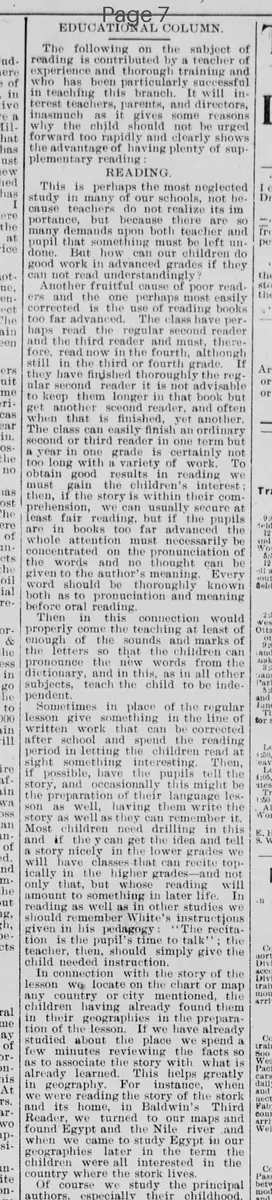
The following on the subject of reading is contributed by a teacher of experience and thorough training and who has been particularly successful in teaching this branch. It will interest teachers, parents, and directors, inasmuch as it gives some reasons why the child should not be urged forward too rapidly and clearly shows the advantage of having plenty of supplementary reading:
READING.
This is perhaps the most neglected study in many of our schools, not because teachers do not realize its importance, but because there are so many demands upon both teacher and pupil that something must be left undone. But how can our children do good work in advanced grades if they can not read understandingly?
Another fruitful cause of poor readers and the one perhaps most easily corrected is the use of reading books too far advanced. The class have perhaps read the regular second reader and the third reader and must, therefore, read now in the fourth, although still in the third or fourth grade. If they have finished thoroughly the regular second reader it is not advisable to keep them longer in that book but get another second reader, and often when that is finished, yet another. The class can easily finish an ordinary second or third reader in one term but a year in one grade is certainly not too long with a variety of work. To obtain good results in reading we must gain the children's interest; then, if the story is within their comprehension, we can usually secure at least fair reading, but if the pupils are in books too far advanced the whole attention must necessarily be concentrated on the pronunciation of the words and no thought can be given to the author's meaning. Every word should be thoroughly known both as to pronunciation and meaning before oral reading.
Then in this connection would properly come the teaching at least of enough of the sounds and marks of the letters so that the children can pronounce the new words from the dictionary, and in this, as in all other subjects, teach the child to be independent.
Sometimes in place of the regular lesson give something in the line of written work that can be corrected after school and spend the reading period in letting the children read at sight something interesting. Then, if possible, have the pupils tell the story, and occasionally this might be the preparation of their language lesson as well, having them write the story as well as they can remember it. Most children need drilling in this and if they can get the idea and tell a story nicely in the lower grades we will have classes that can recite top-ically in the higher grades—and not only that, but whose reading will amount to something in later life. In reading as well as in other studies we should remember White's instructions given in his pedagogy: "The recitation is the pupil's time to talk"; the teacher, then, should simply give the child needed instruction.
In connection with the story of the lesson we locate on the chart or map any country or city mentioned, the children having already found them in their geographies in the preparation of the lesson. If we have already studied about the place we spend a few minutes reviewing the facts so as to associate the story with what is already learned. This helps greatly in geography. For instance, when we were reading the story of the stork and its home, in Baldwin's Third Reader, we turned to our maps and found Egypt and the Nile river and when we came to study Egypt in our geographies later in the term the children were all interested in the country where the stork lives.
Of course we study the principal authors, especially their childhood. The children are more interested in and remember an author better if we can find some interesting story about him when he was somewhere near their own age. If, at the close of the year, our classes can stand the test given by Prof. Greenwood in his Principles of Education
"To pronounce distinctly all words so as to be heard,
To emphasize all words so as to be understood,
To express the thought clearly so as to be felt, and to attain clearness of expressing thought by separating and contrasting ideas,
We may feel that our work has not been entirely in vain.
What sub-type of article is it?
What keywords are associated?
What entities or persons were involved?
Story Details
Key Persons
Story Details
Advice from an experienced teacher on effective reading instruction: avoid advancing too quickly in readers, use supplementary books, build interest and comprehension, teach phonics for independence, incorporate sight reading and retelling, integrate with geography and author studies, aiming for clear pronunciation, emphasis, and expression as per Greenwood's principles.