Thank you for visiting SNEWPapers!
Sign up free
Story
August 11, 1927
The Bamberg Herald
Bamberg, Bamberg County, South Carolina
What is this article about?
Judge John D. Humphries, a Fulton County Superior Court judge and amateur astronomer from Hapeville, Georgia, uses astronomical facts about the vastness of space to support his belief in a spiritual heaven, countering scientists who deny its existence due to spatial limitations.
Clipping
OCR Quality
98%
Excellent
Full Text
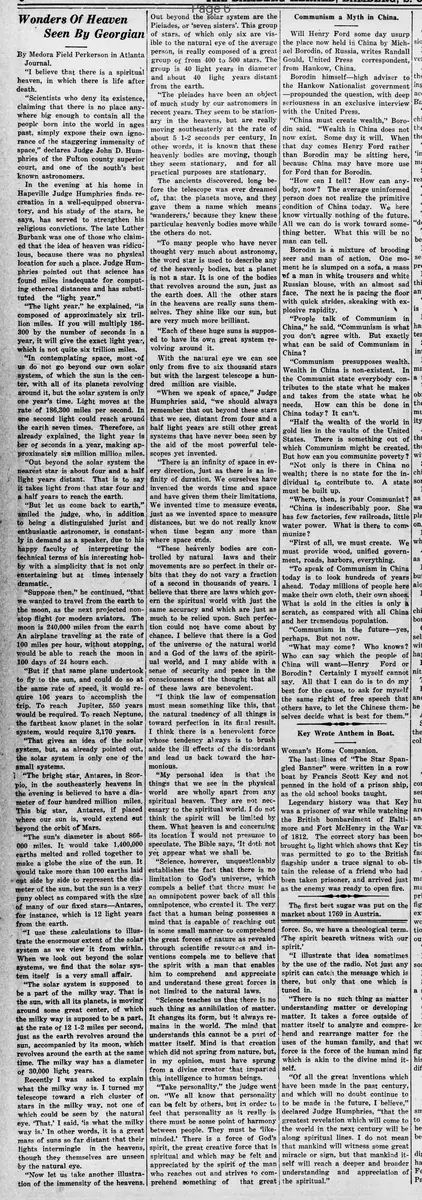
Wonders Of Heaven
Seen By Georgian
By Medora Field Perkerson in Atlanta Journal.
"I believe that there is a spiritual heaven, in which there is life after death.
"Scientists who deny its existence, claiming that there is no place anywhere big enough to contain all the people born into the world in ages past, simply expose their own ignorance of the staggering immensity of space." declares Judge John D. Humphries of the Fulton county superior court, and one of the south's best known astronomers.
In the evening at his home in Hapeville Judge Humphries finds recreation in a well-equipped observatory, and his study of the stars, he says, has served to strengthen his religious convictions. The late Luther Burbank was one of those who claimed that the idea of heaven was ridiculous, because there was no physical location for such a place. Judge Humphries pointed out that science has found miles inadequate for computing ethereal distances and has substituted the "light year."
"The light year," he explained, "is composed of approximately six trillion miles. If you will multiply 186,300 by the number of seconds in a year, it will give the exact light year, which is not quite six trillion miles.
"In contemplating space, most of us do not go beyond our own solar system, of which the sun is the center, with all of its planets revolving around it, but the solar system is only one year's time. Light moves at the rate of 186,300 miles per second. In one second light could reach around the earth seven times. Therefore, as already explained, the light year is number of seconds in a year, making approximately six million million miles.
"Out beyond the solar system the nearest star is about four and a half light years distant. That is to say it takes light from that star four and a half years to reach the earth.
"But let us come back to earth." smiled the judge, who, in addition to being a distinguished jurist and enthusiastic astronomer, is constantly in demand as a speaker, due to his happy faculty of interpreting the technical terms of his interesting hobby with a simplicity that is not only entertaining but at times intensely dramatic.
"Suppose then," he continued, "that we wanted to travel from the earth to the moon, as the next projected non-stop flight for modern aviators. The moon is 240,000 miles from the earth An airplane traveling at the rate of 100 miles per hour, without stopping, would be able to reach the moon in 100 days of 24 hours each.
"But if that same plane undertook to fly to the sun, and could do so at the same rate of speed, it would require 106 years to accomplish the trip. To reach Jupiter, 550 years would be required. To reach Neptune, the farthest know planet in the solar system, would require 3,170 years.
"That gives an idea of the solar system, but, as already pointed out, the solar system is only one of the small systems.
"The bright star. Antares, in Scorpio, in the southeasterly heavens in the evening is believed to have a diameter of four hundred million miles. This big star, Antares, if placed where our sun is, would extend out beyond the orbit of Mars.
"The sun's diameter is about 866,000 miles. It would take 1,400,000 earths melted and rolled together to make a globe the size of the sun. It would take more than 100 earths laid out side by side to represent the diameter of the sun, but the sun is a very puny object as compared with the size of many of our fixed stars--Antares, for instance, which is 12 light years from the earth.
"I use these calculations to illustrate the enormous extent of the solar system as we view it from within. When we look out beyond the solar systems, we find that the solar system itself is a very small affair.
"The solar system is supposed to be a part of the milky way. That is the sun, with all its planets, is moving around some great center, of which the milky way is supposed to be a part, at the rate of 12 1-2 miles per second, just as the earth revolves around the sun, accompanied by its moon, which revolves around the earth at the same time. The milky way has a diameter of 30,000 light years.
Recently I was asked to explain what the milky way is. I turned my telescope toward a rich cluster of stars in the milky way, not one of which could be seen by the natural eye. 'That,' I said, 'is what the milky way is.' In other words, it is a great mass of suns so far distant that their lights intermingle in the heavens, though they themselves are unseen by the natural eye.
"Now let us take another illustration of the immensity of the heavens.
Out beyond the solar system are the Pleiades, or 'seven sisters'. This group of stars. of which only six are visible to the natural eye of the average person, is really composed of a great group of from 400 to 500 stars. The group is 40 light years in diameter and about 40 light years distant from the earth.
"The pleiades have been an object of much study by our astronomers in recent years. They seem to be stationary in the heavens, but are really moving southeasterly at the rate of about 5 1-2 seconds per century, In other words. it is known that these heavenly bodies are moving. though they seem stationary, and for all practical purposes are stationary.
The ancients discovered. long before the telescope was ever dreamed of, that the planets move, and they gave them a name which means wanderers.' because they knew these particular heavenly bodies move while the others do not.
"To many people who have never thought very much about astronomy. the word star is used to describe any of the heavenly bodies, but a planet is not a star. It is one of the bodies that revolves around the sun, just as the earth does. All the other stars in the heavens are really suns themselves. They shine like our sun, but are very much more brilliant.
"Each of these huge suns is supposed to have its own great system revolving around it.
With the natural eye we can see only from five to six thousand stars but with the largest telescope a hundred million are visible.
"When we speak of space," Judge Humphries said, "we should always remember that out beyond these stars that we see. distant from four and a half light years are still other great systems that have never been seen by the aid of the most powerful telescopes yet invented.
"There is an infinity of space in every direction, just as there is an infinity of duration, We ourselves have invented the words time and space and have given them their limitations. We invented time to measure events, just as we invented space to measure distances, but we do not really know when time began any more than where space ends.
"These heavenly bodies are controlled by natural laws and their movements are so perfect in their orbits that they do not vary a fraction of a second in thousands of years. I believe that there are laws which govern the spiritual world with just the same accuracy and which are just as much to be relied upon. Such perfection could not have come about by chance. I believe that there is a God of the universe of the natural world and a God of the laws of the spiritual world, and I may abide with a sense of security and peace in the consciousness of the thought that all of these laws are benevolent.
"I think the law of compensation must mean something like this, that the natural tendency of all things is toward perfection in its final result. I think there is a benevolent force whose tendency always is to brush aside the ill effects of the discordant and lead us back toward the harmonious.
"My personal idea is that the things that we see in the physical world are wholly apart from any spiritual heaven. They are not necessary to the spiritual world. I do not think the spirit will be limited by them. What heaven is and concerning its location I would not presume to speculate. The Bible says, 'It does not yet appear what we shall be.
"Science, however, unquestionably establishes the fact that there is no limitation to God's universe, which compels a belief that there must be an omnipotent power back of all this omnipotence. who created it. The very fact that a human being possesses a mind that is capable of reaching out in some small manner to comprehend the great forces of nature as revealed through scientific resources and inventions compels me to believe that the spirit with a man that enables him to comprehend and appreciate and understand these great forces is not limited to the natural laws:
"Science teaches us that there is no such thing as annihilation of matter. It changes its form, but it always remains in the world. The mind that understands this cannot be a part of matter itself. Mind is that creation which did not spring from nature, but. in my opinion, must have sprung from a divine creator that imparted this intelligence to human beings.
."Take personality," the judge went on. "We all know that personality can be felt by others, but in order to feel that personality as it really is there must be some point of harmony between people. They must be 'like-minded.' There is a force of God's spirit, the great creative force that is spiritual and which may be felt and appreciated by the spirit of the man who reaches out and strives to comprehend something of that great force. So, we have a theological term. The spirit beareth witness with our spirit.'
"I illustrate that idea sometimes by the use of the radio. Not just any spirit can catch the message which is there, but only that one which is tuned in.
"There is no such thing as matter understanding matter or developing matter. It takes a force outside of matter itself to analyze and comprehend and rearrange matter for the uses of the human family, and that force is the force of the human mind which is akin to the divine mind itself.
"Of all the great inventions which have been made in the past century, and which will no doubt continue to be made in the future, I believe," declared Judge Humphries, "that the greatest revelation which will come to the world in the next century will be along spiritual lines. I do not mean that mankind will witness some great miracle or sign, but that mankind itself will reach a deeper and broader understanding and appreciation of the spiritual."
Seen By Georgian
By Medora Field Perkerson in Atlanta Journal.
"I believe that there is a spiritual heaven, in which there is life after death.
"Scientists who deny its existence, claiming that there is no place anywhere big enough to contain all the people born into the world in ages past, simply expose their own ignorance of the staggering immensity of space." declares Judge John D. Humphries of the Fulton county superior court, and one of the south's best known astronomers.
In the evening at his home in Hapeville Judge Humphries finds recreation in a well-equipped observatory, and his study of the stars, he says, has served to strengthen his religious convictions. The late Luther Burbank was one of those who claimed that the idea of heaven was ridiculous, because there was no physical location for such a place. Judge Humphries pointed out that science has found miles inadequate for computing ethereal distances and has substituted the "light year."
"The light year," he explained, "is composed of approximately six trillion miles. If you will multiply 186,300 by the number of seconds in a year, it will give the exact light year, which is not quite six trillion miles.
"In contemplating space, most of us do not go beyond our own solar system, of which the sun is the center, with all of its planets revolving around it, but the solar system is only one year's time. Light moves at the rate of 186,300 miles per second. In one second light could reach around the earth seven times. Therefore, as already explained, the light year is number of seconds in a year, making approximately six million million miles.
"Out beyond the solar system the nearest star is about four and a half light years distant. That is to say it takes light from that star four and a half years to reach the earth.
"But let us come back to earth." smiled the judge, who, in addition to being a distinguished jurist and enthusiastic astronomer, is constantly in demand as a speaker, due to his happy faculty of interpreting the technical terms of his interesting hobby with a simplicity that is not only entertaining but at times intensely dramatic.
"Suppose then," he continued, "that we wanted to travel from the earth to the moon, as the next projected non-stop flight for modern aviators. The moon is 240,000 miles from the earth An airplane traveling at the rate of 100 miles per hour, without stopping, would be able to reach the moon in 100 days of 24 hours each.
"But if that same plane undertook to fly to the sun, and could do so at the same rate of speed, it would require 106 years to accomplish the trip. To reach Jupiter, 550 years would be required. To reach Neptune, the farthest know planet in the solar system, would require 3,170 years.
"That gives an idea of the solar system, but, as already pointed out, the solar system is only one of the small systems.
"The bright star. Antares, in Scorpio, in the southeasterly heavens in the evening is believed to have a diameter of four hundred million miles. This big star, Antares, if placed where our sun is, would extend out beyond the orbit of Mars.
"The sun's diameter is about 866,000 miles. It would take 1,400,000 earths melted and rolled together to make a globe the size of the sun. It would take more than 100 earths laid out side by side to represent the diameter of the sun, but the sun is a very puny object as compared with the size of many of our fixed stars--Antares, for instance, which is 12 light years from the earth.
"I use these calculations to illustrate the enormous extent of the solar system as we view it from within. When we look out beyond the solar systems, we find that the solar system itself is a very small affair.
"The solar system is supposed to be a part of the milky way. That is the sun, with all its planets, is moving around some great center, of which the milky way is supposed to be a part, at the rate of 12 1-2 miles per second, just as the earth revolves around the sun, accompanied by its moon, which revolves around the earth at the same time. The milky way has a diameter of 30,000 light years.
Recently I was asked to explain what the milky way is. I turned my telescope toward a rich cluster of stars in the milky way, not one of which could be seen by the natural eye. 'That,' I said, 'is what the milky way is.' In other words, it is a great mass of suns so far distant that their lights intermingle in the heavens, though they themselves are unseen by the natural eye.
"Now let us take another illustration of the immensity of the heavens.
Out beyond the solar system are the Pleiades, or 'seven sisters'. This group of stars. of which only six are visible to the natural eye of the average person, is really composed of a great group of from 400 to 500 stars. The group is 40 light years in diameter and about 40 light years distant from the earth.
"The pleiades have been an object of much study by our astronomers in recent years. They seem to be stationary in the heavens, but are really moving southeasterly at the rate of about 5 1-2 seconds per century, In other words. it is known that these heavenly bodies are moving. though they seem stationary, and for all practical purposes are stationary.
The ancients discovered. long before the telescope was ever dreamed of, that the planets move, and they gave them a name which means wanderers.' because they knew these particular heavenly bodies move while the others do not.
"To many people who have never thought very much about astronomy. the word star is used to describe any of the heavenly bodies, but a planet is not a star. It is one of the bodies that revolves around the sun, just as the earth does. All the other stars in the heavens are really suns themselves. They shine like our sun, but are very much more brilliant.
"Each of these huge suns is supposed to have its own great system revolving around it.
With the natural eye we can see only from five to six thousand stars but with the largest telescope a hundred million are visible.
"When we speak of space," Judge Humphries said, "we should always remember that out beyond these stars that we see. distant from four and a half light years are still other great systems that have never been seen by the aid of the most powerful telescopes yet invented.
"There is an infinity of space in every direction, just as there is an infinity of duration, We ourselves have invented the words time and space and have given them their limitations. We invented time to measure events, just as we invented space to measure distances, but we do not really know when time began any more than where space ends.
"These heavenly bodies are controlled by natural laws and their movements are so perfect in their orbits that they do not vary a fraction of a second in thousands of years. I believe that there are laws which govern the spiritual world with just the same accuracy and which are just as much to be relied upon. Such perfection could not have come about by chance. I believe that there is a God of the universe of the natural world and a God of the laws of the spiritual world, and I may abide with a sense of security and peace in the consciousness of the thought that all of these laws are benevolent.
"I think the law of compensation must mean something like this, that the natural tendency of all things is toward perfection in its final result. I think there is a benevolent force whose tendency always is to brush aside the ill effects of the discordant and lead us back toward the harmonious.
"My personal idea is that the things that we see in the physical world are wholly apart from any spiritual heaven. They are not necessary to the spiritual world. I do not think the spirit will be limited by them. What heaven is and concerning its location I would not presume to speculate. The Bible says, 'It does not yet appear what we shall be.
"Science, however, unquestionably establishes the fact that there is no limitation to God's universe, which compels a belief that there must be an omnipotent power back of all this omnipotence. who created it. The very fact that a human being possesses a mind that is capable of reaching out in some small manner to comprehend the great forces of nature as revealed through scientific resources and inventions compels me to believe that the spirit with a man that enables him to comprehend and appreciate and understand these great forces is not limited to the natural laws:
"Science teaches us that there is no such thing as annihilation of matter. It changes its form, but it always remains in the world. The mind that understands this cannot be a part of matter itself. Mind is that creation which did not spring from nature, but. in my opinion, must have sprung from a divine creator that imparted this intelligence to human beings.
."Take personality," the judge went on. "We all know that personality can be felt by others, but in order to feel that personality as it really is there must be some point of harmony between people. They must be 'like-minded.' There is a force of God's spirit, the great creative force that is spiritual and which may be felt and appreciated by the spirit of the man who reaches out and strives to comprehend something of that great force. So, we have a theological term. The spirit beareth witness with our spirit.'
"I illustrate that idea sometimes by the use of the radio. Not just any spirit can catch the message which is there, but only that one which is tuned in.
"There is no such thing as matter understanding matter or developing matter. It takes a force outside of matter itself to analyze and comprehend and rearrange matter for the uses of the human family, and that force is the force of the human mind which is akin to the divine mind itself.
"Of all the great inventions which have been made in the past century, and which will no doubt continue to be made in the future, I believe," declared Judge Humphries, "that the greatest revelation which will come to the world in the next century will be along spiritual lines. I do not mean that mankind will witness some great miracle or sign, but that mankind itself will reach a deeper and broader understanding and appreciation of the spiritual."
What sub-type of article is it?
Biography
Curiosity
Extraordinary Event
What themes does it cover?
Providence Divine
Moral Virtue
Fate Providence
What keywords are associated?
Astronomy
Spiritual Heaven
Light Year
Milky Way
Divine Providence
Immensity Of Space
What entities or persons were involved?
Judge John D. Humphries
Luther Burbank
Where did it happen?
Hapeville, Georgia
Story Details
Key Persons
Judge John D. Humphries
Luther Burbank
Location
Hapeville, Georgia
Story Details
Judge Humphries, an astronomer and judge, explains astronomical vastness to argue for a spiritual heaven beyond physical limits, strengthening his religious beliefs through science.