Thank you for visiting SNEWPapers!
Sign up free
Editorial
May 20, 1872
The Daily State Journal
Richmond, Alexandria, Virginia
What is this article about?
Editorial defends preference for separate schools for Black and white children, attributing it to public good rather than prejudice. Responds to Dispatch's claim of conversion and critiques Enquirer's allusion to Radical editors in Richmond. Discusses Baker Street school and Colored Normal School as evidence.
Clipping
OCR Quality
95%
Excellent
Full Text
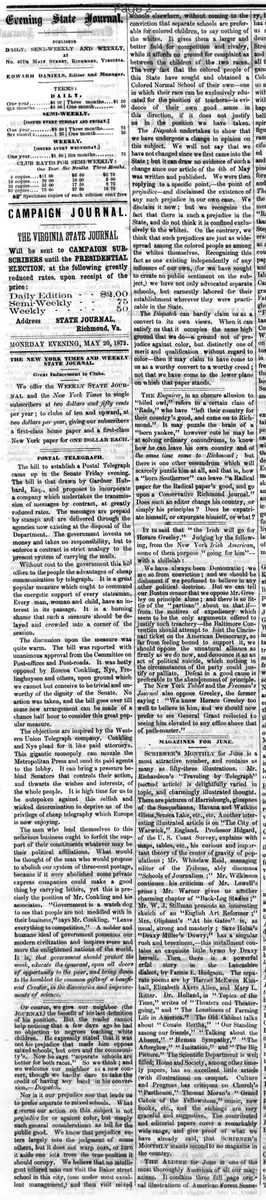
Of course, we give our neighbor (the JOURNAL) the benefit of his last definition of his position. But the reader cannot help noticing that a few days ago he had no objection to negroes teaching white children. He expressly stated that it was not his prejudice that made him oppose mixed schools, but ours and the community's. Now he says "separate schools are better for both races." So we think; and we welcome our neighbor as a new convert, though we hardly dare to take the credit of having any hand in his conversion. -Dispatch.
Nor is it our prejudice now that leads us to prefer separate to mixed schools. What governs our action on this subject is not prejudice for or against color, but simply such general considerations as tell for the public good. We know that prejudice enters largely into the judgment of some others, but it does not warp ours, or turn it aside one iota from the true position it should occupy. We believe that no intelligent colored man can visit the Baker street school in this city, (one under most excellent management,) and then visit mixed schools elsewhere, without coming to the conviction that separate schools are preferable for colored children, to say nothing of the whites. It gives them a larger and better field for competition and rivalry, while it affords no ground for complaint as between the children of the two races.
The very fact that the colored people of this State have sought and obtained a Colored Normal School of their own-one in which their race can be exclusively educated for the position of teachers-is evidence of their own good sense in this direction, if it does not justify us in the position we have taken.
The Dispatch undertakes to show that we have undergone a change in opinion on this subject. We will not say that we have not changed since we first came into the State; but it can draw no evidence of such a change since our article of the 4th of May was written and published. We were then replying to a specific point,-the point of prejudice,-and disclaimed the existence of any such prejudice in our own case. We disclaim it now; but we recognize the fact that there is such a prejudice in the State, and do not think it is confined exclusively to the whites. On the contrary, we think that such prejudices are just as widespread among the colored people as among the whites themselves. Recognizing this fact as one existing independently of any influence of our own, (for we have sought to create no public sentiment on the subject,) we have not only advocated separate schools, but earnestly labored for their establishment wherever they were practicable in the State.
The Dispatch can hardly claim us as a convert to its own views. When it can satisfy us that it occupies the same high ground that we do-a ground not of prejudice against color, but distinctly one of merit and qualification without regard to color-then it may claim to have come to us as a worthy convert to a worthy creed; not that we have come to the lower plane on which that paper stands.
The Enquirer, in an obscure allusion to "biled owl," refers to a certain class of "Rads," who have "left their country for their country's good, and come on to Richmond." It may puzzle the brain of a "born yankee," however cute he may be at solving ordinary conundrums, to know how he can leave his own country and at the same time come to Richmond: but there is one other conundrum which will scarcely puzzle him at all, and that is, how a "born Southerner" can leave "a Radical paper for the Radical paper's good, and go upon a Conservative Richmond journal." Does such an editor change his country, or simply his principles? Does he expatriate himself, or expurgate himself, or what?
Nor is it our prejudice now that leads us to prefer separate to mixed schools. What governs our action on this subject is not prejudice for or against color, but simply such general considerations as tell for the public good. We know that prejudice enters largely into the judgment of some others, but it does not warp ours, or turn it aside one iota from the true position it should occupy. We believe that no intelligent colored man can visit the Baker street school in this city, (one under most excellent management,) and then visit mixed schools elsewhere, without coming to the conviction that separate schools are preferable for colored children, to say nothing of the whites. It gives them a larger and better field for competition and rivalry, while it affords no ground for complaint as between the children of the two races.
The very fact that the colored people of this State have sought and obtained a Colored Normal School of their own-one in which their race can be exclusively educated for the position of teachers-is evidence of their own good sense in this direction, if it does not justify us in the position we have taken.
The Dispatch undertakes to show that we have undergone a change in opinion on this subject. We will not say that we have not changed since we first came into the State; but it can draw no evidence of such a change since our article of the 4th of May was written and published. We were then replying to a specific point,-the point of prejudice,-and disclaimed the existence of any such prejudice in our own case. We disclaim it now; but we recognize the fact that there is such a prejudice in the State, and do not think it is confined exclusively to the whites. On the contrary, we think that such prejudices are just as widespread among the colored people as among the whites themselves. Recognizing this fact as one existing independently of any influence of our own, (for we have sought to create no public sentiment on the subject,) we have not only advocated separate schools, but earnestly labored for their establishment wherever they were practicable in the State.
The Dispatch can hardly claim us as a convert to its own views. When it can satisfy us that it occupies the same high ground that we do-a ground not of prejudice against color, but distinctly one of merit and qualification without regard to color-then it may claim to have come to us as a worthy convert to a worthy creed; not that we have come to the lower plane on which that paper stands.
The Enquirer, in an obscure allusion to "biled owl," refers to a certain class of "Rads," who have "left their country for their country's good, and come on to Richmond." It may puzzle the brain of a "born yankee," however cute he may be at solving ordinary conundrums, to know how he can leave his own country and at the same time come to Richmond: but there is one other conundrum which will scarcely puzzle him at all, and that is, how a "born Southerner" can leave "a Radical paper for the Radical paper's good, and go upon a Conservative Richmond journal." Does such an editor change his country, or simply his principles? Does he expatriate himself, or expurgate himself, or what?
What sub-type of article is it?
Education
Social Reform
What keywords are associated?
Separate Schools
Mixed Schools
Racial Prejudice
Education Reform
Colored Normal School
Baker Street School
Partisan Editors
What entities or persons were involved?
Dispatch
Journal
Enquirer
Colored People
Baker Street School
Colored Normal School
Editorial Details
Primary Topic
Preference For Separate Schools Over Mixed Schools For Racial Reasons
Stance / Tone
Defensive Advocacy For Separate Schools Based On Public Good, Not Prejudice
Key Figures
Dispatch
Journal
Enquirer
Colored People
Baker Street School
Colored Normal School
Key Arguments
Separate Schools Are Better For Both Races Due To Public Good Considerations, Not Prejudice.
Prejudice Against Mixed Schools Exists In The Community, Including Among Colored People.
Baker Street School Demonstrates Benefits Of Separate Education For Colored Children.
Colored Normal School Shows Colored People's Preference For Exclusive Education.
No Change In Opinion Since May 4 Article; Always Disclaimed Personal Prejudice.
Dispatch Occupies A Lower Plane Of Prejudice, While We Advocate Based On Merit.
Critique Of Enquirer's Allusion To Radical Editors Moving To Richmond.