Thank you for visiting SNEWPapers!
Sign up free
Letter to Editor
October 5, 1829
Providence Daily Advertiser
Providence, Providence County, Rhode Island
What is this article about?
In 1829, A.B.M. Bradley writes to Postmaster General William T. Barry, accusing him of $10,000 indebtedness and $100,000 public losses due to misconduct, urging resignation to avoid removal or impeachment. Editorial notes frame it as a leaked confidential letter amid political tensions.
Clipping
OCR Quality
95%
Excellent
Full Text
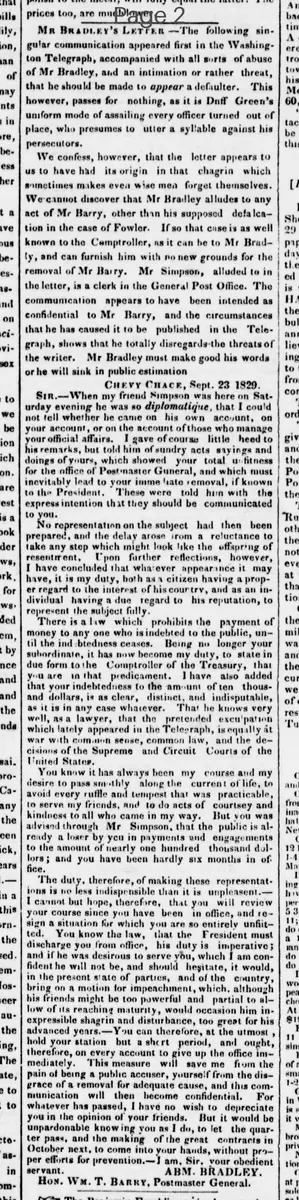
MR. BRADLEY'S LETTER.—The following singular communication appeared first in the Washington Telegraph, accompanied with all sorts of abuse of Mr. Bradley, and an intimation or rather threat, that he should be made to appear a defaulter. This however, passes for nothing, as it is Duff Green's uniform mode of assailing every officer turned out of place, who presumes to utter a syllable against his persecutors.
We confess, however, that the letter appears to us to have had its origin in that chagrin which sometimes makes even wise men forget themselves. We cannot discover that Mr. Bradley alludes to any act of Mr. Barry, other than his supposed defalcation in the case of Fowler. If so that case is as well known to the Comptroller, as it can be to Mr. Bradley, and can furnish him with no new grounds for the removal of Mr. Barry. Mr. Simpson, alluded to in the letter, is a clerk in the General Post Office. The communication appears to have been intended as confidential to Mr. Barry, and the circumstances that he has caused it to be published in the Telegraph, shows that he totally disregards the threats of the writer. Mr. Bradley must make good his words or he will sink in public estimation.
CHEVY CHASE, Sept. 23, 1829.
SIR:—When my friend Simpson was here on Saturday evening he was so diplomatique, that I could not tell whether he came on his own account, on your account, or on the account of those who manage your official affairs. I gave of course little heed to his remarks, but told him of sundry acts sayings and doings of yours, which showed your total unfitness for the office of Postmaster General, and which must inevitably lead to your immediate removal, if known to the President. These were told him with the express intention that they should be communicated to you.
No representation on the subject had then been prepared, and the delay arose from a reluctance to take any step which might look like the offspring of resentment. Upon further reflections, however, I have concluded that whatever appearance it may have, it is my duty, both as a citizen having a proper regard to the interest of his country, and as an individual having a due regard to his reputation, to represent the subject fully.
There is a law which prohibits the payment of money to any one who is indebted to the public, until the indebtedness ceases. Being no longer your subordinate, it has now become my duty, to state in due form to the Comptroller of the Treasury, that you are in that predicament. I have also added that your indebtedness to the amount of ten thousand dollars, is as clear, distinct, and indisputable, as it is in any case whatever. That he knows very well, as a lawyer, that the pretended exculpation which lately appeared in the Telegraph, is equally at war with common sense, common law, and the decisions of the Supreme and Circuit Courts of the United States.
You know it has always been my course and my desire to pass smoothly along the current of life, to avoid every ruffle and tempest that was practicable to serve my friends, and to do acts of courtesy and kindness to all who came in my way. But you was advised through Mr. Simpson, that the public is already a loser by you in payments and engagements to the amount of nearly one hundred thousand dollars; and you have been hardly six months in office.
The duty, therefore, of making these representations is no less indispensable than it is unpleasant.—I cannot but hope, therefore, that you will review your course since you have been in office, and resign a situation for which you are so entirely unfitted. You know the law, that the President must discharge you from office, his duty is imperative; and if he was desirous to serve you, which I am confident he will not be, and should hesitate, it would, in the present state of parties, and of the country, bring on a motion for impeachment, which, although his friends might be too powerful and partial to allow of its reaching maturity, would occasion him inexpressible chagrin and disturbance, too great for his advanced years.—You can therefore, at the utmost, hold your station but a short period, and ought, therefore, on every account to give up the office immediately. This measure will save me from the pain of being a public accuser, yourself from the disgrace of a removal for adequate cause, and this communication will then become confidential. For whatever has passed, I have no wish to depreciate you in the opinion of your friends. But it would be unpardonable knowing you as I do, to let the quarter pass, and the making of the great contracts in October next, to come into your hands, without proper efforts for prevention.—I am, Sir, your obedient servant,
ABM. BRADLEY.
HoN. WM. T. BARRY, Postmaster General.
We confess, however, that the letter appears to us to have had its origin in that chagrin which sometimes makes even wise men forget themselves. We cannot discover that Mr. Bradley alludes to any act of Mr. Barry, other than his supposed defalcation in the case of Fowler. If so that case is as well known to the Comptroller, as it can be to Mr. Bradley, and can furnish him with no new grounds for the removal of Mr. Barry. Mr. Simpson, alluded to in the letter, is a clerk in the General Post Office. The communication appears to have been intended as confidential to Mr. Barry, and the circumstances that he has caused it to be published in the Telegraph, shows that he totally disregards the threats of the writer. Mr. Bradley must make good his words or he will sink in public estimation.
CHEVY CHASE, Sept. 23, 1829.
SIR:—When my friend Simpson was here on Saturday evening he was so diplomatique, that I could not tell whether he came on his own account, on your account, or on the account of those who manage your official affairs. I gave of course little heed to his remarks, but told him of sundry acts sayings and doings of yours, which showed your total unfitness for the office of Postmaster General, and which must inevitably lead to your immediate removal, if known to the President. These were told him with the express intention that they should be communicated to you.
No representation on the subject had then been prepared, and the delay arose from a reluctance to take any step which might look like the offspring of resentment. Upon further reflections, however, I have concluded that whatever appearance it may have, it is my duty, both as a citizen having a proper regard to the interest of his country, and as an individual having a due regard to his reputation, to represent the subject fully.
There is a law which prohibits the payment of money to any one who is indebted to the public, until the indebtedness ceases. Being no longer your subordinate, it has now become my duty, to state in due form to the Comptroller of the Treasury, that you are in that predicament. I have also added that your indebtedness to the amount of ten thousand dollars, is as clear, distinct, and indisputable, as it is in any case whatever. That he knows very well, as a lawyer, that the pretended exculpation which lately appeared in the Telegraph, is equally at war with common sense, common law, and the decisions of the Supreme and Circuit Courts of the United States.
You know it has always been my course and my desire to pass smoothly along the current of life, to avoid every ruffle and tempest that was practicable to serve my friends, and to do acts of courtesy and kindness to all who came in my way. But you was advised through Mr. Simpson, that the public is already a loser by you in payments and engagements to the amount of nearly one hundred thousand dollars; and you have been hardly six months in office.
The duty, therefore, of making these representations is no less indispensable than it is unpleasant.—I cannot but hope, therefore, that you will review your course since you have been in office, and resign a situation for which you are so entirely unfitted. You know the law, that the President must discharge you from office, his duty is imperative; and if he was desirous to serve you, which I am confident he will not be, and should hesitate, it would, in the present state of parties, and of the country, bring on a motion for impeachment, which, although his friends might be too powerful and partial to allow of its reaching maturity, would occasion him inexpressible chagrin and disturbance, too great for his advanced years.—You can therefore, at the utmost, hold your station but a short period, and ought, therefore, on every account to give up the office immediately. This measure will save me from the pain of being a public accuser, yourself from the disgrace of a removal for adequate cause, and this communication will then become confidential. For whatever has passed, I have no wish to depreciate you in the opinion of your friends. But it would be unpardonable knowing you as I do, to let the quarter pass, and the making of the great contracts in October next, to come into your hands, without proper efforts for prevention.—I am, Sir, your obedient servant,
ABM. BRADLEY.
HoN. WM. T. BARRY, Postmaster General.
What sub-type of article is it?
Persuasive
Political
Investigative
What themes does it cover?
Politics
Economic Policy
Crime Punishment
What keywords are associated?
Postmaster General
William T Barry
Abm Bradley
Defalcation
Financial Misconduct
Resignation
Impeachment
Public Indebtedness
What entities or persons were involved?
Abm. Bradley
Hon. Wm. T. Barry, Postmaster General
Letter to Editor Details
Author
Abm. Bradley
Recipient
Hon. Wm. T. Barry, Postmaster General
Main Argument
bradley accuses barry of financial misconduct including $10,000 personal indebtedness and nearly $100,000 public losses, deeming him unfit for postmaster general and urging immediate resignation to avoid mandatory presidential removal or impeachment.
Notable Details
Reference To Fowler Case Defalcation
Mr. Simpson As Intermediary
Law Prohibiting Payments To Public Debtors
Critique Of Barry's Telegraph Exculpation As Contrary To Law And Court Decisions
Threat Of Reporting To Comptroller Of The Treasury