Thank you for visiting SNEWPapers!
Sign up free
Literary
June 17, 1829
The Massachusetts Spy, And Worcester County Advertiser
Worcester, Worcester County, Massachusetts
What is this article about?
An essay advising on the importance of economy in family management, emphasizing the husband's role in providing and the wife's in preventing waste to avoid poverty and ensure welfare.
Clipping
OCR Quality
95%
Excellent
Full Text
From the Providence Evening Gazette.
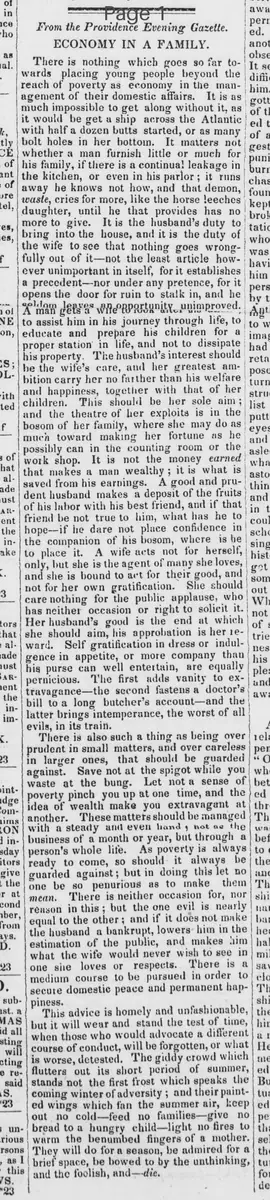
ECONOMY IN A FAMILY.
There is nothing which goes so far towards placing young people beyond the reach of poverty as economy in the management of their domestic affairs. It is as much impossible to get along without it, as it would be get a ship across the Atlantic with half a dozen butts started, or as many bolt holes in her bottom. It matters not whether a man furnish little or much for his family, if there is a continual leakage in the kitchen, or even in his parlor; it runs away he knows not how, and that demon, waste, cries for more, like the horse leech's daughter, until he that provides has no more to give. It is the husband's duty to bring into the house, and it is the duty of the wife to see that nothing goes wrongfully out of it—not the least article however unimportant in itself, for it establishes a precedent—nor under any pretence, for it opens the door for ruin to stalk in, and he seldom leaves opportunity unimproved.
A man gets a wife to assist him in his journey through life, to educate and prepare his children for a proper station in life, and not to dissipate his property. The husband's interest should be the wife's care, and her greatest ambition carry her no farther than his welfare and happiness, together with that of her children. This should be her sole aim; and the theatre of her exploits is in the bosom of her family, where she may do as much toward making her fortune as he possibly can in the counting room or the work shop. It is not the money earned that makes a man wealthy; it is what is saved from his earnings. A good and prudent husband makes a deposit of the fruits of his labor with his best friend, and if that friend be not true to him, what has he to hope—if he dare not place confidence in the companion of his bosom, where is he to place it. A wife acts not for herself, only, but she is the agent of many she loves, and she is bound to act for their good, and not for her own gratification. She should care nothing for the public applause, who has neither occasion or right to solicit it. Her husband's good is the end at which she should aim, his approbation is her reward. Self gratification in dress or indulgence in appetite, or more company than his purse can well entertain, are equally pernicious. The first adds vanity to extravagance—the second fastens a doctor's bill to a long butcher's account—and the latter brings intemperance, the worst of all evils, in its train.
There is also such a thing as being over prudent in small matters, and over careless in larger ones, that should be guarded against. Save not at the spigot while you waste at the bung. Let not a sense of poverty pinch you up at one time, and the idea of wealth make you extravagant at another. These matters should be managed with a steady and even hand—not as the business of a month or year, but through a person's whole life. As poverty is always ready to come, so should it always be guarded against; but in doing this let no one be so penurious as to make them mean. There is neither occasion for, nor reason in this; but the one evil is nearly equal to the other; and if it does not make the husband a bankrupt, lowers him in the estimation of the public, and makes him what the wife would never wish to see in one she loves or respects. There is a medium course to be pursued in order to secure domestic peace and permanent happiness.
This advice is homely and unfashionable, but it will wear and stand the test of time, when those who would advocate a different course of conduct, will be forgotten, or what is worse, detested. The giddy crowd which flutters out its short period of summer, stands not the first frost which speaks the coming winter of adversity; and their painted wings which fan the summer air, keep out no cold—feed no families—give no bread to a hungry child—light no fires to warm the benumbed fingers of a mother. They will do for a season, be admired for a brief space, be bowed to by the unthinking, and the foolish, and—die.
ECONOMY IN A FAMILY.
There is nothing which goes so far towards placing young people beyond the reach of poverty as economy in the management of their domestic affairs. It is as much impossible to get along without it, as it would be get a ship across the Atlantic with half a dozen butts started, or as many bolt holes in her bottom. It matters not whether a man furnish little or much for his family, if there is a continual leakage in the kitchen, or even in his parlor; it runs away he knows not how, and that demon, waste, cries for more, like the horse leech's daughter, until he that provides has no more to give. It is the husband's duty to bring into the house, and it is the duty of the wife to see that nothing goes wrongfully out of it—not the least article however unimportant in itself, for it establishes a precedent—nor under any pretence, for it opens the door for ruin to stalk in, and he seldom leaves opportunity unimproved.
A man gets a wife to assist him in his journey through life, to educate and prepare his children for a proper station in life, and not to dissipate his property. The husband's interest should be the wife's care, and her greatest ambition carry her no farther than his welfare and happiness, together with that of her children. This should be her sole aim; and the theatre of her exploits is in the bosom of her family, where she may do as much toward making her fortune as he possibly can in the counting room or the work shop. It is not the money earned that makes a man wealthy; it is what is saved from his earnings. A good and prudent husband makes a deposit of the fruits of his labor with his best friend, and if that friend be not true to him, what has he to hope—if he dare not place confidence in the companion of his bosom, where is he to place it. A wife acts not for herself, only, but she is the agent of many she loves, and she is bound to act for their good, and not for her own gratification. She should care nothing for the public applause, who has neither occasion or right to solicit it. Her husband's good is the end at which she should aim, his approbation is her reward. Self gratification in dress or indulgence in appetite, or more company than his purse can well entertain, are equally pernicious. The first adds vanity to extravagance—the second fastens a doctor's bill to a long butcher's account—and the latter brings intemperance, the worst of all evils, in its train.
There is also such a thing as being over prudent in small matters, and over careless in larger ones, that should be guarded against. Save not at the spigot while you waste at the bung. Let not a sense of poverty pinch you up at one time, and the idea of wealth make you extravagant at another. These matters should be managed with a steady and even hand—not as the business of a month or year, but through a person's whole life. As poverty is always ready to come, so should it always be guarded against; but in doing this let no one be so penurious as to make them mean. There is neither occasion for, nor reason in this; but the one evil is nearly equal to the other; and if it does not make the husband a bankrupt, lowers him in the estimation of the public, and makes him what the wife would never wish to see in one she loves or respects. There is a medium course to be pursued in order to secure domestic peace and permanent happiness.
This advice is homely and unfashionable, but it will wear and stand the test of time, when those who would advocate a different course of conduct, will be forgotten, or what is worse, detested. The giddy crowd which flutters out its short period of summer, stands not the first frost which speaks the coming winter of adversity; and their painted wings which fan the summer air, keep out no cold—feed no families—give no bread to a hungry child—light no fires to warm the benumbed fingers of a mother. They will do for a season, be admired for a brief space, be bowed to by the unthinking, and the foolish, and—die.
What sub-type of article is it?
Essay
What themes does it cover?
Moral Virtue
Temperance
What keywords are associated?
Family Economy
Domestic Management
Prudence
Waste
Husband Duties
Wife Duties
Extravagance
Moderation
What entities or persons were involved?
From The Providence Evening Gazette.
Literary Details
Title
Economy In A Family.
Author
From The Providence Evening Gazette.
Key Lines
There Is Nothing Which Goes So Far Towards Placing Young People Beyond The Reach Of Poverty As Economy In The Management Of Their Domestic Affairs.
It Is The Husband's Duty To Bring Into The House, And It Is The Duty Of The Wife To See That Nothing Goes Wrongfully Out Of It.
It Is Not The Money Earned That Makes A Man Wealthy; It Is What Is Saved From His Earnings.
Save Not At The Spigot While You Waste At The Bung.
This Advice Is Homely And Unfashionable, But It Will Wear And Stand The Test Of Time.