Thank you for visiting SNEWPapers!
Sign up free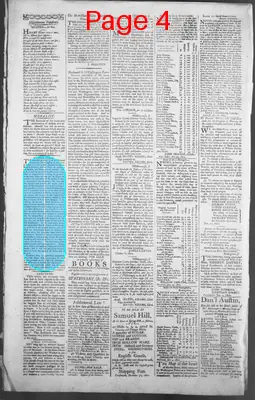
Literary
February 16, 1802
The New Hampshire Gazette
Portsmouth, Rockingham County, New Hampshire
What is this article about?
This essay extols manual labor, particularly agriculture and mechanics, as divine blessings essential for health, safety, and morals. It emphasizes iron's vital role in civilization, praises Tubal-cain as its first forger, condemns Nimrod for weaponizing it, and recalls Adam as Eden's gardener to rebuke those scorning farmers.
Clipping
OCR Quality
95%
Excellent
Full Text
AGRICULTURAL
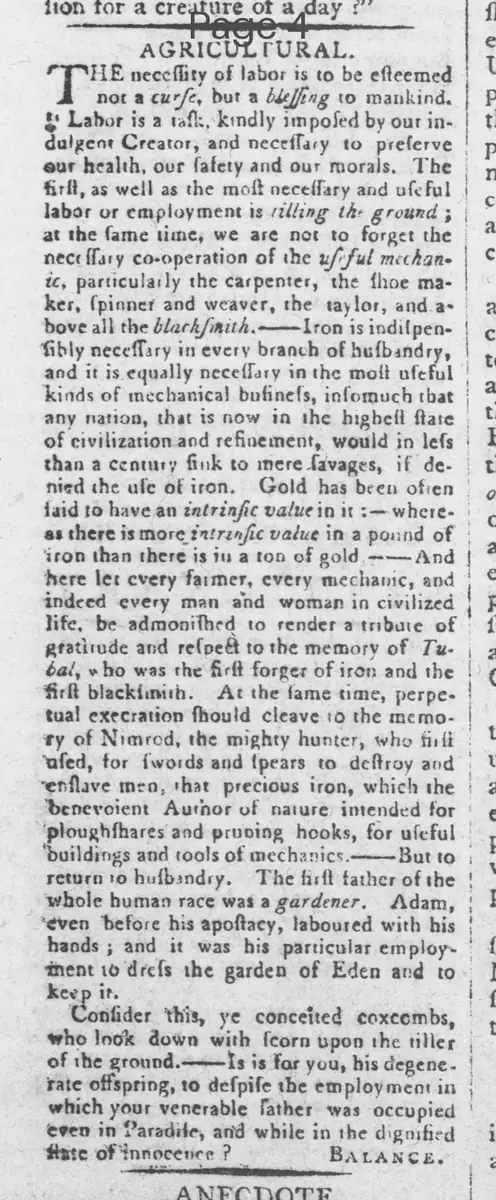
The necessity of labor is to be esteemed not a curse, but a blessing to mankind. Labor is a task, kindly imposed by our indulgent Creator, and necessary to preserve our health, our safety and our morals. The first, as well as the most necessary and useful labor or employment is tilling the ground; at the same time, we are not to forget the necessary co-operation of the useful mechanic, particularly the carpenter, the shoemaker, spinner and weaver, the tailor, and above all the blacksmith.--Iron is indispensably necessary in every branch of husbandry, and it is equally necessary in the most useful kinds of mechanical business, insomuch that any nation, that is now in the highest state of civilization and refinement, would in less than a century sink to mere savages, if deprived of the use of iron. Gold has been often said to have an intrinsic value in it:--whereas there is more intrinsic value in a pound of iron than there is in a ton of gold---And here let every farmer, every mechanic, and indeed every man and woman in civilized life, be admonished to render a tribute of gratitude and respect to the memory of Tubal-cain, who was the first forger of iron and the first blacksmith. At the same time, perpetual execration should cleave to the memory of Nimrod, the mighty hunter, who first used, for swords and spears to destroy and enslave men, that precious iron, which the benevolent Author of nature intended for ploughshares and pruning hooks, for useful buildings and tools of mechanics.---But to return to husbandry. The first father of the whole human race was a gardener. Adam, even before his apostasy, laboured with his hands: and it was his particular employment to dress the garden of Eden and to keep it.
Consider this, ye conceited coxcombs, who look down with scorn upon the tiller of the ground.--It is for you, his degenerate offspring, to despise the employment in which your venerable father was occupied even in Paradise, and while in the dignified state of innocence?
The necessity of labor is to be esteemed not a curse, but a blessing to mankind. Labor is a task, kindly imposed by our indulgent Creator, and necessary to preserve our health, our safety and our morals. The first, as well as the most necessary and useful labor or employment is tilling the ground; at the same time, we are not to forget the necessary co-operation of the useful mechanic, particularly the carpenter, the shoemaker, spinner and weaver, the tailor, and above all the blacksmith.--Iron is indispensably necessary in every branch of husbandry, and it is equally necessary in the most useful kinds of mechanical business, insomuch that any nation, that is now in the highest state of civilization and refinement, would in less than a century sink to mere savages, if deprived of the use of iron. Gold has been often said to have an intrinsic value in it:--whereas there is more intrinsic value in a pound of iron than there is in a ton of gold---And here let every farmer, every mechanic, and indeed every man and woman in civilized life, be admonished to render a tribute of gratitude and respect to the memory of Tubal-cain, who was the first forger of iron and the first blacksmith. At the same time, perpetual execration should cleave to the memory of Nimrod, the mighty hunter, who first used, for swords and spears to destroy and enslave men, that precious iron, which the benevolent Author of nature intended for ploughshares and pruning hooks, for useful buildings and tools of mechanics.---But to return to husbandry. The first father of the whole human race was a gardener. Adam, even before his apostasy, laboured with his hands: and it was his particular employment to dress the garden of Eden and to keep it.
Consider this, ye conceited coxcombs, who look down with scorn upon the tiller of the ground.--It is for you, his degenerate offspring, to despise the employment in which your venerable father was occupied even in Paradise, and while in the dignified state of innocence?
What sub-type of article is it?
Essay
What themes does it cover?
Agriculture Rural
Moral Virtue
Religious
What keywords are associated?
Agriculture
Labor
Iron
Blacksmith
Tubal Cain
Nimrod
Adam
Eden
Moral Lesson
Literary Details
Key Lines
The Necessity Of Labor Is To Be Esteemed Not A Curse, But A Blessing To Mankind.
Iron Is Indispensably Necessary In Every Branch Of Husbandry...
The First Father Of The Whole Human Race Was A Gardener.
Consider This, Ye Conceited Coxcombs, Who Look Down With Scorn Upon The Tiller Of The Ground.