Thank you for visiting SNEWPapers!
Sign up free
Literary
November 29, 1900
The Republican
Oakland, Garrett County, Maryland
What is this article about?
Engaged couple Althea Winthrop and Wilfred Brayton face their first challenge when Wilfred must take in his late brother's 12-year-old daughter, Dora, who arrives uninvited for their wedding in northern Michigan. With guidance from Aunt Roey, they embrace the responsibility, highlighting themes of love, duty, and family.
Clipping
OCR Quality
95%
Excellent
Full Text
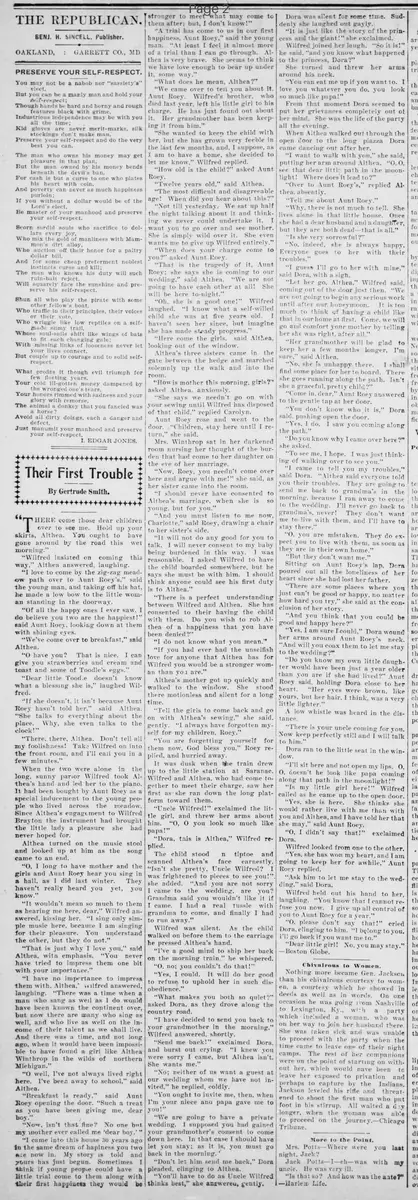
Their First Trouble
By Gertrude Smith.
"THERE come those dear children ever to see me. Hold up your skirts, Althea. You ought to have gone around by the road this wet morning."
"Wilfred insisted on coming this way," Althea answered, laughing. "I love to come by the zig-zag meadow path over to Aunt Roey's," said the young man, and taking off his hat, he made a low bow to the little woman standing in the doorway.
"Of all the happy ones I ever saw, I do believe you two are the happiest!" said Aunt Roey, looking down at them with shining eyes.
"We've come over to breakfast," said Althea.
"O have you? That is nice. I can give you strawberries and cream and toast and some of Toodle's eggs."
"Dear little Toodle doesn't know what a blessing she is," laughed Wilfred.
"If she doesn't, it isn't because Aunt Roey hasn't told her," said Althea. "She talks to everything about the place. Why, she even talks to the clock!"
"There, there, Althea. Don't tell all my foolishness! Take Wilfred on into the front room, and I'll call you in a few minutes."
When the two were alone in the long, sunny parlor Wilfred took Althea's hand and led her to the piano. It had been bought by Aunt Roey as a special inducement to the young people who lived across the meadow. Since Althea's engagement to Wilfred Brayton the instrument had brought the little lady a pleasure she had never hoped for.
Althea turned on the music stool and looked up at him as the song came to an end.
"O, I long to have mother and the girls and Aunt Roey hear you sing in a hall, as I did last winter. They haven't really heard you yet, you know."
"It wouldn't mean so much to them as hearing me here, dear," Wilfred answered, kissing her. "I sing only simple music here, because I am singing for their pleasure. You understand the other, but they do not."
"That is just why I love you," said Althea, with emphasis. "You never have tried to impress them one bit with your importance."
"I have no importance to impress them with, Althea," Wilfred answered, laughing. "There was a time when a man who sang as well as I do would have been known the continent over, but now there are many who sing as well, and who live as well on the income of their talent as we shall live. And there was a time, and not long ago, when it would have been impossible to have found a girl like Althea Winthrop in the wilds of northern Michigan."
"O well, I've not always lived right here. I've been away to school," said Althea.
"Breakfast is ready," said Aunt Roey opening the door. "Such a treat as you have been giving me, dear boy."
"Now, isn't that fine? No one but my mother ever called me 'dear boy.' I came into this house 30 years ago in the same dream of happiness you two are now in. My story is told and yours has just begun. Sometimes I think if young people could have a little trial come to them along with their first happiness they would be stronger to meet what may come to them after; but I don't know!"
"A trial has come to us in our first happiness, Aunt Roey," said the young man. "At least I feel it almost more of a trial than I can go through. Althea is very brave. She seems to think we have love enough to bear up under it, some way."
"What does he mean, Althea?"
"We came over to tell you about it, Aunt Roey. Wilfred's brother, who died last year, left his little girl to his charge. He has just found out about it. Her grandmother has been keeping it from him."
"She wanted to keep the child with her, but she has grown very feeble in the last few months, and, I suppose, as I am to have a home, she decided to let me know," Wilfred replied.
"How old is the child?" asked Aunt Roey.
"Twelve years old," said Althea. "The most difficult and disagreeable age! When did you hear about this?"
"Not till yesterday. We sat up half the night talking about it and thinking we never could undertake it. I want you to go over and see mother. She is simply wild over it. She even wants me to give up Wilfred entirely."
"When does your charge come to you?" asked Aunt Roey.
"That is the tragedy of it, Aunt Roey; she says she is coming to our wedding," said Althea. "We are not going to have each other at all! She will be here to-night."
"Oh, she is a good one!" Wilfred laughed. "I know what a self-willed child she was at five years old. I haven't seen her since, but imagine she has made steady progress."
"Here come the girls," said Althea looking out of the window.
Althea's three sisters came in the gate between the hedge and marched solemnly up the walk and into the room.
"How is mother this morning, girls?" asked Althea, anxiously.
"She says we needn't go on with your sewing until Wilfred has disposed of that child," replied Carolyn.
Aunt Roey rose and went to the door. "Children, stay here until I return," she said.
Mrs. Winthrop sat in her darkened room nursing her thought of the burden that had come to her daughter on the eve of her marriage.
"Now, Roey, you needn't come over here and argue with me!" she said, as her sister came into the room.
"I should never have consented to Althea's marriage, when she is so young, but for you."
"And you must listen to me now, Charlotte," said Roey, drawing a chair to her sister's side.
"It will not do any good for you to talk. I will never consent to my baby being burdened in this way. I was reasonable. I asked Wilfred to have the child boarded somewhere, but he says she must be with him. I should think anyone could see his first duty is to Althea."
"There is a perfect understanding between Wilfred and Althea. She has consented to their having the child with them. Do you wish to rob Althea of a happiness that you have been denied?"
"I do not know what you mean."
"If you had ever had the unselfish love for anyone that Althea has for Wilfred you would be a stronger woman than you are."
Althea's mother got up quickly and walked to the window. She stood there motionless and silent for a long time.
"Tell the girls to come back and go on with Althea's sewing," she said, gently. "I always have forgotten myself for my children, Roey."
"You are forgetting yourself for them now, God bless you," Roey replied, and hurried away.
It was dusk when the train drew up to the little station at Saranac. Wilfred and Althea, who had come together to meet their charge, saw her first as she ran down the long platform toward them.
"Uncle Wilfred!" exclaimed the little girl, and threw her arms about him. "O, O you look so much like papa!"
"Dora, this is Althea," Wilfred replied.
The child stood on tiptoe and scanned Althea's face earnestly.
"Isn't she pretty, Uncle Wilfred? I was frightened to pieces to see you!" she added. "And you are not sorry I came to the wedding, are you? Grandma said you wouldn't like it if I came. I had a real tussle with grandma to come, and finally I had to run away."
Wilfred was silent. As the child walked on before them to the carriage he pressed Althea's hand.
"I've a good mind to ship her back on the morning train," he whispered.
"O, no; you couldn't do that!"
"Yes, I could. It will do her good to refuse to uphold her in such disobedience."
"What makes you both so quiet?" asked Dora, as they drove along the country road.
"I have decided to send you back to your grandmother in the morning," Wilfred answered, shortly.
"Send me back!" exclaimed Dora, and burst out crying. "I knew you were sorry I came, but Althea isn't. She wants me."
"No; neither of us want a guest at our wedding whom we have not invited," he replied, coldly.
"You ought to invite me, then, when I'm your niece and papa gave me to you!"
"We are going to have a private wedding. I supposed you had gained your grandmother's consent to come down here. In that case I should have let you stay; as it is, you must go back in the morning."
"Don't let him send me back," Dora pleaded, clinging to Althea.
"You'll have to do as Uncle Wilfred thinks best," she answered, gently.
Dora was silent for some time. Suddenly she laughed out gayly.
"It is just like the story of the princess and the giant!" she exclaimed.
Wilfred joined her laugh. "So it is!" he said, "and you know what happened to the princess, Dora?"
She turned and threw her arms around his neck.
"You can eat me up if you want to. I love you whatever you do, you look so much like papa!"
From that moment Dora seemed to put her grievances completely out of her mind. She was the life of the party all the evening.
When Althea walked out through the open door to the long piazza Dora came dancing out after her.
"I want to walk with you," she said, putting her arm around Althea. "O, O, see that dear little path in the moonlight! Where does it lead to?"
"Over to Aunt Roey's," replied Althea, absently.
"Tell me about Aunt Roey."
"Why, there is not much to tell. She lives alone in that little house. Once she had a dear husband and a daughter, but they are both dead—that is all."
"Is she very sorrowful?"
"No, indeed, she is always happy. Everyone goes to her with their troubles."
"I guess I'll go to her with mine," said Dora, with a sigh.
"Let her go, Althea," Wilfred said, coming out of the door just then. "We are not going to begin any serious work until after our honeymoon. It is too much to think of having a child like that in our home at first. Come, we will go and comfort your mother by telling her she was right, after all."
"Her grandmother will be glad to keep her a few months longer, I'm sure," said Althea.
"No, she is unhappy there. I shall find some place for her to board. There she goes running along the path. Isn't she a graceful, pretty child?"
"Come in, dear," Aunt Roey answered to the gentle tap at her door.
"You don't know who it is," Dora said, pushing open the door.
"Yes, I do. I saw you coming along the path."
"Do you know why I came over here?" she asked.
"To see me, I hope. I was just thinking of walking over to see you."
"I came to tell you my troubles," said Dora. "Althea said everyone told you their troubles. They are going to send me back to grandma's in the morning, because I ran away to come to the wedding. I'll never go back to grandma's, never! They don't want me to live with them, and I'll have to stay there."
"O, you are mistaken. They do expect you to live with them, as soon as they are in their own home."
"But they don't want me."
Sitting on Aunt Roey's lap, Dora poured out all the loneliness of her heart since she had lost her father.
"There are some places where you just can't be good or happy, no matter how hard you try," she said at the conclusion of her story.
"And you think that you could be good and happy here?"
"Yes, I am sure I could." Dora wound her arms around Aunt Roey's neck. "And will you coax them to let me stay to the wedding?"
"Do you know my own little daughter would have been just a year older than you are if she had lived?" Aunt Roey said, holding Dora close to her heart.
"Her eyes were brown, like yours, but her hair, I think, was a very little lighter."
A low whistle was heard in the distance.
"There is your uncle coming for you. Now keep perfectly still and I will talk to him."
Dora ran to the little seat in the window.
"I'll sit here and not open my lips. O, O, doesn't he look like papa coming along that path in the moonlight!"
"Is my little girl here!" Wilfred called as he came up to the open door.
"Yes, she is here. She thinks she would rather live with me than with you and Althea, and I have told her that she may," said Aunt Roey.
"O, I didn't say that!" exclaimed Dora.
Wilfred looked from one to the other.
"Yes, she has won my heart, and I am going to keep her for awhile," Aunt Roey replied.
"Ask him to let me stay to the wedding," said Dora.
Wilfred held out his hand to her laughing. "You know that I cannot refuse you now. I give up all control of you to Aunt Roey for a year."
"O, please don't say that!" cried Dora, clinging to him. "I belong to you. I'll go back if you want me to."
"Dear little girl! No, you may stay."
—Boston Globe.
By Gertrude Smith.
"THERE come those dear children ever to see me. Hold up your skirts, Althea. You ought to have gone around by the road this wet morning."
"Wilfred insisted on coming this way," Althea answered, laughing. "I love to come by the zig-zag meadow path over to Aunt Roey's," said the young man, and taking off his hat, he made a low bow to the little woman standing in the doorway.
"Of all the happy ones I ever saw, I do believe you two are the happiest!" said Aunt Roey, looking down at them with shining eyes.
"We've come over to breakfast," said Althea.
"O have you? That is nice. I can give you strawberries and cream and toast and some of Toodle's eggs."
"Dear little Toodle doesn't know what a blessing she is," laughed Wilfred.
"If she doesn't, it isn't because Aunt Roey hasn't told her," said Althea. "She talks to everything about the place. Why, she even talks to the clock!"
"There, there, Althea. Don't tell all my foolishness! Take Wilfred on into the front room, and I'll call you in a few minutes."
When the two were alone in the long, sunny parlor Wilfred took Althea's hand and led her to the piano. It had been bought by Aunt Roey as a special inducement to the young people who lived across the meadow. Since Althea's engagement to Wilfred Brayton the instrument had brought the little lady a pleasure she had never hoped for.
Althea turned on the music stool and looked up at him as the song came to an end.
"O, I long to have mother and the girls and Aunt Roey hear you sing in a hall, as I did last winter. They haven't really heard you yet, you know."
"It wouldn't mean so much to them as hearing me here, dear," Wilfred answered, kissing her. "I sing only simple music here, because I am singing for their pleasure. You understand the other, but they do not."
"That is just why I love you," said Althea, with emphasis. "You never have tried to impress them one bit with your importance."
"I have no importance to impress them with, Althea," Wilfred answered, laughing. "There was a time when a man who sang as well as I do would have been known the continent over, but now there are many who sing as well, and who live as well on the income of their talent as we shall live. And there was a time, and not long ago, when it would have been impossible to have found a girl like Althea Winthrop in the wilds of northern Michigan."
"O well, I've not always lived right here. I've been away to school," said Althea.
"Breakfast is ready," said Aunt Roey opening the door. "Such a treat as you have been giving me, dear boy."
"Now, isn't that fine? No one but my mother ever called me 'dear boy.' I came into this house 30 years ago in the same dream of happiness you two are now in. My story is told and yours has just begun. Sometimes I think if young people could have a little trial come to them along with their first happiness they would be stronger to meet what may come to them after; but I don't know!"
"A trial has come to us in our first happiness, Aunt Roey," said the young man. "At least I feel it almost more of a trial than I can go through. Althea is very brave. She seems to think we have love enough to bear up under it, some way."
"What does he mean, Althea?"
"We came over to tell you about it, Aunt Roey. Wilfred's brother, who died last year, left his little girl to his charge. He has just found out about it. Her grandmother has been keeping it from him."
"She wanted to keep the child with her, but she has grown very feeble in the last few months, and, I suppose, as I am to have a home, she decided to let me know," Wilfred replied.
"How old is the child?" asked Aunt Roey.
"Twelve years old," said Althea. "The most difficult and disagreeable age! When did you hear about this?"
"Not till yesterday. We sat up half the night talking about it and thinking we never could undertake it. I want you to go over and see mother. She is simply wild over it. She even wants me to give up Wilfred entirely."
"When does your charge come to you?" asked Aunt Roey.
"That is the tragedy of it, Aunt Roey; she says she is coming to our wedding," said Althea. "We are not going to have each other at all! She will be here to-night."
"Oh, she is a good one!" Wilfred laughed. "I know what a self-willed child she was at five years old. I haven't seen her since, but imagine she has made steady progress."
"Here come the girls," said Althea looking out of the window.
Althea's three sisters came in the gate between the hedge and marched solemnly up the walk and into the room.
"How is mother this morning, girls?" asked Althea, anxiously.
"She says we needn't go on with your sewing until Wilfred has disposed of that child," replied Carolyn.
Aunt Roey rose and went to the door. "Children, stay here until I return," she said.
Mrs. Winthrop sat in her darkened room nursing her thought of the burden that had come to her daughter on the eve of her marriage.
"Now, Roey, you needn't come over here and argue with me!" she said, as her sister came into the room.
"I should never have consented to Althea's marriage, when she is so young, but for you."
"And you must listen to me now, Charlotte," said Roey, drawing a chair to her sister's side.
"It will not do any good for you to talk. I will never consent to my baby being burdened in this way. I was reasonable. I asked Wilfred to have the child boarded somewhere, but he says she must be with him. I should think anyone could see his first duty is to Althea."
"There is a perfect understanding between Wilfred and Althea. She has consented to their having the child with them. Do you wish to rob Althea of a happiness that you have been denied?"
"I do not know what you mean."
"If you had ever had the unselfish love for anyone that Althea has for Wilfred you would be a stronger woman than you are."
Althea's mother got up quickly and walked to the window. She stood there motionless and silent for a long time.
"Tell the girls to come back and go on with Althea's sewing," she said, gently. "I always have forgotten myself for my children, Roey."
"You are forgetting yourself for them now, God bless you," Roey replied, and hurried away.
It was dusk when the train drew up to the little station at Saranac. Wilfred and Althea, who had come together to meet their charge, saw her first as she ran down the long platform toward them.
"Uncle Wilfred!" exclaimed the little girl, and threw her arms about him. "O, O you look so much like papa!"
"Dora, this is Althea," Wilfred replied.
The child stood on tiptoe and scanned Althea's face earnestly.
"Isn't she pretty, Uncle Wilfred? I was frightened to pieces to see you!" she added. "And you are not sorry I came to the wedding, are you? Grandma said you wouldn't like it if I came. I had a real tussle with grandma to come, and finally I had to run away."
Wilfred was silent. As the child walked on before them to the carriage he pressed Althea's hand.
"I've a good mind to ship her back on the morning train," he whispered.
"O, no; you couldn't do that!"
"Yes, I could. It will do her good to refuse to uphold her in such disobedience."
"What makes you both so quiet?" asked Dora, as they drove along the country road.
"I have decided to send you back to your grandmother in the morning," Wilfred answered, shortly.
"Send me back!" exclaimed Dora, and burst out crying. "I knew you were sorry I came, but Althea isn't. She wants me."
"No; neither of us want a guest at our wedding whom we have not invited," he replied, coldly.
"You ought to invite me, then, when I'm your niece and papa gave me to you!"
"We are going to have a private wedding. I supposed you had gained your grandmother's consent to come down here. In that case I should have let you stay; as it is, you must go back in the morning."
"Don't let him send me back," Dora pleaded, clinging to Althea.
"You'll have to do as Uncle Wilfred thinks best," she answered, gently.
Dora was silent for some time. Suddenly she laughed out gayly.
"It is just like the story of the princess and the giant!" she exclaimed.
Wilfred joined her laugh. "So it is!" he said, "and you know what happened to the princess, Dora?"
She turned and threw her arms around his neck.
"You can eat me up if you want to. I love you whatever you do, you look so much like papa!"
From that moment Dora seemed to put her grievances completely out of her mind. She was the life of the party all the evening.
When Althea walked out through the open door to the long piazza Dora came dancing out after her.
"I want to walk with you," she said, putting her arm around Althea. "O, O, see that dear little path in the moonlight! Where does it lead to?"
"Over to Aunt Roey's," replied Althea, absently.
"Tell me about Aunt Roey."
"Why, there is not much to tell. She lives alone in that little house. Once she had a dear husband and a daughter, but they are both dead—that is all."
"Is she very sorrowful?"
"No, indeed, she is always happy. Everyone goes to her with their troubles."
"I guess I'll go to her with mine," said Dora, with a sigh.
"Let her go, Althea," Wilfred said, coming out of the door just then. "We are not going to begin any serious work until after our honeymoon. It is too much to think of having a child like that in our home at first. Come, we will go and comfort your mother by telling her she was right, after all."
"Her grandmother will be glad to keep her a few months longer, I'm sure," said Althea.
"No, she is unhappy there. I shall find some place for her to board. There she goes running along the path. Isn't she a graceful, pretty child?"
"Come in, dear," Aunt Roey answered to the gentle tap at her door.
"You don't know who it is," Dora said, pushing open the door.
"Yes, I do. I saw you coming along the path."
"Do you know why I came over here?" she asked.
"To see me, I hope. I was just thinking of walking over to see you."
"I came to tell you my troubles," said Dora. "Althea said everyone told you their troubles. They are going to send me back to grandma's in the morning, because I ran away to come to the wedding. I'll never go back to grandma's, never! They don't want me to live with them, and I'll have to stay there."
"O, you are mistaken. They do expect you to live with them, as soon as they are in their own home."
"But they don't want me."
Sitting on Aunt Roey's lap, Dora poured out all the loneliness of her heart since she had lost her father.
"There are some places where you just can't be good or happy, no matter how hard you try," she said at the conclusion of her story.
"And you think that you could be good and happy here?"
"Yes, I am sure I could." Dora wound her arms around Aunt Roey's neck. "And will you coax them to let me stay to the wedding?"
"Do you know my own little daughter would have been just a year older than you are if she had lived?" Aunt Roey said, holding Dora close to her heart.
"Her eyes were brown, like yours, but her hair, I think, was a very little lighter."
A low whistle was heard in the distance.
"There is your uncle coming for you. Now keep perfectly still and I will talk to him."
Dora ran to the little seat in the window.
"I'll sit here and not open my lips. O, O, doesn't he look like papa coming along that path in the moonlight!"
"Is my little girl here!" Wilfred called as he came up to the open door.
"Yes, she is here. She thinks she would rather live with me than with you and Althea, and I have told her that she may," said Aunt Roey.
"O, I didn't say that!" exclaimed Dora.
Wilfred looked from one to the other.
"Yes, she has won my heart, and I am going to keep her for awhile," Aunt Roey replied.
"Ask him to let me stay to the wedding," said Dora.
Wilfred held out his hand to her laughing. "You know that I cannot refuse you now. I give up all control of you to Aunt Roey for a year."
"O, please don't say that!" cried Dora, clinging to him. "I belong to you. I'll go back if you want me to."
"Dear little girl! No, you may stay."
—Boston Globe.
What sub-type of article is it?
Prose Fiction
What themes does it cover?
Love Romance
Moral Virtue
What keywords are associated?
Short Story
Engagement
Wedding
Niece
Family Duty
Unselfish Love
Aunt Roey
What entities or persons were involved?
By Gertrude Smith.
Literary Details
Title
Their First Trouble
Author
By Gertrude Smith.
Key Lines
"A Trial Has Come To Us In Our First Happiness, Aunt Roey," Said The Young Man.
"You Can Eat Me Up If You Want To. I Love You Whatever You Do, You Look So Much Like Papa!"
"There Are Some Places Where You Just Can't Be Good Or Happy, No Matter How Hard You Try," She Said At The Conclusion Of Her Story.
"If You Had Ever Had The Unselfish Love For Anyone That Althea Has For Wilfred You Would Be A Stronger Woman Than You Are."