Thank you for visiting SNEWPapers!
Sign up free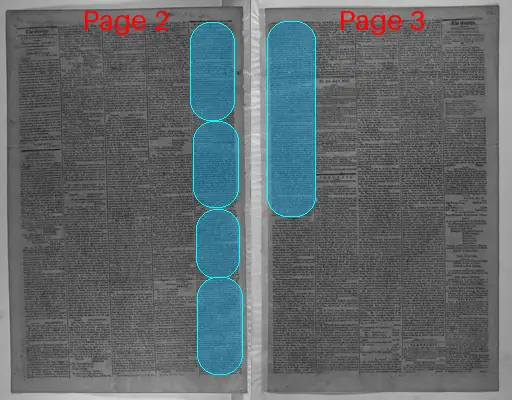
Gazette Of The United States, & Philadelphia Daily Advertiser
Philadelphia, Philadelphia County, Pennsylvania
What is this article about?
This editorial, part of 'Reflections on Monroe's View' series, criticizes U.S. Minister James Monroe for improperly promising to share details of the Jay Treaty with Britain's French Committee of Public Safety before U.S. ratification, including sending a messenger to obtain a copy and refusing other information unless sharable. It includes correspondence between Monroe, Jay, and the French committee defending U.S. diplomatic integrity.
Merged-components note: Continuation of the editorial 'Reflections on Monroe's View. No. VII.' across page boundary, with sequential reading order.
Clippings

1 of 2
OCR Quality
Full Text
Reflections on Monroe's View.
No. VII.
I proceed now to the examination of the fourth instance of misconduct in Mr. Monroe, which has been specified. He promised to the committee of public safety, unnecessarily and improperly to communicate to them the stipulations of the treaty negotiated with Great-Britain, so soon as they should be known to him; and before the treaty could properly have been sent to the United States, sent a special messenger to London to obtain a copy for the particular purpose of laying it before that committee, and pertinaciously refused to know from Sir any the contents of the treaty. unless permitted to communicate them to the committee.
Before any remarks are made, it will be necessary to recite the several letters which passed upon this subject. On the 27th December 1794, the committee wrote to Mr. Monroe as follows: "We are informed citizen, that there was lately concluded at London, a treaty of alliance and commerce between the British government and citizen Jay, envoy extraordinary of the United States. A vague report spreads itself, that in this treaty the citizen Jay has forgotten those things which sut. treaties with the American people, and the sacrifices which the French people made to render them free, gave us a right to expect on the part of a minister of a nation, which we have so many motives to consider as friendly. It is important that we know positively in what light we are to hold this affair. There ought not to subsist between two free people the dissimulation which belongs to courts, and it gives us pleasure to declare, that we consider you as much opposed personally to that kind of policy as we ourselves. We invite you then to communicate to us as soon as possible the treaty whereof there is question. It is the only means whereby you enable the French nation justly to appreciate those reports, so injurious to the American government, and to which that treaty gave birth"—(p. 103.)
To this letter our minister answered the same day, in the following words—"I was favoured this morning with yours of yesterday, intimating that the report of a treaty, said to be concluded by Mr. Jay, envoy extraordinary of the United States to England with that nation, derogatory to the treaties of alliance and commerce subsisting between those states and this republic, had given you some disquietude, and requesting information from me upon that point. I obey the invitation with pleasure, because, I well know that a candid policy is that alone which becomes republics. and because it is likewise most correspondent with the wishes of the American government and my own feelings.
"Having already communicated to you the limited object of Mr. Jay's mission, it only remains, for me to inform you what I know of the result. All that I know upon this subject, is comprised in a letter received yesterday from Mr. Jay, of November 25th, in which he says that he had fulfilled the principal object of his mission by concluding a treaty, signed on the 19th of the same month, which contains a declaration "that it should not be construed nor operate contrary to our existing treaties, and that therefore our engagements are not affected by it." - He adds, that as the treaty is not yet ratified, it would be improper to publish it." I am altogether ignorant of the particular stipulations of the treaty, but beg leave to assure, that as soon as I shall be informed thereof, I will communicate the same to you. I take it however for granted, that the report is without foundation ; for I cannot believe that an American minister would ever forget the connections between the United States and France, which every day's experience demonstrates to be the interest of both republics till further, to cement." The letter of Mr. Jay to which Mr. Monroe refers, is as follows :—
London, Nov. 25th 1794
"By a letter written and sent a few days ago, I had the pleasure of informing you, that on the 19th inst. the principal business of my mission was concluded by a treaty signed on that day. It contains a declaration that it shall not be construed nor operate contrary to our existing treaties; as therefore, our engagements with other nations remain unaffected by it, there is reason to hope that our preserving peace and good understanding with this country, will not give uneasiness to any other. As the treaty is not yet ratified, it would be improper to publish it. It appears to me to be upon the whole fair, and as equal as could be expected. In some respects both nations will probably be pleased, and in others displeased."
The letter to which Mr. Jay refers, is dated 24th November, and as follows : "Sir, It gives me pleasure to inform you, that a treaty between the United States and his Britannic majesty was signed on the 19th instant. This circumstance ought not to give any uneasiness to the convention. The treaty expressly declares, that nothing contained in it shall be construed or operate contrary to existing treaties between the United States and other powers. I flatter myself, that the United States, as well as all their ministers, will upon every occasion, manifest the most scrupulous regard to good faith, and that those nations who wish us well, will be pleased with our preserving peace and a good understanding with others."
A few days after this, Mr. Jay, on the 28th November, wrote to Mr. Monroe—"As Mr. Pinckney has a cipher with our ministers in Europe, either he or I will shortly use it in communicating to you the principal heads of the treaty confidentially. You need not hesitate in the mean time, to say explicitly, that it contains nothing repugnant to our engagements with any other nation." To this letter Mr. Monroe, on the 17th January 1795, returned this answer.—
"Sir, Early in December last, English papers were received here, containing such accounts of your adjustment with the British administration, as excited much uneasiness in the councils of this government, and I had in contemplation to dispatch a confidential person to you, for such information of what had been done, as would enable me to remove it. At that moment, however, I was favoured with yours of the 25th November, intimating that the contents of the treaty could not be made known until it was ratified; but that I might say it contained nothing derogatory to our existing treaties with other powers. "Thus advised, I thought it improper to make the application, because I concluded the arrangement was mutual, and not to be departed from. I proceeded therefore to make the best in my power of the information already given. To-day, however. I was favored with yours of the 28th of the same month, by which I find you consider yourself at liberty to communicate to me the contents of the treaty; and as it is of great importance to our affairs here, to remove all doubt upon this point, I have thought it proper to resume my original plan of sending to you for the necessary information, and have in consequence, dispatched the bearer, Mr. John Purviance, for that purpose. I have been the more induced to this from the further consideration, that in case I should be favoured with the communication promised in cypher. it would be impossible for me to comprehend it, as Mr. Morris took his with him. Mr. Purviance is from Maryland, a gentleman of integrity and merit, and to whom you may commit whatever you please. may think proper to confide, with perfect safety.
It is necessary however, to observe that as nothing in the instrument itself, and which as usually, it thinks will justify this government but a copy of the instrument itself intitled to; or it will be useless for me to ing make to it any new communication short of that. he
I have of my engagements here, and how I deem it I mention this, that you may know precisely the of tek ject. I beg leave to refer you to Mr. Purviance my duty to a.I under them in relation to this ob- trey felf tor whatever information you may wish on this ubject, or the affairs more generally of the re- at publique" -(page 115). To his letter, Mr. Jay answered on the 9th February-" Sir, I have received the letter you did the honor to write on the 15th of last month, by Mr. Purviance.
It is much to be regretted, that any unauthorized account in English newspapers of my adjustment with the British administration, should have excited much uneasiness in the coun- o, as it does not imply that confidence in the cils of the French government; and the more honor and good faith of the United States which B they certainly merit. You must be sensible that to the United States, as a free and independent na- tion, have an unquestionable right to make any mutual convenience may dictate; provided those pacific arrangements with other powers which arrangements do not contradict or oppugn their prior engagements with other states.
Our treaty with France, took me as being the Whether this adjustment was consistent with only question which could demand or receive the consideration of that republic; and I thought it due to the friendship uniting between the two a a.c countries, that the French government, should have, without delay, the most perfect satis- faction on that head I therefore, by three letters, viz. the 24th, 25th and 28th of November 1794, gave you what I hoped would be very accep- table and satisfactory information on that point : T I am happy in this opportunity of giving you an exact and literal extract from that treaty; it is in these words, viz,
" Nothing in this treaty contained shall how- ever be construed or operate contrary to former or existing public treaties with other sovereigns or States."
2
Considering that events favorable to our country could not fail to give you pleasure, I did intend to communicate to you concisely some of the most interesting particulars of this treaty, but in the most perfect confidence ? As that in- strument has not yet been ratified, nor received the ultimate forms to give it validity ; as fur- ther questions respecting parts of it may yet a- rise and give occasion to further discussions and negotiations, so that if finally concluded at all, it may then be different from what it now is, the impropriety of making it public at present is palpable and obvious. Such a proceeding would be inconvenient and unprecedented: It does not belong to ministers who negotiate treaties to publish them even when perfected, much less treaties not yet completed, and remaining open to arbitration or rejection; such acts belong ex- clusively to the governments who form them.
I cannot but flatter myself that the present gov- ernment is too enlightened and reasonable to expe that any consideration ought to induce me to over- look the bounds of my authority, or to be negli- gent of the respect which is due to the United States. That respect, and, my obligations to observe it, -will not permit me to give, without the permission of their government, a copy of the instrument in question to any person, or for any purpose;. and by no means for the pur- pose of being submitted to the consideration and judgment of the councils of a foreign nation, however friendly. I will, Sir, take the earliest opportunity of transmitting a copy of your letter to me, and of this answer to it, to the Secretary of State, and will immediately and punctually subject: execute such orders and instructions as I may receive on the
To this most excellent letter of Mr. Jay. byr ministers at Paris could not, and therefore did not, return any answer; and so the correspondence was concluded between them, except that afterwards Mr. Trumbull went to Paris, by whom Mr. Jay wrote again to Mr. Monroe, referring him, rela tive to the treaty, to verbal information, to be re ceived from Mr. Trumbull, in perfect confidence; which also Mr. Monroe declined in these terms.
SCIPIO.
What sub-type of article is it?
What keywords are associated?
What entities or persons were involved?
Editorial Details
Primary Topic
Monroe's Misconduct In Sharing Jay Treaty Details With French Committee Of Public Safety
Stance / Tone
Critical Of Monroe, Defensive Of Jay And U.S. Diplomacy
Key Figures
Key Arguments