Thank you for visiting SNEWPapers!
Sign up free
The Daily Gazette
Wilmington, New Castle County, Delaware
What is this article about?
Letters from Henry M. Stanley from Nyangwe discuss slavery and Livingstone's journey in the African interior. Describes atrocities of slave trade witnessed firsthand, depopulation of areas, and details of Livingstone's final wanderings and death. Notes only Livingstone and Stanley explored Nyangwe, as Cameron was barred. Stanley suggests naming Lualaba after Livingstone. Comments on slave trade maintained by Arabs with relations to great powers, exposure of trade connived at by European nations, and how opening territory to commerce could annihilate slave trade.
Clipping
OCR Quality
Full Text
This is Event 1 of 2. The full text below covers all events in this component.
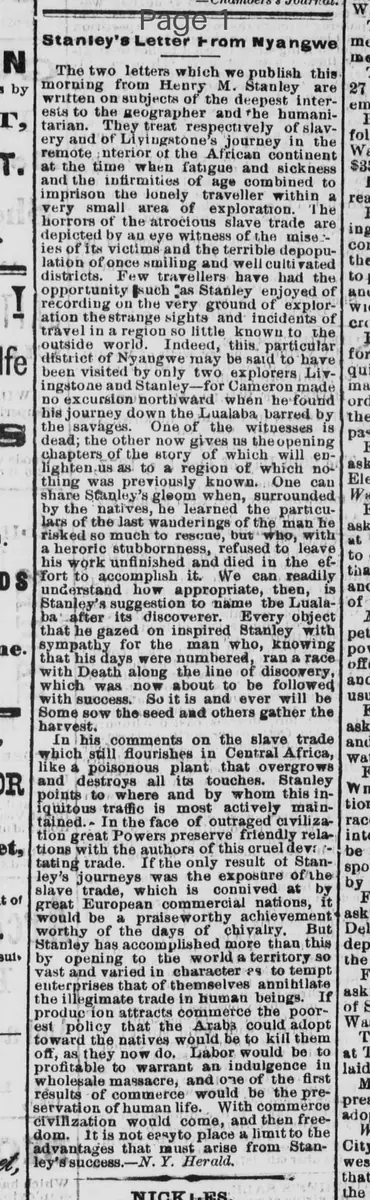
The two letters which we publish this morning from Henry M. Stanley are written on subjects of the deepest interest to the geographer and the humanitarian. They treat respectively of slavery and of Livingstone's journey in the remote interior of the African continent at the time when fatigue and sickness and the infirmities of age combined to imprison the lonely traveller within a very small area of exploration. The horrors of the atrocious slave trade are depicted by an eye witness of the miseries of its victims and the terrible depopulation of once smiling and well cultivated districts. Few travellers have had the opportunity such as Stanley enjoyed of recording on the very ground of exploration the strange sights and incidents of travel in a region so little known to the outside world. Indeed, this particular district of Nyangwe may be said to have been visited by only two explorers Livingstone and Stanley-for Cameron made no excursion northward when he found his journey down the Lualaba barred by the savages. One of the witnesses is dead; the other now gives us the opening chapters of the story which will enlighten us as to a region of which nothing was previously known. One can share Stanley's gloom when, surrounded by the natives, he learned the particulars of the last wanderings of the man he risked so much to rescue, but who, with a heroic stubbornness, refused to leave his work unfinished and died in the effort to accomplish it. We can readily understand how appropriate, then, is Stanley's suggestion to name the Lualaba after its discoverer. Every object that he gazed on inspired Stanley with sympathy for the man who, knowing that his days were numbered, ran a race with Death along the line of discovery, which was now about to be followed with success. So it is and ever will be Some sow the seed and others gather the harvest.
In his comments on the slave trade which still flourishes in Central Africa, like a poisonous plant that overgrows and destroys all it touches. Stanley points to where and by whom this iniquitous traffic is most actively maintained. In the face of outraged civilization great Powers preserve friendly relations with the authors of this cruel devastating trade. If the only result of Stanley's journeys was the exposure of the slave trade, which is connived at by great European commercial nations, it would be a praiseworthy achievement worthy of the days of chivalry. But Stanley has accomplished more than this by opening to the world a territory so vast and varied in character as to tempt enterprises that of themselves annihilate the illegitimate trade in human beings. If production attracts commerce the poorest policy that the Arabs could adopt toward the natives would be to kill them off, as they now do. Labor would be too profitable to warrant an indulgence in wholesale massacre, and one of the first results of commerce would be the preservation of human life. With commerce civilization would come, and then freedom. It is not easy to place a limit to the advantages that must arise from Stanley's success.-N. Y. Herald.
What sub-type of article is it?
What keywords are associated?
What entities or persons were involved?
Where did it happen?
Foreign News Details
Primary Location
Nyangwe
Key Persons
Outcome
horrors of slave trade including depopulation of districts; livingstone died in effort to accomplish his work; suggestion to name lualaba after livingstone; potential for commerce to preserve human life and bring freedom
Event Details
Letters from Henry M. Stanley from Nyangwe discuss slavery and Livingstone's journey in the African interior. Describes atrocities of slave trade witnessed firsthand, depopulation of areas, and details of Livingstone's final wanderings and death. Notes only Livingstone and Stanley explored Nyangwe, as Cameron was barred. Stanley suggests naming Lualaba after Livingstone. Comments on slave trade maintained by Arabs with relations to great powers, exposure of trade connived at by European nations, and how opening territory to commerce could annihilate slave trade.