Thank you for visiting SNEWPapers!
Sign up free
Editorial
October 1, 1838
Lynchburg Virginian
Lynchburg, Virginia
What is this article about?
Editorial from Charlottesville Jeffersonian Republican details Conservative opposition to Sub-Treasury and National Bank, advocating State Banks as depositories. Warns of executive overreach and unconstitutionality, citing Jefferson, Madison, and State Banks' post-1837 recovery.
Clipping
OCR Quality
88%
Good
Full Text
POLITICAL.
From the Charlottesville Jeffersonian Republican.
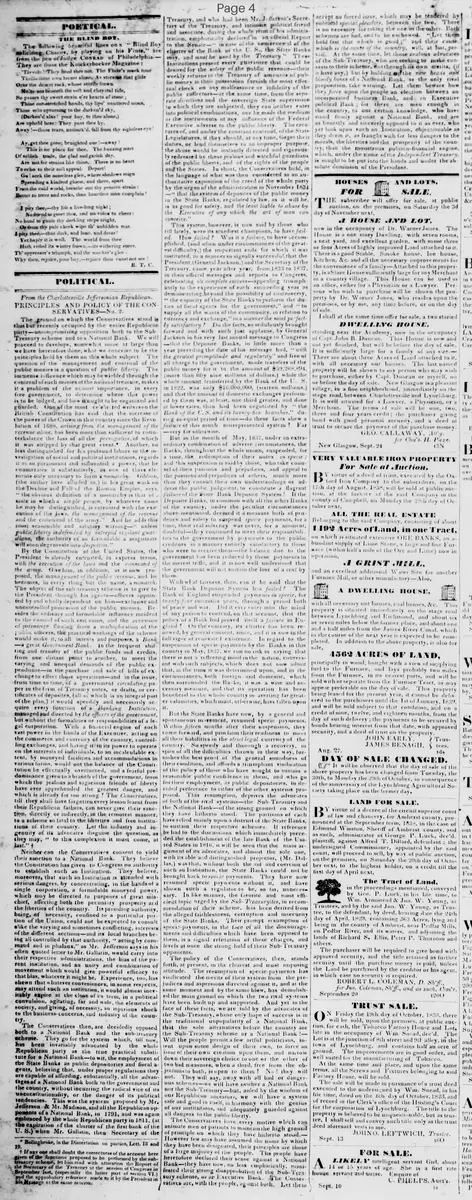
PRINCIPLES AND POLICY OF THE CONSERVATIVES--No. 2.
The ground on which the Conservatives stand is that but recently occupied by the entire Republican party--uncompromising opposition both to the Sub-Treasury scheme and to a National Bank. We will proceed to develop, somewhat more at large than we have heretofore done, what we conceive to be the principles held by them on this whole subject. The question of the management and control of the public monies is a question of public liberty. The immense influence which may be wielded through the control of such masses of the national treasure, makes it a problem of the utmost importance, in every free government, to determine where this power is to be lodged, and how it ought to be organized and guarded. One of the most celebrated writers on the British Constitution has said that the increase of the power of the Crown in that country since the Revolution of 1688, arising from the management of the revenue alone, has been more than sufficient to counterbalance the loss of all the prerogative, of which it was stripped by that great event. Another, no less distinguished for his profound labors in the investigation of social and political institutions, regards it as so paramount and influential a power, that he enumerates it substantively, as one of three elements only necessary to form a monarchy. Gibbon, (the author here alluded to,) in his great work on the Decline and Fall of the Roman Empire, says, "the obvious definition of a monarchy is that of a state in which a single person, by whatever name he may be distinguished, is entrusted with the execution of the laws, the management of the revenue and the command of the army." And he adds this most seasonable and salutary warning--"unless public liberty is defended by intrepid vigilant guardians, the authority of so formidable a magistrate will soon degenerate into despotism."
By the Constitution of the United States, the President is already entrusted, in express terms, with the execution of the laws and the command of the army. Give him, in addition, as is now proposed, the management of the public revenue, and he becomes, in every thing but the name, a monarch. The object of the sub-treasury scheme is to give to the President through his agents--officers appointed by and wholly dependent on him--exclusive and uncontrolled possession of the public monies. Besides the ordinary and formidable influence incident to the control of such vast sums, and the accession of patronage flowing from a multiplication of the public officers, the practical workings of the scheme would make it, to all intents and purposes, a Bank --a great Government Bank. to the frequent shutting and transfer of the public funds and credits, from one distant point to another, to meet the varying and unequal demands of the public expenditure--in the purchase and sale of bills of exchange to effect those operations--and in the issue, from time to time, of a government circulating paper in the form of Treasury notes, or drafts, or certificates of deposits. (all of which is an integral part of the plan.) it would speedily and necessarily acquire every function of a Banking Institution, managed and directed by the officers of the government. but without the formalities or responsibilities of a legal corporation. With a financial engine of such vast power in the hands of the Executive, acting on the commerce and currency of the country, controlling exchanges, and having it in its power to operate on the interests of individuals, to an incalculable extent, by moneyed facilities and accommodations in various forms, would not the balance of the Constitution be effectually overturned, and a fearful predominance given to a branch of the government, from which the jealous and sagacious friends of liberty have ever apprehended the greatest danger, and which is already far too strong? The Conservatives, till they shall have forgotten every lesson learnt from their Republican fathers, can never give their sanction, directly or indirectly, in the remotest manner, to a scheme so fatal to the liberties and free institutions of their country. Let the industry and ingenuity of its advocates disguise the question, as they may, "to this complexion it must come, at last."
Neither can the Conservatives consent to yield their sanction to a National Bank. They believe the Constitution has given to Congress no authority to establish such an Institution. They believe, moreover, that such an Institution is attended with serious dangers, by concentrating, in the hands of a single corporation, a formidable moneyed power, which may be directed to purposes of great mischief, affecting both the pecuniary prosperity and the liberties of the country. Its presiding authority, being, of necessity, confined to a particular portion of the Union, could not be expected to consult alike the varying and sometimes conflicting, interests of the different sections--and its local branches being all controlled by that authority, "acting by command and in phalanx," as Mr. Jefferson says in his often quoted letter to Mr. Gallatin, would carry into their respective administrations, the bias of the parent institution, and an unity and combination of movement which would give powerful efficacy to that bias, whatever it might be. Experience, too, has shewn that whatever conveniences, in some respects, may attend such an institution, it would almost inevitably expire at the close of its term, in a political convulsion, agitating, far and wide, the elements of society, and giving, of necessity, an injurious shock to the business-concerns, and industry of the country.
The Conservatives then, are decidedly opposed both to a National Bank and the sub-treasury scheme. They go for the system which, till now, has been invariably advocated by the whole Republican party as the true practical substitute for a National Bank--to wit, the employment of the State Banks as public depositories and fiscal agents, believing that, under proper regulations they are capable of affording, substantially, all the advantages of a National Bank both to the government and the country, without incurring the radical vice of its unconstitutionality, or the danger of its political tendencies. This was the system proposed by Mr. Jefferson & Mr. Madison, and all the Republican opponents of a National Bank, in 1791, and was again embraced by the whole Republican party in 1811, (at the expiration of the charter of the first bank of the U. S.) when Mr. Gallatin, then Secretary of the Treasury, and who had been Mr. Jefferson's Secretary of the Treasury, and intimate political friend and associate, during the whole term of his administration, emphatically declared in an official Report to the Senate--"in case of the non-renewal of the charter of the Bank of the U. S., the State Banks may, and must be used by the Treasury." These Institutions present every guarantee that could be desired for the safety of the public revenue--their weekly returns to the Treasury of amounts of public money in their possession furnish the most effectual check on any malfeasance or infidelity of the public collectors--at the same time, from the separate directions and the sovereign State supervision to which they are subjected, they cannot enter into political combinations, nor be made the medium or the instruments of any influence of the Federal Executive adverse to the public liberty. The creatures of, and under the constant control, of the State Legislatures, if they should, at any time, forget their duties, or lend themselves to an improper purpose. the abuse would be instantly detected and vigorously redressed by these jealous and watchful guardians of the public liberty, and of the rights of the people and the States. In short, the Conservatives hold, in the language of what was then considered as an authoritative exposition of the creed of the whole party by the organ of the administration in November 1834 --"that the system of deposites of the public money in the State Banks, regulated by law, as it will be. is as good for safety, and the least liable to abuse by the Executive of any which the art of man can conceive."
This system, however, is now said by those who till lately, were its sturdiest champions, to have failed. How failed? Was it a failure, to have accomplished, (and often under circumstances of the greatest difficulty.) the important ends for which it was instituted, in a manner so signally successful, that the President (General Jackson,) and the Secretary of the Treasury, came, year after year, from 1833 to 1837, in their official messages and reports to Congress, celebrating its complete success--appealing, triumphantly to the experience of each succeeding year as demonstrating, beyond the possibility of controversy. "the capacity of the State Banks to perform the duties of fiscal agents for the government." and "to supply all the wants of the community, in relation to currency and exchange," in a manner the most perfectly satisfactory? Do the facts, so sedulously brought forward and with such just applause, by General Jackson in his very last annual message to Congress --that the Deposite Banks, in little more than a year preceding the date of his message had, "with the greatest promptitude and regularity" and free of all charge to the government, made transfers of the public money for it to the amount of $59,265,894 (more than fifty nine millions of dollars.) while the whole amount transferred by the Bank of the U. S. in 1829, was only $16,000,000, (sixteen millions,) and that the amount of domestic exchanges performed by them was, at least, one third greater, and done at lower rates, than had been negotiated by "the Bank of the U.S. and its twenty-five branches." during an equal period of time--do these facts shew a failure of this much misrepresented system? Far --very far otherwise.
But in the month of May, 1837, under an extraordinary combination of adverse circumstances, the Banks, throughout the whole union, suspended, for a time, the redemption of their notes in specie; and this suspension is said by those, who take counsel of their passions and prejudices, and appeal to the passions and prejudices of others, much more than they consult their own understandings or address the public judgment, to constitute a flagrant failure of the State Bank Deposite System! If the Deposite Banks, in common with all the other Banks of the country, under the peculiar circumstances above-mentioned, deemed it a measure both of prudence and safety to suspend specie payments, for a time, their real solvency was never, for a moment, doubtful--they continued to meet their responsibilities to the government by payments to the public creditors in a manner entirely satisfactory to those who were to receive them--the balance due to the government has been reduced by these payments to the merest trifle, and it is now well understood that the government will not sustain the loss of a cent by them.
With what fairness, then, can it be said that the State Bank Deposite System has failed? The Bank of England suspended payments in specie, for twenty four successive years, through a period both of peace and war. Did it ever enter into the mind of any person to contend, on that account, that the policy of a Bank had proved itself a failure in England? On the contrary, its charter has been renewed, by general consent, since, and it is now in the full vigor of renovated existence. In regard to the suspension of specie-payments by the Banks in this country in May, 1837, we run no risk in saying that there is not a reflecting mind in the nation, conversant with such subjects, which does not now admit that, at the time it was determined upon, and in the circumstances, both foreign and domestic, which then surrounded the Banks, it was a wise and necessary measure, and that its operation has been beneficial to the whole country in averting far greater calamities, which must, otherwise, have fallen upon it.
But the State Banks have now, by a general and spontaneous movement, resumed specie payments. Within fifteen months after their suspension, they come forward, and proclaim their readiness to meet all their liabilities in the strict legal currency of the country. So speedy and thorough a recovery, in spite of all the difficulties thrown in their way, furnishes the best proof of the general soundness of their condition, and affords a triumphant vindication of the policy of those who have sought to sustain a reasonable public confidence in them, and who go for their employment, as public depositories, in decided preference to either of the other systems proposed." This resumption, deprives the advocates of both of the rival systems--the Sub-Treasury and the National Bank--of the strong ground on which they have hitherto stood. The partisans of each have relied mainly upon a distrust of the State Banks, to sustain their respective schemes. If reference be had to the discussions which immediately preceded the establishment of the late Bank of the United States in 1816, it will be seen that the main argument of its advocates, and almost the sole one, with its able and distinguished projector, (Mr. Dallas) was that, without both the aid and coercion of such an Institution, the State Banks could not be brought back to specie payments. They have now resumed specie payments without it, and have shown such a regulator to be, so far, unnecessary. In like manner, the favorite and most efficient topic urged by the Sub-Treasuryites, in recommendation of their scheme, has been derived from the alleged faithlessness, corruption and insecurity of the State Banks. Their prompt resumption of specie-payments, in the face of all the discouragements and difficulties which have been opposed to them, is a signal refutation of these charges, and levels at once the strong-hold of their Sub-Treasury opponents.
The policy of the Conservatives, then, stands forth, at present, in the clearest and most imposing attitude. The resumption of specie-payments has vindicated the merits of their system from the prejudices and aspersions directed against it, and at the same moment and by the same blow, has demolished the main ground on which the two rival systems have been built up and supported. And yet on the face of these facts, we are told by the advocates of the Sub-Treasury, whose only hope of success is in the traditional unpopularity of a National Bank, that the sole alternatives before the country are the Sub-Treasury scheme or a National Bank!-- Will the people permit a few artful politicians, intent upon some design of their own, to force an issue of their own creation upon them, and narrow down their sovereign choice to one or the other of two bad measures, when a third, free from the objection to both, is open to them? No! they will not. They will say, away with all bad or dangerous schemes--we will have neither a National Bank nor the Sub-Treasury--but, aided by the wisdom of our Republican ancestors, we will have a system safe and good in itself, in harmony with the genius of our institutions, and adequately guarded against all dangers to the public liberty.
The Conservatives have every motive which can animate men or patriots to maintain the high ground of principle on which they have hitherto stood.- However few may have assumed the name by which they have been designated, their principles are those of a large majority of the people. The people have heretofore declared their sense against a National Bank--they have now, no less emphatically, manifested their strong disapprobation of the Sub-Treasury scheme, or an Executive Bank. The Conservatives are, with the people, against both. Let them accept no forced issue, which may be tendered by political special pleaders, between the two. There is no necessity for taking the one or the other. Both schemes are bad, and to be eschewed. "Let them hold fast that which is good;" and their cause, which is the cause of the country, will, at last, prevail. At the same time, let those zealous advocates of the Sub-Treasury, who are seeking to make converts to their scheme, not through its own merits, (if it have any,) but by holding up the raw heads and bloody bones of a National Bank, as the only rival proposition, take warning. Let them beware how they force upon the people an election between an incorporated business Bank, and an Executive political Bank; for there are men enough in the country, to our certain knowledge, who have stood firmly against a National Bank, and are as honestly and sincerely opposed to it as ever, who yet look upon such an Institution, objectionable as they deem it, as fraught with far less dangers to the morals, the liberties and the prosperity of the country, than the monstrous politico-financial engine, which, under the name of the Independent Treasury, is sought to be put into the hands and under the absolute dominion of the President.
From the Charlottesville Jeffersonian Republican.
PRINCIPLES AND POLICY OF THE CONSERVATIVES--No. 2.
The ground on which the Conservatives stand is that but recently occupied by the entire Republican party--uncompromising opposition both to the Sub-Treasury scheme and to a National Bank. We will proceed to develop, somewhat more at large than we have heretofore done, what we conceive to be the principles held by them on this whole subject. The question of the management and control of the public monies is a question of public liberty. The immense influence which may be wielded through the control of such masses of the national treasure, makes it a problem of the utmost importance, in every free government, to determine where this power is to be lodged, and how it ought to be organized and guarded. One of the most celebrated writers on the British Constitution has said that the increase of the power of the Crown in that country since the Revolution of 1688, arising from the management of the revenue alone, has been more than sufficient to counterbalance the loss of all the prerogative, of which it was stripped by that great event. Another, no less distinguished for his profound labors in the investigation of social and political institutions, regards it as so paramount and influential a power, that he enumerates it substantively, as one of three elements only necessary to form a monarchy. Gibbon, (the author here alluded to,) in his great work on the Decline and Fall of the Roman Empire, says, "the obvious definition of a monarchy is that of a state in which a single person, by whatever name he may be distinguished, is entrusted with the execution of the laws, the management of the revenue and the command of the army." And he adds this most seasonable and salutary warning--"unless public liberty is defended by intrepid vigilant guardians, the authority of so formidable a magistrate will soon degenerate into despotism."
By the Constitution of the United States, the President is already entrusted, in express terms, with the execution of the laws and the command of the army. Give him, in addition, as is now proposed, the management of the public revenue, and he becomes, in every thing but the name, a monarch. The object of the sub-treasury scheme is to give to the President through his agents--officers appointed by and wholly dependent on him--exclusive and uncontrolled possession of the public monies. Besides the ordinary and formidable influence incident to the control of such vast sums, and the accession of patronage flowing from a multiplication of the public officers, the practical workings of the scheme would make it, to all intents and purposes, a Bank --a great Government Bank. to the frequent shutting and transfer of the public funds and credits, from one distant point to another, to meet the varying and unequal demands of the public expenditure--in the purchase and sale of bills of exchange to effect those operations--and in the issue, from time to time, of a government circulating paper in the form of Treasury notes, or drafts, or certificates of deposits. (all of which is an integral part of the plan.) it would speedily and necessarily acquire every function of a Banking Institution, managed and directed by the officers of the government. but without the formalities or responsibilities of a legal corporation. With a financial engine of such vast power in the hands of the Executive, acting on the commerce and currency of the country, controlling exchanges, and having it in its power to operate on the interests of individuals, to an incalculable extent, by moneyed facilities and accommodations in various forms, would not the balance of the Constitution be effectually overturned, and a fearful predominance given to a branch of the government, from which the jealous and sagacious friends of liberty have ever apprehended the greatest danger, and which is already far too strong? The Conservatives, till they shall have forgotten every lesson learnt from their Republican fathers, can never give their sanction, directly or indirectly, in the remotest manner, to a scheme so fatal to the liberties and free institutions of their country. Let the industry and ingenuity of its advocates disguise the question, as they may, "to this complexion it must come, at last."
Neither can the Conservatives consent to yield their sanction to a National Bank. They believe the Constitution has given to Congress no authority to establish such an Institution. They believe, moreover, that such an Institution is attended with serious dangers, by concentrating, in the hands of a single corporation, a formidable moneyed power, which may be directed to purposes of great mischief, affecting both the pecuniary prosperity and the liberties of the country. Its presiding authority, being, of necessity, confined to a particular portion of the Union, could not be expected to consult alike the varying and sometimes conflicting, interests of the different sections--and its local branches being all controlled by that authority, "acting by command and in phalanx," as Mr. Jefferson says in his often quoted letter to Mr. Gallatin, would carry into their respective administrations, the bias of the parent institution, and an unity and combination of movement which would give powerful efficacy to that bias, whatever it might be. Experience, too, has shewn that whatever conveniences, in some respects, may attend such an institution, it would almost inevitably expire at the close of its term, in a political convulsion, agitating, far and wide, the elements of society, and giving, of necessity, an injurious shock to the business-concerns, and industry of the country.
The Conservatives then, are decidedly opposed both to a National Bank and the sub-treasury scheme. They go for the system which, till now, has been invariably advocated by the whole Republican party as the true practical substitute for a National Bank--to wit, the employment of the State Banks as public depositories and fiscal agents, believing that, under proper regulations they are capable of affording, substantially, all the advantages of a National Bank both to the government and the country, without incurring the radical vice of its unconstitutionality, or the danger of its political tendencies. This was the system proposed by Mr. Jefferson & Mr. Madison, and all the Republican opponents of a National Bank, in 1791, and was again embraced by the whole Republican party in 1811, (at the expiration of the charter of the first bank of the U. S.) when Mr. Gallatin, then Secretary of the Treasury, and who had been Mr. Jefferson's Secretary of the Treasury, and intimate political friend and associate, during the whole term of his administration, emphatically declared in an official Report to the Senate--"in case of the non-renewal of the charter of the Bank of the U. S., the State Banks may, and must be used by the Treasury." These Institutions present every guarantee that could be desired for the safety of the public revenue--their weekly returns to the Treasury of amounts of public money in their possession furnish the most effectual check on any malfeasance or infidelity of the public collectors--at the same time, from the separate directions and the sovereign State supervision to which they are subjected, they cannot enter into political combinations, nor be made the medium or the instruments of any influence of the Federal Executive adverse to the public liberty. The creatures of, and under the constant control, of the State Legislatures, if they should, at any time, forget their duties, or lend themselves to an improper purpose. the abuse would be instantly detected and vigorously redressed by these jealous and watchful guardians of the public liberty, and of the rights of the people and the States. In short, the Conservatives hold, in the language of what was then considered as an authoritative exposition of the creed of the whole party by the organ of the administration in November 1834 --"that the system of deposites of the public money in the State Banks, regulated by law, as it will be. is as good for safety, and the least liable to abuse by the Executive of any which the art of man can conceive."
This system, however, is now said by those who till lately, were its sturdiest champions, to have failed. How failed? Was it a failure, to have accomplished, (and often under circumstances of the greatest difficulty.) the important ends for which it was instituted, in a manner so signally successful, that the President (General Jackson,) and the Secretary of the Treasury, came, year after year, from 1833 to 1837, in their official messages and reports to Congress, celebrating its complete success--appealing, triumphantly to the experience of each succeeding year as demonstrating, beyond the possibility of controversy. "the capacity of the State Banks to perform the duties of fiscal agents for the government." and "to supply all the wants of the community, in relation to currency and exchange," in a manner the most perfectly satisfactory? Do the facts, so sedulously brought forward and with such just applause, by General Jackson in his very last annual message to Congress --that the Deposite Banks, in little more than a year preceding the date of his message had, "with the greatest promptitude and regularity" and free of all charge to the government, made transfers of the public money for it to the amount of $59,265,894 (more than fifty nine millions of dollars.) while the whole amount transferred by the Bank of the U. S. in 1829, was only $16,000,000, (sixteen millions,) and that the amount of domestic exchanges performed by them was, at least, one third greater, and done at lower rates, than had been negotiated by "the Bank of the U.S. and its twenty-five branches." during an equal period of time--do these facts shew a failure of this much misrepresented system? Far --very far otherwise.
But in the month of May, 1837, under an extraordinary combination of adverse circumstances, the Banks, throughout the whole union, suspended, for a time, the redemption of their notes in specie; and this suspension is said by those, who take counsel of their passions and prejudices, and appeal to the passions and prejudices of others, much more than they consult their own understandings or address the public judgment, to constitute a flagrant failure of the State Bank Deposite System! If the Deposite Banks, in common with all the other Banks of the country, under the peculiar circumstances above-mentioned, deemed it a measure both of prudence and safety to suspend specie payments, for a time, their real solvency was never, for a moment, doubtful--they continued to meet their responsibilities to the government by payments to the public creditors in a manner entirely satisfactory to those who were to receive them--the balance due to the government has been reduced by these payments to the merest trifle, and it is now well understood that the government will not sustain the loss of a cent by them.
With what fairness, then, can it be said that the State Bank Deposite System has failed? The Bank of England suspended payments in specie, for twenty four successive years, through a period both of peace and war. Did it ever enter into the mind of any person to contend, on that account, that the policy of a Bank had proved itself a failure in England? On the contrary, its charter has been renewed, by general consent, since, and it is now in the full vigor of renovated existence. In regard to the suspension of specie-payments by the Banks in this country in May, 1837, we run no risk in saying that there is not a reflecting mind in the nation, conversant with such subjects, which does not now admit that, at the time it was determined upon, and in the circumstances, both foreign and domestic, which then surrounded the Banks, it was a wise and necessary measure, and that its operation has been beneficial to the whole country in averting far greater calamities, which must, otherwise, have fallen upon it.
But the State Banks have now, by a general and spontaneous movement, resumed specie payments. Within fifteen months after their suspension, they come forward, and proclaim their readiness to meet all their liabilities in the strict legal currency of the country. So speedy and thorough a recovery, in spite of all the difficulties thrown in their way, furnishes the best proof of the general soundness of their condition, and affords a triumphant vindication of the policy of those who have sought to sustain a reasonable public confidence in them, and who go for their employment, as public depositories, in decided preference to either of the other systems proposed." This resumption, deprives the advocates of both of the rival systems--the Sub-Treasury and the National Bank--of the strong ground on which they have hitherto stood. The partisans of each have relied mainly upon a distrust of the State Banks, to sustain their respective schemes. If reference be had to the discussions which immediately preceded the establishment of the late Bank of the United States in 1816, it will be seen that the main argument of its advocates, and almost the sole one, with its able and distinguished projector, (Mr. Dallas) was that, without both the aid and coercion of such an Institution, the State Banks could not be brought back to specie payments. They have now resumed specie payments without it, and have shown such a regulator to be, so far, unnecessary. In like manner, the favorite and most efficient topic urged by the Sub-Treasuryites, in recommendation of their scheme, has been derived from the alleged faithlessness, corruption and insecurity of the State Banks. Their prompt resumption of specie-payments, in the face of all the discouragements and difficulties which have been opposed to them, is a signal refutation of these charges, and levels at once the strong-hold of their Sub-Treasury opponents.
The policy of the Conservatives, then, stands forth, at present, in the clearest and most imposing attitude. The resumption of specie-payments has vindicated the merits of their system from the prejudices and aspersions directed against it, and at the same moment and by the same blow, has demolished the main ground on which the two rival systems have been built up and supported. And yet on the face of these facts, we are told by the advocates of the Sub-Treasury, whose only hope of success is in the traditional unpopularity of a National Bank, that the sole alternatives before the country are the Sub-Treasury scheme or a National Bank!-- Will the people permit a few artful politicians, intent upon some design of their own, to force an issue of their own creation upon them, and narrow down their sovereign choice to one or the other of two bad measures, when a third, free from the objection to both, is open to them? No! they will not. They will say, away with all bad or dangerous schemes--we will have neither a National Bank nor the Sub-Treasury--but, aided by the wisdom of our Republican ancestors, we will have a system safe and good in itself, in harmony with the genius of our institutions, and adequately guarded against all dangers to the public liberty.
The Conservatives have every motive which can animate men or patriots to maintain the high ground of principle on which they have hitherto stood.- However few may have assumed the name by which they have been designated, their principles are those of a large majority of the people. The people have heretofore declared their sense against a National Bank--they have now, no less emphatically, manifested their strong disapprobation of the Sub-Treasury scheme, or an Executive Bank. The Conservatives are, with the people, against both. Let them accept no forced issue, which may be tendered by political special pleaders, between the two. There is no necessity for taking the one or the other. Both schemes are bad, and to be eschewed. "Let them hold fast that which is good;" and their cause, which is the cause of the country, will, at last, prevail. At the same time, let those zealous advocates of the Sub-Treasury, who are seeking to make converts to their scheme, not through its own merits, (if it have any,) but by holding up the raw heads and bloody bones of a National Bank, as the only rival proposition, take warning. Let them beware how they force upon the people an election between an incorporated business Bank, and an Executive political Bank; for there are men enough in the country, to our certain knowledge, who have stood firmly against a National Bank, and are as honestly and sincerely opposed to it as ever, who yet look upon such an Institution, objectionable as they deem it, as fraught with far less dangers to the morals, the liberties and the prosperity of the country, than the monstrous politico-financial engine, which, under the name of the Independent Treasury, is sought to be put into the hands and under the absolute dominion of the President.
What sub-type of article is it?
Economic Policy
Constitutional
Partisan Politics
What keywords are associated?
Sub Treasury Scheme
National Bank
State Banks
Public Monies
Executive Power
Specie Payments
Republican Principles
Fiscal Policy
What entities or persons were involved?
Conservatives
Republican Party
President
Thomas Jefferson
James Madison
Albert Gallatin
Bank Of The United States
State Banks
Editorial Details
Primary Topic
Principles And Policy Of The Conservatives On Banking And Treasury
Stance / Tone
Opposition To Sub Treasury And National Bank, Support For State Banks
Key Figures
Conservatives
Republican Party
President
Thomas Jefferson
James Madison
Albert Gallatin
Bank Of The United States
State Banks
Key Arguments
Opposition To Sub Treasury As Granting Monarch Like Power To President Through Control Of Public Monies
Sub Treasury Would Function As A Government Bank Without Corporate Responsibilities
National Bank Unconstitutional And Concentrates Dangerous Moneyed Power
State Banks As Safe, Constitutional Alternative Advocated By Republicans Since 1791
State Banks Provide Checks Via State Supervision, Preventing Executive Influence
Recent Resumption Of Specie Payments By State Banks Vindicates Their Reliability
Historical Success Under Jackson Administration Demonstrates State Banks' Efficacy
Rejection Of Forced Choice Between Sub Treasury And National Bank In Favor Of Proven System