Thank you for visiting SNEWPapers!
Sign up free
The National Republican And Ohio Political Register
Cincinnati, Hamilton County, Ohio
What is this article about?
Letters from John Hawes to Mr. Baylies detail the booming Pacific whale fishery from New Bedford and Nantucket, estimating annual value at $1.5 million and advocating for a U.S. settlement at Columbia River to boost commerce, fisheries, and spars trade to Peru and Chile.
Merged-components note: Continuation of the article on the importance of occupying the Columbia River and the whale fishery, with the second component providing additional estimates on the same topic.
Clipping
OCR Quality
Full Text
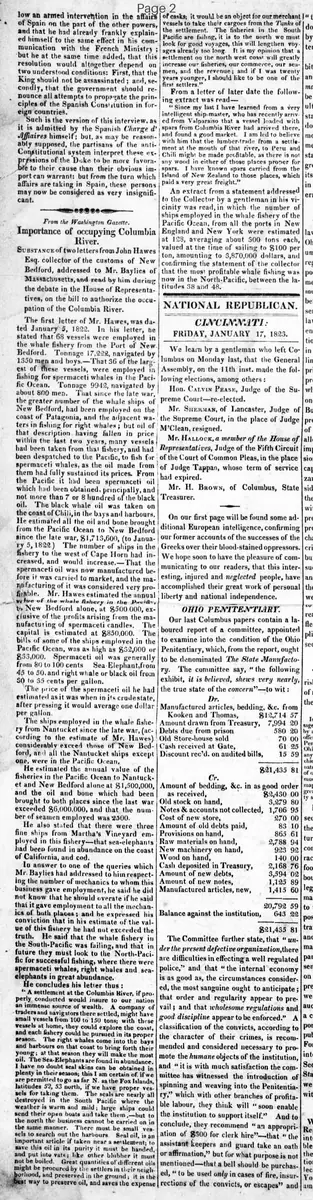
Importance of occupying Columbia River.
Substance of two letters from John Hawes, Esq. collector of the customs of New Bedford, addressed to Mr. Baylies of Massachusetts, and read by him during the debate in the House of Representatives, on the bill to authorize the occupation of the Columbia River.
The first letter of Mr. Hawes, was dated January 5, 1822. In his letter, he stated that 68 vessels were employed in the whale fishery from the Port of New Bedford. Tonnage 17,220, navigated by 1350 men and boys. That 36 of the largest of these vessels, were employed in fishing for spermaceti whales in the Pacific Ocean. Tonnage 9942, navigated by about 800 men. That since the late war, the greater number of the whale ships of New Bedford, had been employed on the coast of Patagonia, and the adjacent waters in fishing for right whales; but oil of that description having fallen in price within the last two years, many vessels had been taken from that fishery, and had been despatched to the Pacific, to fish for spermaceti whales, as the oil made from them had fully sustained its prices. From the Pacific it had been spermaceti oil which had been obtained, principally, and not more than 7 or 8 hundred of the black oil. The black whale oil was taken on the coast of Chili, in the bays and harbours.
He estimated all the oil and bone brought from the Pacific Ocean to New Bedford since the late war, $1,713,600, (to January 5, 1822.) The number of ships in the fishery to the west of Cape Horn had increased, and would increase. That the spermaceti oil was now manufactured before it was carried to market, and the manufacturing of it was considered very profitable. Mr. Hawes estimated the annual value of the whale fishery in the Pacific, to New Bedford alone, at $500,000, exclusive of the profits arising from the manufacturing of spermaceti candles. The capital is estimated at $850,000. The bills of some of the ships employed in the Pacific Ocean, was as high as $52,000 or $53,000. Spermaceti oil was generally from 80 to 100 cents. Sea Elephant, from 45 to 50, and right whale or black oil from 30 to 35 cents per gallon.
The price of the spermaceti oil he had estimated as it was when in its crude state, after pressing it would average one dollar per gallon.
The ships employed in the whale fishery from Nantucket since the late war, (according to the estimate of Mr. Hawes) considerably exceed those of New Bedford, and all the Nantucket ships except one, were in the Pacific Ocean.
He estimated the annual value of the fisheries in the Pacific Ocean to Nantucket and New Bedford alone at $1,500,000, and the oil and bone which had been brought to both places since the last war exceeded $6,000,000, and that the number of seamen employed was 2500.
He also stated that there were three fine ships from Martha's Vineyard employed in this fishery—that sea-elephants had been found in abundance on the coast of California, and cod.
In answer to one of the queries which Mr. Baylies had addressed to him respecting the number of mechanics to whom this business gave employment, he said he did not know that he should overrate if he said that it gave employment to all the mechanics of both places; and he expressed his conviction that in his estimate of the value of this fishery he had not exceeded the truth. He said that the whale fishery in the South-Pacific was failing, and that in future they must look to the North-Pacific for successful fishing, where there were spermaceti whales, right whales and sea-elephants in great abundance.
He concludes his letter thus:
"A settlement at the Columbia River, if properly conducted would insure to our nation an immense source of wealth. A company of traders and navigators there settled, might have small vessels from 100 to 150 tons; with these vessels at home, they could explore the coast, and each fishery could be pursued in its proper season. The right whales come into the bays and harbours on that coast to bring forth their young; at that season they will make the most oil. The Sea-Elephants are found in abundance. I have no doubt seal skins can be obtained in plenty in their season; this I am certain of. If we are permitted to go as far N. as the Fox Islands, latitudes 52, 53 north, if we have proper vessels for taking them. The seals are nearly all destroyed in the South Pacific where the weather is warm and mild; large ships could send their open boats and take them,—but to the north the business cannot be carried on in the same manner. There must be small vessels to search out the harbours. Seal oil, is an important article if taken near a settlement; to save this oil in its purity it must be handed, and put into vats; like other blubber it must not be boiled. Great quantities of different oils might be procured by the settlers in their neighborhood, and preserved in the ground; it is the best way to preserve oil, and saves the expense of casks; it would be an object for our merchant vessels to take their cargoes from the Tanks of the settlement. The fisheries in the South Pacific are failing, it is to the north we must look for good voyages, this will lengthen voyages already too long. It is my opinion that a settlement on the north west coast will greatly increase our fisheries, our commerce, our seamen, and the revenue; and if I was twenty years younger, I should like to be one of the first settlers."
From a letter of later date the following extract was read:
"Since my last I have learned from a very intelligent ship-master, who has recently arrived from Valparaiso that a vessel loaded with spars from Columbia River had arrived there, and found a good market. I am led to believe with him that the lumber-trade from a settlement at the mouth of that river, to Peru and Chili might be made profitable, as there is not any wood in either of those places proper for spars. I have known spars carried from the Island of New Zealand to those places, which paid a very great freight."
An extract from a statement addressed to the Collector by a gentleman in his vicinity was read, in which the number of ships employed in the whale fishery of the Pacific Ocean, from all the ports in New England and New York were estimated at 128, averaging about 300 tons each, valued at the time of sailing to $100 per ton, amounting to 3,870,000 dollars, and confirming the statement of the collector that the most profitable whale fishing was now in the North-Pacific, between the latitudes 38 and 48.
What sub-type of article is it?
What themes does it cover?
What keywords are associated?
What entities or persons were involved?
Where did it happen?
Story Details
Key Persons
Location
Columbia River, Pacific Ocean, New Bedford, Nantucket
Event Date
January 5, 1822
Story Details
John Hawes details the economic significance of the Pacific whale fishery to New England ports, estimating high values and employment, and advocates for a settlement at Columbia River to facilitate whaling, sealing, and lumber trade to South America, enhancing U.S. commerce and revenue.