Thank you for visiting SNEWPapers!
Sign up free
Story
July 10, 1869
The Elko Independent
Elko, Elko County, Nevada
What is this article about?
Anecdotes detailing the alcohol and opium addictions of literary geniuses like Coleridge, De Quincey, Burns, Lamb, Poe, Jerrold, Byron, Steele, and historical figures Alexander the Great and Empress Elizabeth, illustrating their downfalls and excesses.
Clipping
OCR Quality
98%
Excellent
Full Text
Vices of Genius.
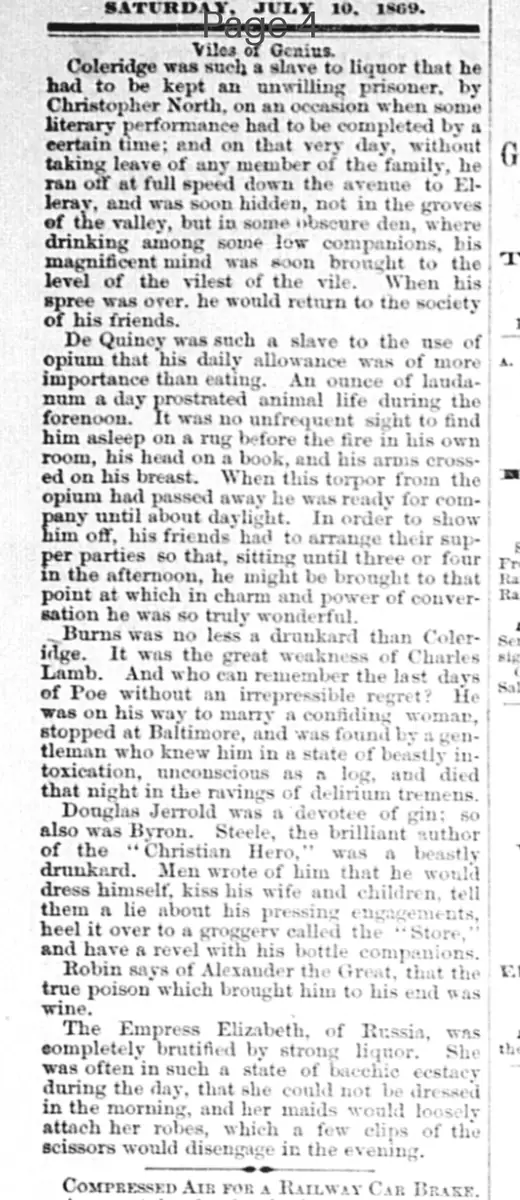
Coleridge was such a slave to liquor that he had to be kept an unwilling prisoner by Christopher North, on an occasion when some literary performance had to be completed by a certain time: and on that very day, without taking leave of any member of the family, he ran off at full speed down the avenue to Elleray, and was soon hidden, not in the groves of the valley, but in some obscure den, where drinking among some low companions, his magnificent mind was soon brought to the level of the vilest of the vile. When his spree was over, he would return to the society of his friends.
De Quincey was such a slave to the use of opium that his daily allowance was of more importance than eating. An ounce of laudanum a day prostrated animal life during the forenoon. It was no unfrequent sight to find him asleep on a rug before the fire in his own room, his head on a book, and his arms crossed on his breast. When this torpor from the opium had passed away he was ready for company until about daylight. In order to show him off, his friends had to arrange their supper parties so that, sitting until three or four in the afternoon, he might be brought to that point at which in charm and power of conversation he was so truly wonderful.
Burns was no less a drunkard than Coleridge. It was the great weakness of Charles Lamb. And who can remember the last days of Poe without an irrepressible regret? He was on his way to marry a confiding woman, stopped at Baltimore, and was found by a gentleman who knew him in a state of beastly intoxication, unconscious as a log, and died that night in the ravings of delirium tremens.
Douglas Jerrold was a devotee of gin: so also was Byron. Steele, the brilliant author of the "Christian Hero," was a beastly drunkard. Men wrote of him that he would dress himself, kiss his wife and children, tell them a lie about his pressing engagements, heel it over to a groggery called the "Store," and have a revel with his bottle companions.
Robin says of Alexander the Great, that the true poison which brought him to his end was wine.
The Empress Elizabeth, of Russia, was completely brutified by strong liquor. She was often in such a state of bacchic ecstasy during the day, that she could not be dressed in the morning, and her maids would loosely attach her robes, which a few clips of the scissors would disengage in the evening.
Coleridge was such a slave to liquor that he had to be kept an unwilling prisoner by Christopher North, on an occasion when some literary performance had to be completed by a certain time: and on that very day, without taking leave of any member of the family, he ran off at full speed down the avenue to Elleray, and was soon hidden, not in the groves of the valley, but in some obscure den, where drinking among some low companions, his magnificent mind was soon brought to the level of the vilest of the vile. When his spree was over, he would return to the society of his friends.
De Quincey was such a slave to the use of opium that his daily allowance was of more importance than eating. An ounce of laudanum a day prostrated animal life during the forenoon. It was no unfrequent sight to find him asleep on a rug before the fire in his own room, his head on a book, and his arms crossed on his breast. When this torpor from the opium had passed away he was ready for company until about daylight. In order to show him off, his friends had to arrange their supper parties so that, sitting until three or four in the afternoon, he might be brought to that point at which in charm and power of conversation he was so truly wonderful.
Burns was no less a drunkard than Coleridge. It was the great weakness of Charles Lamb. And who can remember the last days of Poe without an irrepressible regret? He was on his way to marry a confiding woman, stopped at Baltimore, and was found by a gentleman who knew him in a state of beastly intoxication, unconscious as a log, and died that night in the ravings of delirium tremens.
Douglas Jerrold was a devotee of gin: so also was Byron. Steele, the brilliant author of the "Christian Hero," was a beastly drunkard. Men wrote of him that he would dress himself, kiss his wife and children, tell them a lie about his pressing engagements, heel it over to a groggery called the "Store," and have a revel with his bottle companions.
Robin says of Alexander the Great, that the true poison which brought him to his end was wine.
The Empress Elizabeth, of Russia, was completely brutified by strong liquor. She was often in such a state of bacchic ecstasy during the day, that she could not be dressed in the morning, and her maids would loosely attach her robes, which a few clips of the scissors would disengage in the evening.
What sub-type of article is it?
Biography
Curiosity
What themes does it cover?
Misfortune
Madness
Moral Virtue
What keywords are associated?
Alcohol Addiction
Opium Addiction
Genius Vices
Literary Drunkards
Historical Excesses
Delirium Tremens
Personal Downfall
What entities or persons were involved?
Coleridge
Christopher North
De Quincey
Burns
Charles Lamb
Poe
Douglas Jerrold
Byron
Steele
Alexander The Great
Empress Elizabeth
Story Details
Key Persons
Coleridge
Christopher North
De Quincey
Burns
Charles Lamb
Poe
Douglas Jerrold
Byron
Steele
Alexander The Great
Empress Elizabeth
Story Details
Collection of biographical vignettes on the addictions to alcohol and opium among literary and historical geniuses, depicting their enslavement, daily routines, deceptions, and tragic ends.