Thank you for visiting SNEWPapers!
Sign up free
Seattle Daily Post Intelligencer
Seattle, King County, Washington
What is this article about?
In Washington Territory's District Court, Judge Greene addresses objections to the session's legality based on a Supreme Court ruling on a flawed 1885-6 act title. After bar arguments, the court upholds the act's validity and continues business. (187 chars)
Clipping
OCR Quality
Full Text
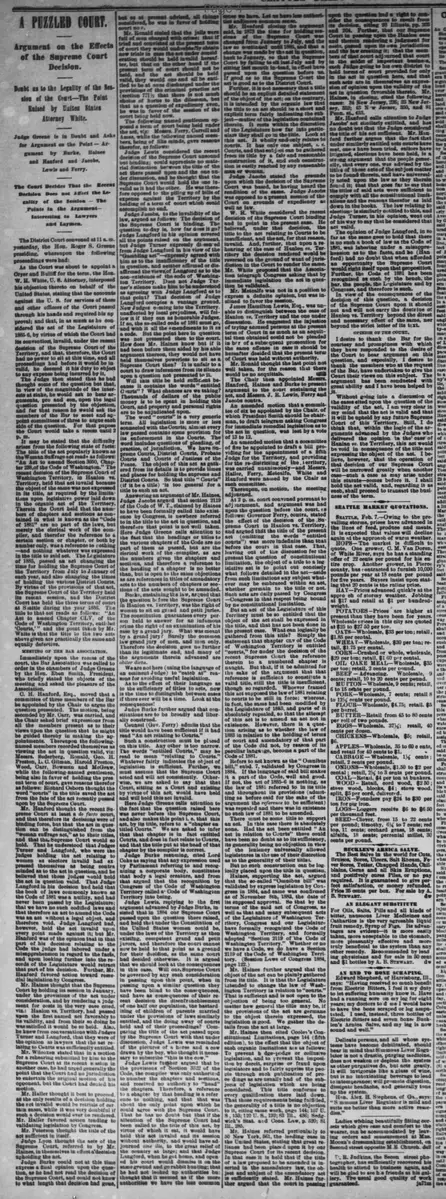
Argument on the Effects of the Supreme Court Decision.
Doubt as to the Legality of the Session of the Court—The Point Raised by United States Attorney White.
Judge Greene is in Doubt and Asks for Argument on the Point—Argument by Burke, Haines and Hanford and Jacobs. Lewis and Ferry.
The Court Decides That the Recent Decision Does Not Affect the Legality of the Session—The Points in the Argument—Interesting to Lawyers and Laymen.
The District Court convened at 11 a.m. yesterday, the Hon. Roger S. Greene presiding, whereupon the following proceedings were had:
As the Court was about to appoint a Crier and Bailiff for the term, the Hon. W. H. White, U. S. Attorney, interposed his objection thereto on behalf of the United States, stating that the accounts against the U. S. for services of these and other officers of the Court passed through his hands and required his approval; and that, in as much as he considered the act of the Legislature of 1885-6, by virtue of which the Court had its convocation, invalid, under the recent decision of the Supreme Court of the Territory, and that, therefore, the Court had no power to sit at this time, and all proceedings had before it would be invalid, he deemed it his duty to object to any expense being incurred by it.
The Judge then stated that he had thought some of the question but that, in view of the magnitude of the interests at stake, he would ask to hear arguments, pro and con, upon the legal question presented by the objection, and for that reason he would ask the members of the Bar to meet and appoint committees of three to argue each side of the question. For that purpose the Court would take a recess until 2 p.m.
He stated that the difficulty arises from the following state of facts:
In 1881, the act under consideration was passed as follows:
As to amended Section 660, Chapter 155, Code of Washington Territory.
The recent decision of the Supreme Court of Washington Territory, in Hanlon vs. Territory, held that material alterations had been made by the compiler, and that the original act as passed did not contain the words "Supreme Court."
The doctrine upon legislative power laid down in the organic act of the Territory, in the case of the Court has this way:
An act amending Section 660, Chapter 155—made in it "the code"—of the laws of the Territory, but merely the clerical work of the compiler, and therefore the reference to a certain Section 660, Chapter 155, or not by number, was not necessary.
Of 1881, passed a act gradually lessening the salaries of the judges of the Supreme Court of the Territory from July 1st, and also changing the times of holding the various United States courts by fixing the times of the District courts.
By this act the Territory held three terms of court daily during the year 1884. The title to that act reads as follows: "An act to amend Chapter 155, of the Code of Washington Territory, entitled 'Courts,' and the District Court be 'District.'"
We think the title to the two acts above considered equally defective.
In or by which the time for holding sessions of the court was changed from January to July, and the law so continued until 1883, and that a change was made by the act in question back to January, so that the Supreme Court by failing to sit last July and by sitting last month instead, in effect have passed upon the question before us.
If good as to the Supreme Court the act is good as to the District Court.
Further, it is not necessary that a title should be an explicit detailed statement of the object of the act; on the contrary, it is intended by the organic law that the title to an act should be a short and explicit term fairly indicating the subject-matter of the legislation contained therein. It rests within the discretion of the Legislature how far into particulars they shall go in the title. Look at this act. It wholly and solely relates to courts. It has only one subject, to wit: Courts, and that subject can be gathered from its title by a fair and reasonable construction of it, and such construction is easily reached by any reasonable man or woman.
Judge Jacobs stated the grounds upon which the decision of the Supreme Court was based, he having heard the rendition of the same.
Judge Jacobs was opposed to a present session of the Court on grounds of expediency as well as law.
W. H. White considered the recent decision of the Supreme Court binding and in point in the present case. He believed, under that decision, the title to the act relating to Courts to be insufficient, and the act, for that reason, invalid. And, further, that upon a rehearing of the case of Hanlon vs. Territory the decision rendered would be reversed on the ground of want of jurisdiction in the Court to render the same.
Mr. White proposed that the Association telegraph Congress asking that by immediate legislation the act in question be validated.
Mr. Metcalfe was not in a position to express a definite opinion, but was inclined to favor the session.
James Hamilton Lewis, Esq., was unable to distinguish between the case of Hanlon vs. Territory and the one under discussion. He suggested the injustice of trying accused persons at the present term of Court in as much as an acquittal then obtained could not be pleaded in bar of a subsequent prosecution for the same offense in case it should be hereafter decided that the present term of Court was held without authority.
Mr. Ronald thought the last point not well taken, for the reason that there would be no acquittals.
The Chair then appointed Messrs. Hanford, Haines and Burke to present argument to the court sustaining the act, and Messrs. J. R. Lewis, Ferry and Jacobs contra.
An amended motion that a committee of six be appointed by the Chair, of which President Smith should be chairman, to draft telegram asking Congress for immediate remedial legislation as to the act in question, was lost by a vote of 13 to 12.
An amended motion that a committee of five be appointed to draft a bill providing for the appointment of a fifth Judge for the Territory, and providing for the re-districting of the territory, was carried unanimously—and Messrs. Haller, Ferry, Metcalfe, White and Hanford were named by the Chair as such committee.
Thereupon, on motion, adjourned.
At 2 p.m. court convened pursuant to adjournment, and argument was had upon the question before the court, as follows:
Governor Ferry, contra, stated the effect of the decision of the Supreme Court in Hanlon vs. Territory, and argued that the title of the present act (omitting the words "entitled courts") was more indefinite than that before the court in that case. That, leaving out of the discussion for the present the question of constitutional limitation, the object of a title to a legislative act is to point out concisely what follows detailed in the act—aside from such limitations any subject whatever may be embraced within an act, whether germane to the title or not. Such acts are daily passed by Congress—Congress in that respect being bound by no constitutional limitation.
But an act of the Legislature of this Territory must be so entitled that the object of the act shall be expressed in the title, and that has not been done in the present case. What can logically be gathered from this title? Simply the statement that chapter CLV of the Code of Washington Territory is entitled "courts," for under the decision of the recent Supreme Court the reference therein to a numbered chapter is naught. But that, if it be admitted for the sake of the argument that that reference is sufficient to constitute a valid title, still the title is insufficient, though so regarded. Whoever framed this act supposed the law of 1881 relating to courts to be still in force; whereas, in fact, the same had been modified by the Legislature of 1883, and parts of it absolutely repealed, so that the attempt of this act is to amend an act not in existence. However, there is a question arising as to whether the law of 1883 in relation to the holding of terms of court and amendatory of that part of the Code did not, by reason of its peculiar language, become a part of the Code of 1881.
Refer to act known as the "Omnibus bill," chap. 7, validated by Congress in 1884. If the language of said bill makes it a part of the Code, well and good. If not, the act of 1885-6 is nothing, as the law of 1881 referred to in its title and throughout its provisions (admitting as before said for the sake of the argument the reference to be sufficient) was repealed and there was in existence no such law of 1881 to be amended.
There must be some title to support an act. In this case there is absolutely none.
Had the act been entitled "An act in relation to Courts" there could have been no doubt as to its sufficiency, its generality being no objection in view of the leniency universally allowed legislatures in the use of their discretion as to the generality of their titles.
But no such construction can be logically placed upon the title in question.
Haines, supporting the act, argued that the so-called "Omnibus bill" was validated by express legislation by Congress in 1884, and same was confirmed as of November 5th, 1883, the date of its supposed approval. So that by the terms of the said act of Congress, as well as that and many subsequent acts of the Legislature of Washington Territory, Congress and our Legislature have formally recognized the Code of Washington Territory, and formally adopted "Section 2119 of the Code of Washington Territory."
Whether or no we have a Code, we do have Section 2119 of the Code of Washington Territory. (Session Laws Congress 1884, page 122.)
Mr. Haines further argued that the object of the act can be plainly gathered from its title. It is that the Legislature intended to change the law of Washington Territory in relation to "courts." That is sufficient and is not open to the objection of being too general. No matter how general the title may be, if the provisions of the act are germane to the object therein expressed, the legislation is good. We gather the details from the act at large.
Mr. Haines then cited Cooley's Constitutional Limitations, page 144 (fifth edition), to the effect that the object of such organic limitations are as follows: To prevent hodge-podge or omnibus legislation, and to prevent the imposition by deceit, surprise or fraud upon the legislature and to fairly apprise the people through such publication of proceedings as are usually had of the subjects of legislation which are being considered.
This title conforms to every qualification there laid down. That those requirements being fulfilled, the generality of a title is no objection to it, citing same work, page 144: 107 U. S. 153: 110 U. S. 192: 53 Ill. 436 Sedgwick's Stat. Const. Law, 130; 81 Ill. 25.
Mr. Haines referred particularly to 50 New York, 551, the leading case in the United States, stating that great reliance had been placed upon it by our Supreme Court for its recent decision.
In that case it is held that if the title of a law proposed to be amended is inserted in the amendatory law, the object and subject of the amendatory act is sufficiently stated. Mr. Haines further argued that the court in passing upon the Hanlon case had a de facto jurisdiction, citing 98 Illinois, pp. 200 and 204. Further, that our Supreme Court in passing upon the Hanlon case and therein rendering a judgment for costs, passed upon its own jurisdiction and the law creating it; that the members of that court adjourned that court in the midst of important business each Judge going to his own district to hold terms of court provided for only in the act in question here, and that such acts are in themselves an expression of opinion upon the validity of the act in question favorable thereto. Mr. Haines, in closing, cited the following cases: 34 New Jersey, 295: 3 New Jersey, 807, 352; 3 N. J. 807 and 81 Penn. St., 433.
Mr. Hanford calls attention to Judge Jacobs' act similarly entitled, and has no doubt but that the Judge considered the title of his act sufficient. Mr. Hanford further argues that the fact that under similarly entitled acts courts have met, cases have been tried, estates have litigated, elections have been held, is a strong argument that the people generally, that every one, was advised by the titles of those acts of the subject matter to be found therein, and have universally acted upon the law as they therein found it: that that goes far to say that the titles of said acts were sufficient to comply with all the constitutional limitations and the reasons therefor as laid down in the books. The law relating to elections is similarly entitled to this, and Judge Turner, in his opinion, went out of his way to say that he considered that act valid.
The opinion of Judge Langford, in so far as the same goes to hold that there is no such a book of law as the Code of 1881, was laboring under a misapprehension as to the facts, and he (Hanford) had no doubt that when afforded an opportunity the Supreme Court would right itself upon that proposition.
Further, the Code of 1881 has been recognized as such by the bench, the bar, the people, the Legislature and by Congress, and therefore is such.
In view of the consequences of the decision of this question, a decision of the Supreme Court upon it should not and will not carry the doctrine of Hanlon vs. Territory beyond the direct and necessary effect of the same, nor beyond the strict letter of its text.
OPINION OF THE COURT,
I desire to thank the Bar for the courtesy and promptness with which they have responded to the desire of the Court to hear argument on this question, and especially, I desire to thank the members who at the request of the Bar, have undertaken to give the Court their views on this subject. The argument has been conducted with great ability and I have been helped by it.
Without going into a discussion of the cases cited upon the question of the validity of the act, I am very clear in my mind that the act is valid and that it will be upheld by any future Supreme Court of this Territory. Still, I do think that, within the logic of the arguments advanced by the Judges who delivered the opinion in the case of Hanlon vs. the Territory, this act would be void in consequence of the title not expressing the object of the act. I believe, however, that the operation of that decision of our Supreme Court will be narrowed greatly when another case—such a case as may arise under this statute—comes before it. I shall hold the act valid, and, regarding it as such, shall proceed to transact the business of the term.
What sub-type of article is it?
What themes does it cover?
What keywords are associated?
What entities or persons were involved?
Where did it happen?
Story Details
Key Persons
Location
Washington Territory
Event Date
1885 1886 (Act); Recent (Supreme Court Decision)
Story Details
The District Court convenes, but U.S. Attorney White objects to proceedings due to a Supreme Court decision invalidating a legislative act on court sessions. Judge Greene requests arguments from the bar. Lawyers debate the act's title sufficiency under territorial organic law. The court ultimately decides the session is legal and proceeds.