Thank you for visiting SNEWPapers!
Sign up free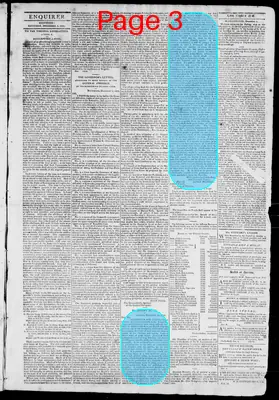
The Enquirer
Richmond, Henrico County, Virginia
What is this article about?
In a letter from London dated November 29, 1803, James Monroe proposes to Virginia Governor John Page that the state purchase British land claims from the Revolution at a discount to resolve disputes amicably. He offers to oversee the process without compensation and suggests using proceeds for public education to preserve liberty.
Clipping
OCR Quality
Full Text
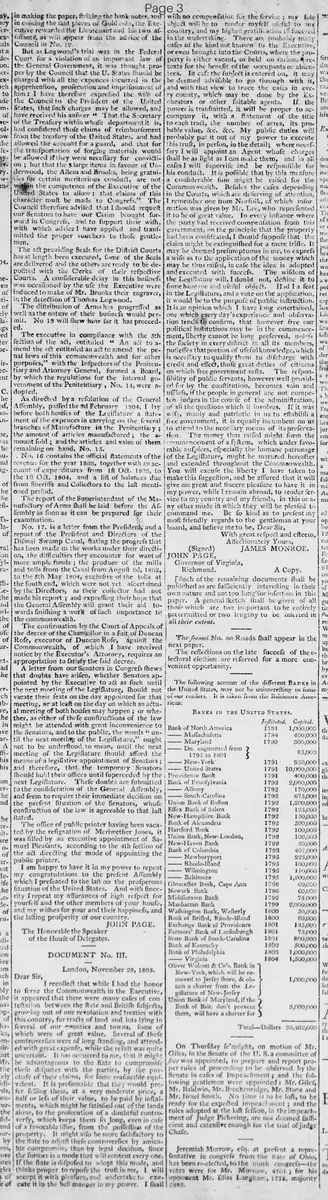
London, November 29, 1803.
Dear Sir,
I recollect that while I had the honor to serve the Commonwealth in the Executive, it appeared that there were many cases of contestation between the state and British subjects, growing out of our revolution and treaties with this country, for tracts of land and lots lying in several of our counties and towns, some of which were of great value. Several of these controversies were of long standing, and attended with great expense, while the result was quite uncertain. It has occurred to me, that it might be advantageous to the state to compromise these disputes with the parties, by the purchase of their claims, for some reasonable equivalent. It is presumable that they would prefer selling them, at a very moderate price, a half or less of their value, to be paid by installments, which might be satisfied out of the lands alone, to the prosecution of a doubtful controversy, which keeps them so long, even in case of a favorable issue, from the possession of the property. It might also be more satisfactory to the state to adjust these controversies by amicable compromise, than by legal decision, since the former is a mode that will content every one.
If the state is disposed to adopt this mode, and thinks proper to repose the trust in me, I will accept it with pleasure, and undertake to execute it in the best manner in my power. I shall wish no compensation for the service: my sole object will be to render myself useful to my country, and my highest gratification to succeed in the undertaking. There are probably many cases of the kind not known to the Executive, or even brought into the Courts, where the property is either vacant, or held on various pretexts for the benefit of the occupants or absentees. In case the subject is entered on, it may be deemed advisable to go through with it, and with that view to trace the cases in every county, which may be done by the Ex. chequers or other suitable agents. If the power is transmitted, it will be proper to accompany it, with a statement of the title to each tract, the number of acres, its probable value, &c. &c. My public duties will probably put it out of my power to execute this trust, in person, in the detail; where necessary I will appoint an Agent whose charges shall be as light as I can make them, and in all cases I will supervise and be responsible for his conduct. It is possible that by this measure a considerable sum might be raised for the Commonwealth. Besides the cases depending in the Courts, which are deserving of attention, I remember one from Norfolk, of which information was given by Mr. Lee, who represented it to be of great value. In every instance where the party had received compensation from this government, on the principle that the property had been confiscated, I should suppose that the claim might be extinguished for a mere trifle. It may be deemed presumptuous in me, to express a wish as to the application of the money which may be thus raised, in case the idea is adopted and executed with success. The wisdom of the Legislature will, I doubt not, destine it to some humane and useful object. Had I a seat in the Legislature, and a vote on the application, it would be to the purpose of public instruction. It is an opinion which I have long entertained, one which every day's experience and observation tends to confirm, that however free our political institutions may be in the commencement, liberty cannot be long, preserved, unless the society in every district in all its members, possesses that portion of useful knowledge, which is necessary to qualify them to discharge with credit and effect, those great duties of citizens on which free government rests. The responsibility of public servants, however well provided for by the constitution, becomes vain and useless, if the people in general are not competent judges in the course of the administration, of all the questions which it involves. If it was wise, manly and patriotic in us to establish a free government, it is equally incumbent on us to attend to the necessary means of its preservation. The money thus raised might form the commencement of a system, which under favorable auspices, especially the humane patronage of the Legislature, might be matured hereafter and extended throughout the Commonwealth.
You will excuse the liberty I have taken to make this suggestion, and be assured that it will give me great and sincere pleasure to have it in my power, while I remain abroad, to render service to my country and my friends, in this or any other mode in which they will be pleased to command me. Be so kind as to present my most friendly regards to the gentleman at your board, and believe me to be, Dear Sir,
With great respect and esteem,
Affectionately Yours,
(Signed) JAMES MONROE.
JOHN PAGE,
Governor of Virginia,
Richmond.
A Copy.
What sub-type of article is it?
What themes does it cover?
What keywords are associated?
What entities or persons were involved?
Letter to Editor Details
Author
James Monroe
Recipient
John Page, Governor Of Virginia, Richmond
Main Argument
the state should purchase british land claims from the revolution at a moderate price to settle disputes amicably, avoiding costly litigation; monroe offers to manage this without compensation and suggests using the funds for public education to preserve liberty.
Notable Details