Thank you for visiting SNEWPapers!
Sign up free
Letter to Editor
August 13, 1872
Daily Kennebec Journal
Augusta, Kennebec County, Maine
What is this article about?
H. M. Bryant, a Liberal Republican and temperance lecturer, rebukes Democratic papers for ignoring their party's anti-prohibition stance from the Bangor Convention and opposing Maine's temperance laws, particularly on cider sales. He defends prohibition, arguing cider can intoxicate and requires regulation.
Clipping
OCR Quality
98%
Excellent
Full Text
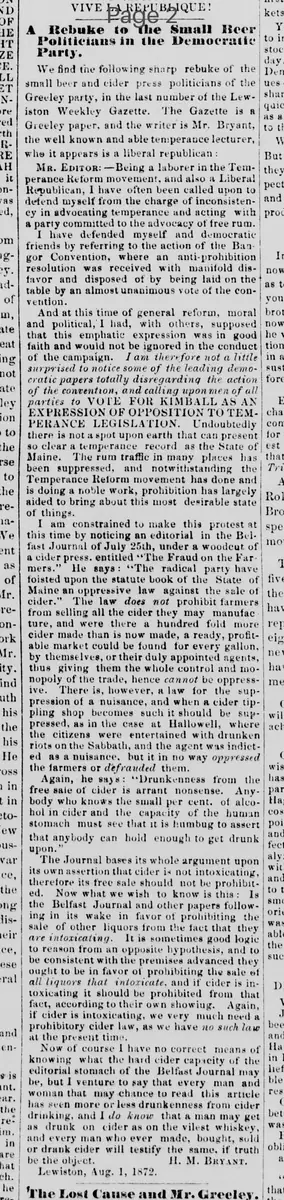
A Rebuke to the Small Beer Politicians in the Democratic Party.
We find the following sharp rebuke of the small beer and cider press politicians of the Greeley party, in the last number of the Lewiston Weekly Gazette. The Gazette is a Greeley paper, and the writer is Mr. Bryant, the well known and able temperance lecturer, who it appears is a liberal republican :
MR. Editor: -Being a laborer in the Temperance Reform movement, and also a Liberal Republican, I have often been called upon to defend myself from the charge of inconsistency in advocating temperance and acting with a party committed to the advocacy of free rum. I have defended myself and democratic friends by referring to the action of the Bangor Convention, where an anti-prohibition resolution was received with manifold disfavor and disposed of by being laid on the table by an almost unanimous vote of the convention. And at this time of general reform, moral and political, I had, with others, supposed that this emphatic expression was in good faith and would not be ignored in the conduct of the campaign. I am therefore not a little surprised to notice some of the leading democratic papers totally disregarding the action of the convention, and calling upon men of all parties to VOTE FOR KIMBALL AS AN EXPRESSION OF OPPOSITION TO TEMPERANCE LEGISLATION. Undoubtedly there is not a spot upon earth that can present so clear a temperance record as the State of Maine. The rum traffic in many places has been suppressed, and notwithstanding the Temperance Reform movement has done and is doing a noble work, prohibition has largely aided to bring about this most desirable state of things. I am constrained to make this protest at this time by noticing an editorial in the Belfast Journal of July 25th, under a woodcut of a cider press. entitled "The Fraud on the Farmers." He says: "The radical party have foisted upon the statute book of the State of Maine an oppressive law against the sale of cider." The law does not prohibit farmers from selling all the cider they may manufacture, and were there a hundred fold more cider made than is now made, a ready, profitable market could be found for every gallon, by themselves, or their duly appointed agents, thus giving them the whole control and monopoly of the trade, hence cannot be oppressive. There is, however, a law for the suppression of a nuisance, and when a cider tippling shop becomes such it should be suppressed, as in the case at Hallowell, where the citizens were entertained with drunken riots on the Sabbath, and the agent was indicted as a nuisance, but it in no way oppressed the farmers or defrauded them. Again, he says: "Drunkenness from the free sale of cider is arrant nonsense. Anybody who knows the small per cent. of alcohol in cider and the capacity of the human stomach must see that it is humbug to assert that anybody can hold enough to get drunk upon." The Journal bases its whole argument upon its own assertion that cider is not intoxicating, therefore its free sale should not be prohibited. Now what we wish to know is this: Is the Belfast Journal and other papers following in its wake in favor of prohibiting the sale of other liquors from the fact that they are intoxicating. It is sometimes good logic to reason from an opposite hypothesis, and to be consistent with the premises advanced they ought to be in favor of prohibiting the sale of all liquors that intoxicate, and if cider is intoxicating it should be prohibited from that fact, according to their own showing. Again, if cider is intoxicating, we very much need a prohibitory cider law, as we have no such law at the present time. Now of course I have no correct means of knowing what the hard cider capacity of the editorial stomach of the Belfast Journal may be, but I venture to say that every man and woman that may chance to read this article has seen more or less drunkenness from cider drinking, and I do know that a man may get as drunk on cider as on the vilest whiskey, and every man who ever made, bought, sold or drank cider will testify the same, if truth be the object.
H. M. BRYANT.
Lewiston, Aug. 1, 1872.
We find the following sharp rebuke of the small beer and cider press politicians of the Greeley party, in the last number of the Lewiston Weekly Gazette. The Gazette is a Greeley paper, and the writer is Mr. Bryant, the well known and able temperance lecturer, who it appears is a liberal republican :
MR. Editor: -Being a laborer in the Temperance Reform movement, and also a Liberal Republican, I have often been called upon to defend myself from the charge of inconsistency in advocating temperance and acting with a party committed to the advocacy of free rum. I have defended myself and democratic friends by referring to the action of the Bangor Convention, where an anti-prohibition resolution was received with manifold disfavor and disposed of by being laid on the table by an almost unanimous vote of the convention. And at this time of general reform, moral and political, I had, with others, supposed that this emphatic expression was in good faith and would not be ignored in the conduct of the campaign. I am therefore not a little surprised to notice some of the leading democratic papers totally disregarding the action of the convention, and calling upon men of all parties to VOTE FOR KIMBALL AS AN EXPRESSION OF OPPOSITION TO TEMPERANCE LEGISLATION. Undoubtedly there is not a spot upon earth that can present so clear a temperance record as the State of Maine. The rum traffic in many places has been suppressed, and notwithstanding the Temperance Reform movement has done and is doing a noble work, prohibition has largely aided to bring about this most desirable state of things. I am constrained to make this protest at this time by noticing an editorial in the Belfast Journal of July 25th, under a woodcut of a cider press. entitled "The Fraud on the Farmers." He says: "The radical party have foisted upon the statute book of the State of Maine an oppressive law against the sale of cider." The law does not prohibit farmers from selling all the cider they may manufacture, and were there a hundred fold more cider made than is now made, a ready, profitable market could be found for every gallon, by themselves, or their duly appointed agents, thus giving them the whole control and monopoly of the trade, hence cannot be oppressive. There is, however, a law for the suppression of a nuisance, and when a cider tippling shop becomes such it should be suppressed, as in the case at Hallowell, where the citizens were entertained with drunken riots on the Sabbath, and the agent was indicted as a nuisance, but it in no way oppressed the farmers or defrauded them. Again, he says: "Drunkenness from the free sale of cider is arrant nonsense. Anybody who knows the small per cent. of alcohol in cider and the capacity of the human stomach must see that it is humbug to assert that anybody can hold enough to get drunk upon." The Journal bases its whole argument upon its own assertion that cider is not intoxicating, therefore its free sale should not be prohibited. Now what we wish to know is this: Is the Belfast Journal and other papers following in its wake in favor of prohibiting the sale of other liquors from the fact that they are intoxicating. It is sometimes good logic to reason from an opposite hypothesis, and to be consistent with the premises advanced they ought to be in favor of prohibiting the sale of all liquors that intoxicate, and if cider is intoxicating it should be prohibited from that fact, according to their own showing. Again, if cider is intoxicating, we very much need a prohibitory cider law, as we have no such law at the present time. Now of course I have no correct means of knowing what the hard cider capacity of the editorial stomach of the Belfast Journal may be, but I venture to say that every man and woman that may chance to read this article has seen more or less drunkenness from cider drinking, and I do know that a man may get as drunk on cider as on the vilest whiskey, and every man who ever made, bought, sold or drank cider will testify the same, if truth be the object.
H. M. BRYANT.
Lewiston, Aug. 1, 1872.
What sub-type of article is it?
Persuasive
Political
Ethical Moral
What themes does it cover?
Temperance
Politics
Morality
What keywords are associated?
Temperance Reform
Liberal Republican
Prohibition
Cider Law
Maine Politics
Democratic Party
Intoxication
What entities or persons were involved?
H. M. Bryant
Mr. Editor
Letter to Editor Details
Author
H. M. Bryant
Recipient
Mr. Editor
Main Argument
democratic papers disregard their party's convention opposition to anti-prohibition and urge votes against temperance legislation; maine's prohibition laws, including on cider, are defended as non-oppressive and necessary since cider can intoxicate like whiskey.
Notable Details
References Bangor Convention's Tabling Of Anti Prohibition Resolution
Critiques Belfast Journal Editorial 'The Fraud On The Farmers' From July 25
Cites Hallowell Case Of Cider Shop Nuisance And Sabbath Riots