Thank you for visiting SNEWPapers!
Sign up free
Sacramento Daily Record Union
Sacramento, Sacramento County, California
What is this article about?
Letter to the editors of the Record-Union proposing local river water power and windmills for pumping Sacramento's sewage to higher levels, critiquing distant power sources like from Brighton or Folsom as costly, and comparing to systems in Philadelphia, Pullman, and Berlin. Emphasizes competent engineering over political appointments. Signed E., Sacramento, September 18, 1883.
Clipping
OCR Quality
Full Text
OF
THE SEWAGE
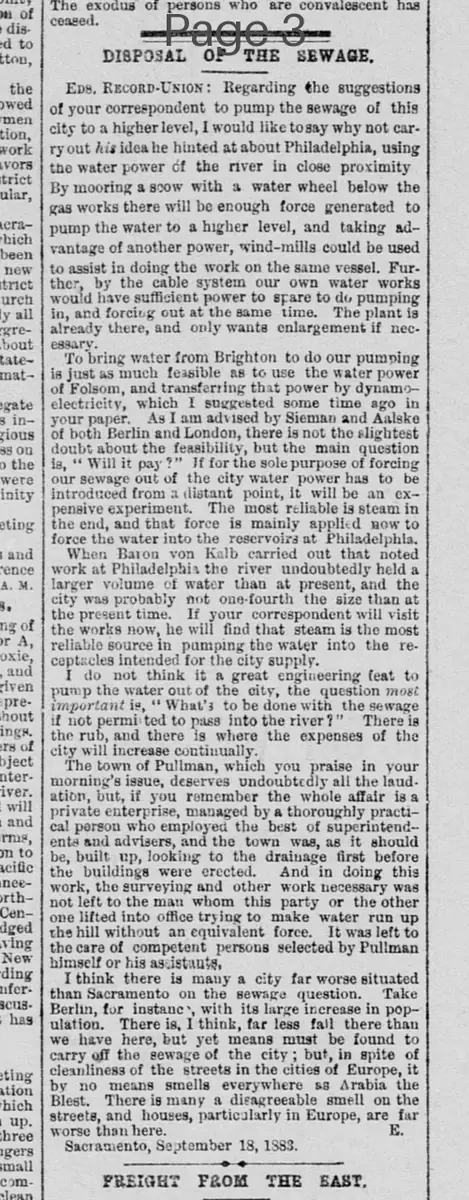
Eds. Record-Union: Regarding the suggestions of your correspondent to pump the sewage of this city to a higher level, I would like to say why not carry out his idea he hinted at about Philadelphia, using the water power of the river in close proximity. By mooring a scow with a water wheel below the gas works there will be enough force generated to pump the water to a higher level, and taking advantage of another power, wind-mills could be used to assist in doing the work on the same vessel. Further, by the cable system our own water works would have sufficient power to spare to do pumping in, and forcing out at the same time. The plant is already there, and only wants enlargement if necessary.
To bring water from Brighton to do our pumping is just as much feasible as to use the water power of Folsom, and transferring that power by dynamo-electricity, which I suggested some time ago in your paper. As I am advised by Siemens and Halske of both Berlin and London, there is not the slightest doubt about the feasibility, but the main question is, "Will it pay?" If for the sole purpose of forcing our sewage out of the city water power has to be introduced from a distant point, it will be an expensive experiment. The most reliable is steam in the end, and that force is mainly applied now to force the water into the reservoirs at Philadelphia.
When Baron von Kalb carried out that noted work at Philadelphia the river undoubtedly held a larger volume of water than at present, and the city was probably not one-fourth the size than at the present time. If your correspondent will visit the works now, he will find that steam is the most reliable source in pumping the water into the receptacles intended for the city supply.
I do not think it a great engineering feat to pump the water out of the city, the question most important is, "What's to be done with the sewage if not permitted to pass into the river?" There is the rub, and there is where the expenses of the city will increase continually.
The town of Pullman, which you praise in your morning's issue, deserves undoubtedly all the laudation, but, if you remember the whole affair is a private enterprise, managed by a thoroughly practical person who employed the best of superintendents and advisers, and the town was, as it should be, built up, looking to the drainage first before the buildings were erected. And in doing this work, the surveying and other work necessary was not left to the man whom this party or the other one lifted into office trying to make water run up the hill without an equivalent force. It was left to the care of competent persons selected by Pullman himself or his assistants.
I think there is many a city far worse situated than Sacramento on the sewage question. Take Berlin, for instance, with its large increase in population. There is, I think, far less fall there than we have here, but yet means must be found to carry off the sewage of the city; but, in spite of cleanliness of the streets in the cities of Europe, it by no means smells everywhere as Arabia the Blest. There is many a disagreeable smell on the streets, and houses, particularly in Europe, are far worse than here.
E.
Sacramento, September 18, 1883.
What sub-type of article is it?
What themes does it cover?
What keywords are associated?
What entities or persons were involved?
Letter to Editor Details
Author
E.
Recipient
Eds. Record Union
Main Argument
proposes using local river water power, windmills, and existing water works for pumping sacramento's sewage to higher levels as a cost-effective alternative to distant sources like brighton or folsom; critiques reliance on political appointees and emphasizes competent management, while questioning ultimate disposal and costs.
Notable Details