Thank you for visiting SNEWPapers!
Sign up free
The Durant News
Durant, Holmes County, Mississippi
What is this article about?
Walter Scott Meriwether promotes the Jerusalem artichoke as a valuable crop for sugar production, highlighting the Bureau of Standards' discovery of an efficient extraction process. It offers high sugar yield, by-products like alcohol and yeast, and benefits for diabetics, providing Mississippi farmers an alternative to cotton dependency.
Clipping
OCR Quality
Full Text
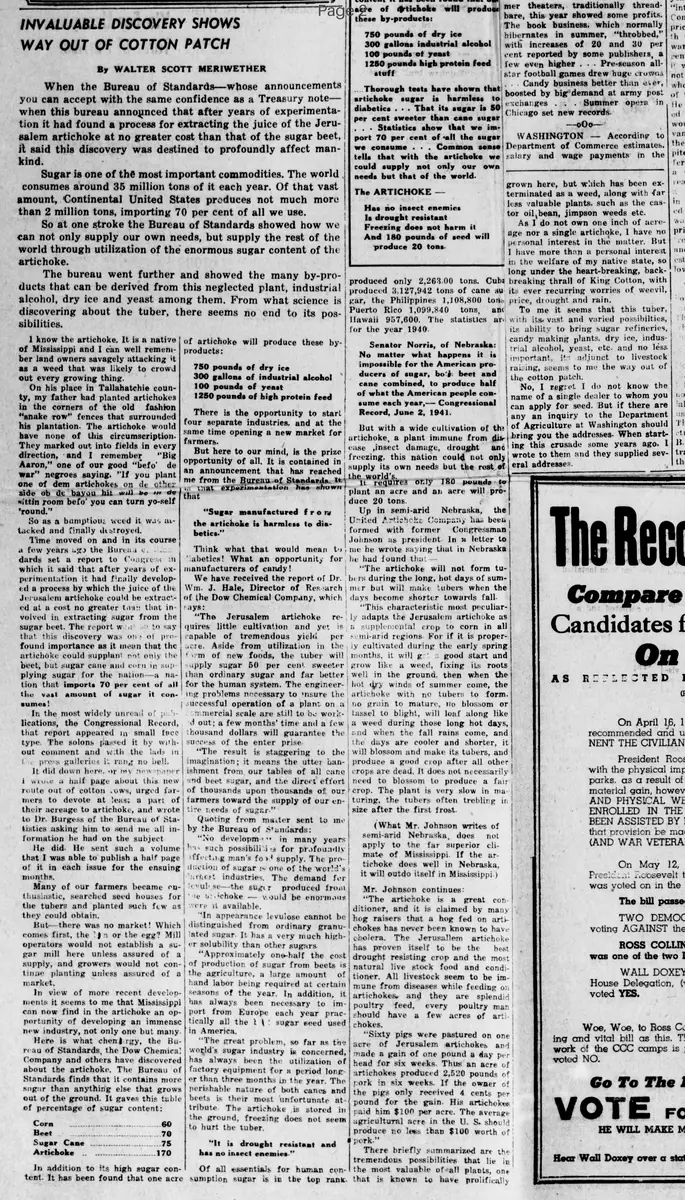
WAY OUT OF COTTON PATCH
By WALTER SCOTT MERIWETHER
When the Bureau of Standards whose announcements you can accept with the same confidence as a Treasury note-- when this bureau announced that after years of experimentation it had found a process for extracting the juice of the Jerusalem artichoke at no greater cost than that of the sugar beet, it said this discovery was destined to profoundly affect mankind.
Sugar is one of the most important commodities. The world consumes around 35 million tons of it each year. Of that vast amount, Continental United States produces not much more than 2 million tons, importing 70 per cent of all we use.
So at one stroke the Bureau of Standards showed how we can not only supply our own needs, but supply the rest of the world through utilization of the enormous sugar content of the artichoke.
The bureau went further and showed the many by-products that can be derived from this neglected plant, industrial alcohol, dry ice and yeast among them. From what science is discovering about the tuber, there seems no end to its possibilities.
I know the artichoke. It is a native of Mississippi and I can well remember land owners savagely attacking it as a weed that was likely to crowd out every growing thing.
On his place in Tallahatchie county, my father had planted artichokes in the corners of the old fashion "snake row" fences that surrounded his plantation. The artichoke would have none of this circumscription. They marked out into fields in every direction, and I remember "Big Aaron," one of our good "befo' de war" negroes saying, "If you plant one of dem artichokes on de other side ob de bayou hit will bo wn de wittin room befo' you can turn yo-self 'round."
So as a bumptious weed it was attacked and finally destroyed.
Time moved on and in its course a few years ago the Bureau of Standards set a report to Congress in which it said that after years of experimentation it had finally developed a process by which the juice of the Jerusalem artichoke could be extracted at a cost no greater than that involved in extracting sugar from the sugar beet. The report went on to say that this discovery was one of profound importance as it meant that the artichoke could supplant not only the beet, but sugar cane and corn in supplying sugar for the nation-- a nation that imports 70 per cent of all the vast amount of sugar it consumes!
In the most widely unread of publications, the Congressional Record, that report appeared in small face type. The solons passed it by without comment and with the lads in the press galleries it rang no bell.
It did down here, or my newspaper would not have given it the attention it did. I wrote a half page about this new route out of cotton rows, urged farmers to devote at least a part of their acreage to artichoke, and wrote to Dr. Burgess of the Bureau of Statistics asking him to send me all information he had on the subject.
He did. He sent such a volume that I was able to publish a half page of it in each issue for the ensuing months.
Many of our farmers became enthusiastic, searched seed houses for the tubers and planted such few as they could obtain.
But--there was no market! Which comes first, the hen or the egg? Mill operators would not establish a sugar mill here unless assured of a supply, and growers would not continue planting unless assured of a market.
In view of more recent developments it seems to me that Mississippi can now find in the artichoke an opportunity of developing an immense new industry, not only one but many.
Here is what then Army, the Bureau of Standards, the Dow Chemical Company and others have discovered about the artichoke. The Bureau of Standards finds that it contains more sugar than anything else that grows out of the ground. It gives this table of percentage of sugar content:
Corn .60
Beet .70
Sugar Cane .75
Artichoke 1.70
In addition to its high sugar content, it has been found that one acre of artichoke will produce these by-products:
750 pounds of dry ice
300 gallons of industrial alcohol
100 pounds of yeast
1250 pounds of high protein feed
There is the opportunity to start four separate industries, and at the same time opening a new market for farmers.
But here to our mind, is the prize opportunity of all. It is contained in an announcement that has reached me from the Bureau of Standards. It is that experimentation has shown that
"Sugar manufactured from the artichoke is harmless to diabetics."
Think what that would mean to diabetics! What an opportunity for manufacturers of candy!
We have received the report of Dr. Wm. J. Hale, Director of Research of the Dow Chemical Company, which says:
"The Jerusalem artichoke requires little cultivation and yet is capable of tremendous yield per acre. Aside from utilization in the form of new foods, the tuber will supply sugar 50 per cent sweeter than ordinary sugar and far better for the human system. The engineering problems necessary to insure the successful operation of a plant on a commercial scale are still to be worked out; a few months' time and a few thousand dollars will guarantee the success of the enterprise.
"The result is staggering to the imagination; it means the utter banishment from our tables of all cane and beet sugar, and the direct effort of thousands upon thousands of our farmers toward the supply of our entire needs of sugar."
Quoting from matter sent to me by the Bureau of Standards:
"No development in many years has such possibilities for profoundly affecting man's food supply. The production of sugar is one of the world's largest industries. The demand for levulose--the sugar produced from the artichoke--would be enormous were it available.
"In appearance levulose cannot be distinguished from ordinary granulated sugar. It has a very much higher solubility than other sugars.
"Approximately one-half the cost of production of sugar from beets is the agriculture, a large amount of hand labor being required at certain seasons of the year. In addition, it has always been necessary to import from Europe each year practically all the beet sugar seed used in America.
"The great problem, so far as the world's sugar industry is concerned, has always been the utilization of factory equipment for a period longer than three months in the year. The perishable nature of both canes and beets is their most unfortunate attribute. The artichoke is stored in the ground, freezing does not seem to hurt the tuber.
"It is drought resistant and has no insect enemies."
Of all essentials for human consumption sugar is in the top rank.
grown here, but which has been exterminated as a weed, along with far less valuable plants, such as the castor oil bean, jimpson weeds etc.
As I do not own one inch of acreage nor a single artichoke, I have no personal interest in the matter. But I have more than a personal interest in the welfare of my native state, so long under the heart-breaking, back-breaking thrall of King Cotton, with its ever recurring worries of weevil, price, drought and rain.
To me it seems that this tuber, with its vast and varied possibilities, its ability to bring sugar refineries, candy making plants, dry ice, industrial alcohol, yeast, etc. and no less important, its adjunct to livestock raising, seems to me the way out of the cotton patch.
No, I regret I do not know the name of a single dealer to whom you can apply for seed. But if there are any an inquiry to the Department of Agriculture at Washington should bring you the addresses. When starting this crusade some years ago, I wrote to them and they supplied several addresses.
What sub-type of article is it?
What themes does it cover?
What keywords are associated?
What entities or persons were involved?
Where did it happen?
Story Details
Key Persons
Location
Mississippi, Tallahatchie County
Event Date
A Few Years Ago
Story Details
The Bureau of Standards discovers a cost-effective process to extract sugar from Jerusalem artichokes, surpassing beets and cane in yield. The author recalls its history as a weed in Mississippi, promotes planting for sugar, by-products, and diabetic-friendly levulose, urging farmers to escape cotton dependency.