Thank you for visiting SNEWPapers!
Sign up free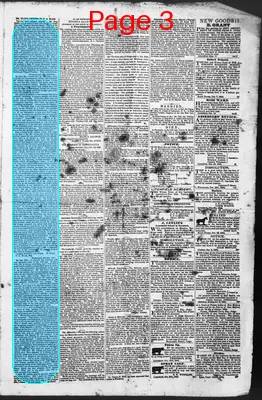
Story
October 24, 1844
Litchfield Enquirer
Litchfield, Litchfield County, Connecticut
What is this article about?
Historical article defends Henry Clay against 1824-25 election 'bargain' accusations by publishing his private 1825 letters to Francis P. Blair, explaining support for Adams over Jackson to avoid military precedent, amid political slanders by enemies like Amos Kendall.
Clipping

OCR Quality
85%
Good
Full Text
The vindictive personal enemies of Mr. Clay, destitute of all proof of their foul charge of 'Coalition,' and 'Bargain' between Messrs. Clay and Adams in 1824-5, have for some years fallen back on the evidence which they have asserted they could give if they possessed and were allowed to publish certain private letters from Mr. Clay to Francis P. Blair (now Editor of the Globe, then of a leading Clay paper in Kentucky.) These letters, written in the most unreserved confidence of a Statesman to an ardent friend and supporter, were transmitted by Mr. Clay in 1827 to Col. John Harvie of Frankfort, by whom they were placed in the hands of Col. Richard H. Taylor, also of Frankfort, for public inspection. Hundreds then saw them and read them. Amos Kendall was of the number and he made and published extracts (from memory, as he said) so garbled and put together, as to give all possible countenance to the slanders on Mr. Clay.— These have been repeatedly republished, and were used by Linn Boyd in his speech against Mr. Clay last winter. Mr. Clay transmitted copies of them last summer to Benj. W. Leigh, Richmond, Virginia, who determined to publish them, as the most effectual way of putting down the slander; and Mr. Clay making no objection, the letters appear in the Richmond Whig of Tuesday. They are as follows:
WASHINGTON, Jan. 5th, 1825.
My Dear Sir:—I send you, by this day's mail, Lord Byron's Conversations, which, notwithstanding Mr. Walsh's unfavorable opinion of them, I think you will find often piquant, and worth, upon the whole, an extensive perusal. Besides the literary and critical interest which they possess, they will have the effect of diminishing, though not entirely removing, the odium which he brought upon himself by his conduct to his wife.
My position in relation to the friends of the three returned candidates is singular enough, and often to me very amusing. In the first place, they all believe that my friends have the power of deciding the question—and then, that I have the power of controlling my friends! Acting upon this assumption, in the same hour. I am sometimes touched gently on the shoulder by a friend, (for example of Gen. Jackson,) who will address me; "My dear sir, all my dependence is upon you; don't disappoint us; you know our partiality was for you, next to the Hero, and how much we want a Western President?" Immediately after, a friend of Mr. Crawford will accost me—"The hopes of the Republican party are concentrated on you; for God's sake preserve it; if you had been returned instead Mr. Crawford, every man of us would have supported you to the last hour. We consider him and you as the only genuine Republican candidates?" Next. a friend of Mr. Adams comes, with tears in his eyes—"Sir, Mr. Adams has always had the greatest respect for you, and admiration of your talents; there is no station to which you are not equal—most undoubtedly you were the second choice of New England—and I pray you to consider seriously whether the public good and your own future interests do not point most distinctly to the choice which you ought to make!" How can one withstand all this disinterested homage and kindness? Really, the friends of all the three gentlemen are so very courteous and affectionate, that I sometimes almost wish that it was in my power to accommodate each of them; but that being impossible, we are beginning to think seriously of the choice which we must finally make. I will tell you, then, that I believe the contest will be limited to Mr. Adams and General Jackson. Mr. Crawford's personal condition precludes the choice of him, if there were no other objection to his election. As the only alternative which is presented to us, it is sufficiently painful, and I consider whatever choice we may make, will be a choice of evils. To both of those gentlemen there are strong personal objections. The principal difference between them is, that in the election of Mr. Adams we shall not, by the example, inflict any wound upon the character of our institutions; but I should much fear hereafter, if not during the present generation, that the election of the General would give to the military spirit a stimulus and a confidence that might lead to the most pernicious results. I shall therefore, with great regret, on account of the dilemma in which the people have placed me, support Mr. Adams. My friends are generally so inclined. What has great weight with me, is the decided preference which a majority of the delegation from Ohio has for him over Gen. Jackson. If, therefore, Kentucky were to vote for the General, it would possibly only have the effect of dividing our friends, without defeating ultimately the election of Mr. Adams. Three of the four States. favorable to Mr. Crawford, are believed to prefer Mr. Adams to the General. Virginia is one of them. I am inclined to think that nearly three-fourths of our delegation have yielded to the influence of these views, and will vote for Mr. Adams. My friends entertain the belief, that their kind wishes towards me, will in the end, be more likely to be accomplished by so bestowing their votes. I hope, however, most carnestly entreated them to thro me cut of their consuleration, in bringing their judgments to a final conclusion, and to look and be guided solely by the public good. If I know myself, that alone has determined me. Your Representative is inclined to concur with us in these sentiments and views; and, if they should meet your approbation, as I know he has great respect for your opinions, I would be glad if you would, by the return mail, address a letter to him, to strengthen him in his inclination.
Be pleased to show this letter to Crittenden alone.
I remain, faithfully, your friend,
H. CLAY.
F. B. BLAIR, Esq.
Washington, 23d Jan. 1825.
My Dear Blair:—I received this morning your very agreeable letter of the 17th inst. A letter from you is always refreshing, and I wish that I could entitle myself to expect them more frequently, by more punctuality and diligence on my part in our correspondence. My last letter informed you of the unction that was unceasingly applied to me by all the returned candidates for the Presidency—or rather their friends. Since then I have avowed my intention to support Mr. Adams, under actual circumstances, and thereupon the oil has been instantly transformed into vinegar. The friends of , (and the devil knows who else, for I think if he does not preside in their councils, he must be quite conversant with them,) have turned upon me, and with the most amiable unanimity agree to vituperate me. I am a deserter from Democracy; a Giant at intrigue; have sold the West—and myself—defeated General Jackson's election to leave open the Western pretensions that I may hereafter fill them myself—blasting all my thousand other of the most gentle, and kind, and fair prospects, &c. &c. &c. To these are added a who are themselves straining every nerve to elect Jackson, that the claims of the West may be satisfied, and I be thereby pretermit-ted, are accusing me of acting on their own principles. The knaves cannot comprehend how a man can be honest. They cannot conceive that I should have solemnly interrogated my conscience and asked it to tell me seriously what it is my duty to do!— That it should have enjoined me not to establish the dangerous precedent of elevating, in this early stage of the Republic, a Military Chieftain merely because he has won a great victory! that it should have told me that a public man is undeserving his station, who will not regardless of aspersion and culumnies, risk himself for his country! I am afraid that you will think me moved by these abu-ses. Be not deceived. I assure you that I never, in my whole life, felt more perfect composure, more entire confidence in the resolution of my judgment, and a more unshaken determination to march up to my duty. And my dear sir, is there an intelligent and unbiased man who must not, sooner or later, concur with me? Mr. Adams, you know well, I should never have selected, if at liberty to draw from the whole mass of our citizens for a President. But there is no danger in his elevation, now, or in time to come. Not so of his competitor, of whom I cannot believe that killing 2,500 Englishmen at New Orleans qualifies for the various, difficult, complicated duties of the Chief Magistracy. I perceive that I am unconsciously writing a sort of de-fiance, which you may probably think implies guilt. What will be the result? you will ask with curiosity if not anxiety. I think Mr. Adams must be elected; such is the prevailing opinion. Still I shall not consider the matter as certain, until the election is over. With my best respects to Mrs. Blair, and Mr. Crittenden, I remain truly your friend,
H. CLAY.
WASHINGTON, Jan. 5th, 1825.
My Dear Sir:—I send you, by this day's mail, Lord Byron's Conversations, which, notwithstanding Mr. Walsh's unfavorable opinion of them, I think you will find often piquant, and worth, upon the whole, an extensive perusal. Besides the literary and critical interest which they possess, they will have the effect of diminishing, though not entirely removing, the odium which he brought upon himself by his conduct to his wife.
My position in relation to the friends of the three returned candidates is singular enough, and often to me very amusing. In the first place, they all believe that my friends have the power of deciding the question—and then, that I have the power of controlling my friends! Acting upon this assumption, in the same hour. I am sometimes touched gently on the shoulder by a friend, (for example of Gen. Jackson,) who will address me; "My dear sir, all my dependence is upon you; don't disappoint us; you know our partiality was for you, next to the Hero, and how much we want a Western President?" Immediately after, a friend of Mr. Crawford will accost me—"The hopes of the Republican party are concentrated on you; for God's sake preserve it; if you had been returned instead Mr. Crawford, every man of us would have supported you to the last hour. We consider him and you as the only genuine Republican candidates?" Next. a friend of Mr. Adams comes, with tears in his eyes—"Sir, Mr. Adams has always had the greatest respect for you, and admiration of your talents; there is no station to which you are not equal—most undoubtedly you were the second choice of New England—and I pray you to consider seriously whether the public good and your own future interests do not point most distinctly to the choice which you ought to make!" How can one withstand all this disinterested homage and kindness? Really, the friends of all the three gentlemen are so very courteous and affectionate, that I sometimes almost wish that it was in my power to accommodate each of them; but that being impossible, we are beginning to think seriously of the choice which we must finally make. I will tell you, then, that I believe the contest will be limited to Mr. Adams and General Jackson. Mr. Crawford's personal condition precludes the choice of him, if there were no other objection to his election. As the only alternative which is presented to us, it is sufficiently painful, and I consider whatever choice we may make, will be a choice of evils. To both of those gentlemen there are strong personal objections. The principal difference between them is, that in the election of Mr. Adams we shall not, by the example, inflict any wound upon the character of our institutions; but I should much fear hereafter, if not during the present generation, that the election of the General would give to the military spirit a stimulus and a confidence that might lead to the most pernicious results. I shall therefore, with great regret, on account of the dilemma in which the people have placed me, support Mr. Adams. My friends are generally so inclined. What has great weight with me, is the decided preference which a majority of the delegation from Ohio has for him over Gen. Jackson. If, therefore, Kentucky were to vote for the General, it would possibly only have the effect of dividing our friends, without defeating ultimately the election of Mr. Adams. Three of the four States. favorable to Mr. Crawford, are believed to prefer Mr. Adams to the General. Virginia is one of them. I am inclined to think that nearly three-fourths of our delegation have yielded to the influence of these views, and will vote for Mr. Adams. My friends entertain the belief, that their kind wishes towards me, will in the end, be more likely to be accomplished by so bestowing their votes. I hope, however, most carnestly entreated them to thro me cut of their consuleration, in bringing their judgments to a final conclusion, and to look and be guided solely by the public good. If I know myself, that alone has determined me. Your Representative is inclined to concur with us in these sentiments and views; and, if they should meet your approbation, as I know he has great respect for your opinions, I would be glad if you would, by the return mail, address a letter to him, to strengthen him in his inclination.
Be pleased to show this letter to Crittenden alone.
I remain, faithfully, your friend,
H. CLAY.
F. B. BLAIR, Esq.
Washington, 23d Jan. 1825.
My Dear Blair:—I received this morning your very agreeable letter of the 17th inst. A letter from you is always refreshing, and I wish that I could entitle myself to expect them more frequently, by more punctuality and diligence on my part in our correspondence. My last letter informed you of the unction that was unceasingly applied to me by all the returned candidates for the Presidency—or rather their friends. Since then I have avowed my intention to support Mr. Adams, under actual circumstances, and thereupon the oil has been instantly transformed into vinegar. The friends of , (and the devil knows who else, for I think if he does not preside in their councils, he must be quite conversant with them,) have turned upon me, and with the most amiable unanimity agree to vituperate me. I am a deserter from Democracy; a Giant at intrigue; have sold the West—and myself—defeated General Jackson's election to leave open the Western pretensions that I may hereafter fill them myself—blasting all my thousand other of the most gentle, and kind, and fair prospects, &c. &c. &c. To these are added a who are themselves straining every nerve to elect Jackson, that the claims of the West may be satisfied, and I be thereby pretermit-ted, are accusing me of acting on their own principles. The knaves cannot comprehend how a man can be honest. They cannot conceive that I should have solemnly interrogated my conscience and asked it to tell me seriously what it is my duty to do!— That it should have enjoined me not to establish the dangerous precedent of elevating, in this early stage of the Republic, a Military Chieftain merely because he has won a great victory! that it should have told me that a public man is undeserving his station, who will not regardless of aspersion and culumnies, risk himself for his country! I am afraid that you will think me moved by these abu-ses. Be not deceived. I assure you that I never, in my whole life, felt more perfect composure, more entire confidence in the resolution of my judgment, and a more unshaken determination to march up to my duty. And my dear sir, is there an intelligent and unbiased man who must not, sooner or later, concur with me? Mr. Adams, you know well, I should never have selected, if at liberty to draw from the whole mass of our citizens for a President. But there is no danger in his elevation, now, or in time to come. Not so of his competitor, of whom I cannot believe that killing 2,500 Englishmen at New Orleans qualifies for the various, difficult, complicated duties of the Chief Magistracy. I perceive that I am unconsciously writing a sort of de-fiance, which you may probably think implies guilt. What will be the result? you will ask with curiosity if not anxiety. I think Mr. Adams must be elected; such is the prevailing opinion. Still I shall not consider the matter as certain, until the election is over. With my best respects to Mrs. Blair, and Mr. Crittenden, I remain truly your friend,
H. CLAY.
What sub-type of article is it?
Historical Event
Biography
Deception Fraud
What themes does it cover?
Deception
Justice
Moral Virtue
What keywords are associated?
Henry Clay Letters
1825 Election
Adams Support
Jackson Opposition
Political Slander
Coalition Accusations
Presidential Bargain
What entities or persons were involved?
Henry Clay
Francis P. Blair
John Quincy Adams
Andrew Jackson
Amos Kendall
William H. Crawford
John Harvie
Richard H. Taylor
Linn Boyd
Benjamin W. Leigh
John J. Crittenden
Where did it happen?
Washington, Frankfort, Kentucky; Richmond, Virginia
Story Details
Key Persons
Henry Clay
Francis P. Blair
John Quincy Adams
Andrew Jackson
Amos Kendall
William H. Crawford
John Harvie
Richard H. Taylor
Linn Boyd
Benjamin W. Leigh
John J. Crittenden
Location
Washington, Frankfort, Kentucky; Richmond, Virginia
Event Date
January 1825
Story Details
Henry Clay's private letters to Francis P. Blair reveal his decision to support John Quincy Adams over Andrew Jackson in the 1825 presidential election to prevent elevating a military figure, amid pressures from supporters and later slanders by enemies using garbled extracts.