Thank you for visiting SNEWPapers!
Sign up free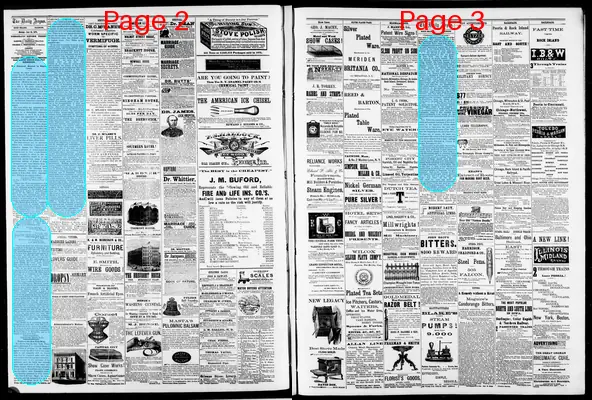
The Daily Argus
Rock Island, Rock Island County County, Illinois
What is this article about?
A newspaper article defends Democratic candidate Samuel J. Tilden against Republican smears during the 1876 campaign, refuting claims of issuing unredeemed 'rag money' at a Lake Superior mine via a letter from his agents, and his alleged sympathy with the New York Tweed Ring using excerpts from his 1873 pamphlet detailing early opposition.
Merged-components note: The page 3 component is explicitly marked as a continuation from page 2 of the Tilden story.
Clippings
1 of 2
OCR Quality
Full Text
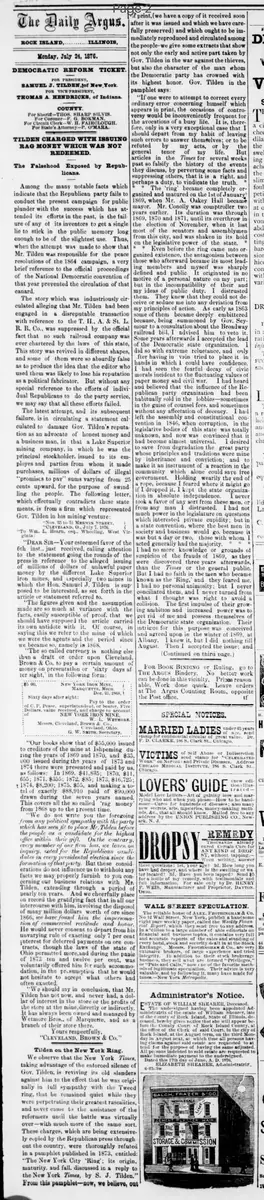
The Falsehood Exposed by Republicans.
Among the many notable facts which indicate that the Republican party fails to conduct the present campaign for public plunder with the success which has attended its efforts in the past, is the failure of any of its inventors to get a single lie to stick in the public memory long enough to be of the slightest use. Thus, when the attempt was made to show that Mr. Tilden was responsible for the peace resolutions of the 1864 campaign, a very brief reference to the official proceedings of the National Democratic convention of that year prevented the circulation of that canard.
The story which was industriously circulated alleging that Mr. Tilden had been engaged in a disreputable transaction with reference to the T. H., A. & St. L. R. R. Co., was suppressed by the official fact that no such railroad company was ever chartered by the laws of this state.
This story was revived in different shapes, and some of them were so absurdly false as to produce the idea that the editor who used them was likely to lose his reputation as a political fabricator. But without any special reference to the efforts of individual Republicans to do the party service, we may say that all these efforts failed.
The latest attempt, and its subsequent failure, is in circulating a statement calculated to damage Gov. Tilden's reputation as an advocate of honest money and a business man, in that a Lake Superior mining company, in which he was the principal stockholder, issued to its employees and parties from whom it made purchases, millions of dollars of illegal "promises to pay" sums varying from 25 cents upward, for the purpose of swindling the people. The following letter, which effectually contradicts these statements, is from a firm which represented Gov. Tilden in his mining venture:
"Nos. 35 to 31 Merwin Street.
"CLEVELAND, O., July 7, 1876.
"To Wm. L. Hearn, esq., Wheeling, West Virginia:
"DEAR SIR—Your esteemed favor of the 6th inst., just received, calling attention to the statement going the rounds of the press in reference to the alleged issuing of millions of dollars of unlawful paper money by the different Lake Superior iron mines, and especially two mines in which the Hon. Samuel J. Tilden is supposed to be interested, as set forth in the article or statement referred to.
"The figures given and the assumption made are so much at variance with the facts, easily susceptible of proof, that we should have supposed the article carried its own antidote with it. Of course, in saying this we refer to the mine of which we were the agents and the period since we became so, namely in 1868.
"The so called currency is nothing else than a draft or order upon Cleveland, Brown & Co., to pay a certain amount of money on presentation or 'sixty days after sight,' in the following form:
:$5 00,
New York Iron Mine,
MARQUETTE, MICH
Dec. 21, 1868,
Sixty days after sight:
Pay to the order
of C. P. Pease, superintendent, or bearer, Five
Dollars, value received, and charge to account
NEW YORK IRON MINE,
W. L. WETMORE.
Messrs. Cleveland, Brown & Co.,
Cleveland, Ohio.
G. W. SMITH. Secretary.
"Our books show that of $55,000 issued to creditors of the mine at Ishpeming during the years of 1869 and 1870, and $35,000 issued during the years of 1873 and 1874 there were presented and paid by us, as follows: In 1869, $41,835; 1870, $11,655; 1871, $355; 1872, $85; 1873, $16,725; 1874, $8,200; 1875, $55, and making a total of exactly $88,910 paid of $90,000 drawn during the seven years named.
This covers all the so called 'rag money from 1868 up to the present time.
We do not write you the foregoing from any political sympathy with the party which has seen fit to place Mr. Tilden before the people as a candidate for the highest office within their gift. On the contrary, every member of our firm has, we learn, on inquiry, voted for the Republican candidates in every presidential election since the formation of that party. But these considerations do not influence us to withhold any facts we may properly furnish to you concerning our business relations with Mr. Tilden, extending through a period of nearly ten years. And we cheerfully place on record the gratifying fact that in all our intercourse with him, involving the disposal of many million dollars worth of ore since 1866, we have found him the impersonation of commercial rectitude and honor.
He would never consent to depart from his unvarying rule of exacting only 7 per cent interest for deferred payments on ore contracts, though the laws of the state of Ohio permitted more, and during the panic of 1873 ten and twelve per cent. was voluntarily offered him for such accommodation, in the presumption that he would not hesitate to accept what others had often exacted.
"We should say in conclusion, that Mr. Tilden has not now, and never had, a dollar of interest in the store or the profits of the store at the mine, directly or indirectly. It has always been owned and managed by Wetmore Bros., of Marquette, and as a branch of their store there.
Yours respectfully,
"CLEVELAND, BROWN & Co."
Tilden on the New York Ring.
We observe that the New York Times, taking advantage of the enforced silence of Gov. Tilden, is reviving its old slanders against him to the effect that he was originally in full sympathy with the Tweed ring, that he remained quiet while they were perpetrating their greatest rascalities, and never came to the assistance of the reformers until the battle was virtually over—with much more of the same sort.
These charges, which are being extensively copied by the Republican press throughout the country, were thoroughly refuted in a pamphlet published in 1873, entitled: “The New York City 'Ring': its origin, maturity, and fall, discussed in a reply to the New York Times, by S. J. Tilden."
From this pamphlet—now, we believe, out of print, (we have a copy of it received soon after it was issued and which we have carefully preserved) and which ought to be immediately reproduced and circulated among the people—we give some extracts that show not only the early and active part taken by Gov. Tilden in the war against the thieves, but also the character of the man whom the Democratic party has crowned with its highest honor.
Gov. Tilden in the pamphlet says:
"If one were to attempt to correct every ordinary error concerning himself which appears in print, the occasions of controversy would be inconveniently frequent for the avocations of a busy life. It is, therefore, only in a very exceptional case that I should depart from my habit of leaving such errors to answer themselves; or to be refuted by my acts, or by the general tenor of my life.
But articles in the Times for several weeks past so falsify the history of the events they discuss, by perverting some facts and suppressing others, that it is a right, and perhaps a duty, to vindicate the truth.
The ring' became completely organized and matured on the 1st of January 1869, when Mr. A. Oakey Hall became mayor. Mr. Connolly was comptroller two years earlier. Its duration was through 1869, 1870 and 1871, until its overthrow in the election of November, when it lost most of the senators and assemblymen from this city, and was shaken in its hold on the legislative power of the state.
Even before the ring came into organized existence, the antagonism between those who afterward became its most leading members and myself was sharply defined and public. It originated in no motive of a personal nature on my part; but in the incompatibility of their and my ideas of public duty. I distrusted them. They knew that they could not deceive or seduce me into any deviation from my principles of action. As early as 1863 some of them became deeply embittered because, being summoned by Gov. Seymour to a consultation about the Broadway railroad bill, I advised him to veto it.
Some years afterwards I accepted the leadership of the Democratic state organization. I did so with extreme reluctance, and only after having in vain tried to place it in hands in which I could have confidence. I had seen the fearful decay of civic morals incident to the fluctuating values of paper money and civil war. I had heard and believed that the influence of the Republican party organization had been habitually sold in the lobbies—sometimes in the guise of counsel fees, and sometimes without any affectation of decency. I had left the assembly and constitutional convention in 1846, when corruption, in the legislative bodies of this state was totally unknown, and now was convinced that it had become almost universal. I desired to save from degradation the great party whose principles and traditions were mine by inheritance and conviction; and to make it an instrument of a reaction in the community which alone could save free government. Holding wearily the end of a rope, because I feared where it might go if I dropped it, I kept the state organization in absolute independence. I never took a favor of any sort from these men, or from any man I distrusted. I had not much power in the legislature on questions which interested private cupidity; but in a state convention, where the best men in society and business would go, because it was but a day or two, those with whom I acted generally had the majority.
I had no more knowledge or grounds of suspicion of the frauds of 1869, as they were discovered three years afterwards, than the Times or the general public. But I had no faith in the men who became known as the 'Ring,' and they feared me. I had no personal animosity; but I never conciliated them, and I never turned from what I thought was right to avoid a collision. The first impulse of their growing ambition and increased power was to get rid of me and possess themselves of the Democratic state organization. Their intrigue for this purpose was conceived and agreed upon in the winter of 1869, at Albany. I knew it, but I did nothing til August. Then I accepted the issue; and
(Continued from second page.)
they were defeated by seven-eighths of the
convention. The country papers of the
Republican party were full of the subject.
The files of the Times show that the con-
test attracted public attention. That these
men and I were not in accord was known
wherever in the United States there was
the least information on such subjects.
P
On the 6th of April 1870. the
day after the passage of the act grant-
ing New York city to the Ring,
the Times, in an article headed Muni-
cipal Reform,' bailed this measure as a
reform: derided the Union League club
and Mr. Greeley with their 'entire lack of
influence,' in that 'so pronounced an ex
pression' against the charter had not
'been heeded by at least one Republican
senator,' On the 8th the same paper
delared that 'Senator Tweed' was in a
fair way to distinguish himself as a re-
former,' and that he had 'put the people
of Manhattan island under great obli-
gations to him.' On the 12th it jeered the
Union League club. Mr. Greeley and Mr,
Tilden, and said that the Republicans
were rather useful to the authors of the
new charter, in the recent contest;' and
that 'but for the Republicans the young
Democracy might to-day be at the top of
the tree,' and that Mayor Hall and his
associates will doubtless show a proper ap.
pueciation of the assistance rendered them
by Republicans when the enemy were
crying war to the knife and the knife to
the hilt.'
The Times is in error
in saying that its 'daily, incessant attacks
on Tammany began in the summer of
1870.' There is not a word of that kind
in its editorial columns until the 20th of
September, when it first touched the
subject incidentally to an article on the
Democratic state convention held the next
day.
Gov. Tilden then proceeds to give a de-
tailed and accurate statement of his move:
mnents in the interest of reform, which
prove him to have been the most con-
sistent and persistent enemy of the "ring"
from the beginning to the end of its career.
We have not, of course, the space, in a
small paper like ours, to follow him, and will
close these extracts with a single passage
from his speech delivered at Cooper in-
stitute, November 2, 1871;
"For myself I would gladly have escap-
ed the burden that has fallen upon me, I
would have preferred to pass next year
and this winter abroad, to have some re-
pose after twenty years of incessant labor
in my profession, It was because I could
not reconcile myself to consent that this
condition of things should exist without
redress, that I deemed it my duty, before I
should finally withdraw from public affairs,
to make a campaign; to follow where any
would dare to lead, to lead where any
would follow, in behalf of the ancient and
glorious principles of American free gov-
crnment. And, by the blessing of God,
according to the strength that is given to
me,
if
you
will not grow weary and
and
faint,
and
falter
on
the
way,
I
will
stand
by
your
side until
not
only civil government shall be reformed in
the city of New York, but until the state
of New York shall once more have a pure
and irreproachable judiciary, and until
the example of this great state shall be set
up to be followed by all the other states.'
What sub-type of article is it?
What themes does it cover?
What keywords are associated?
What entities or persons were involved?
Where did it happen?
Story Details
Key Persons
Location
New York; Lake Superior Mines, Marquette, Mich.; Cleveland, O.
Event Date
1876; Historical Events 1869 1871
Story Details
Republicans accuse Tilden of issuing unredeemed illegal currency at a mine he owned; a letter from agents refutes this, confirming all drafts were paid and praising his integrity. Further, accusations of Tilden sympathizing with the Tweed Ring are refuted by excerpts from his 1873 pamphlet, showing his early and active opposition to the corrupt officials since before 1869.