Thank you for visiting SNEWPapers!
Sign up free
Morning Herald
New York, New York County, New York
What is this article about?
Detailed account of the first academic commencement at Rutgers Female Institute on July 31, 1840, in New York City, featuring examinations in subjects like astronomy and algebra, displays of needlework and paintings, award of medals and diplomas to outstanding young ladies, and emotional ceremonies with odes and hymns.
Clipping
OCR Quality
Full Text
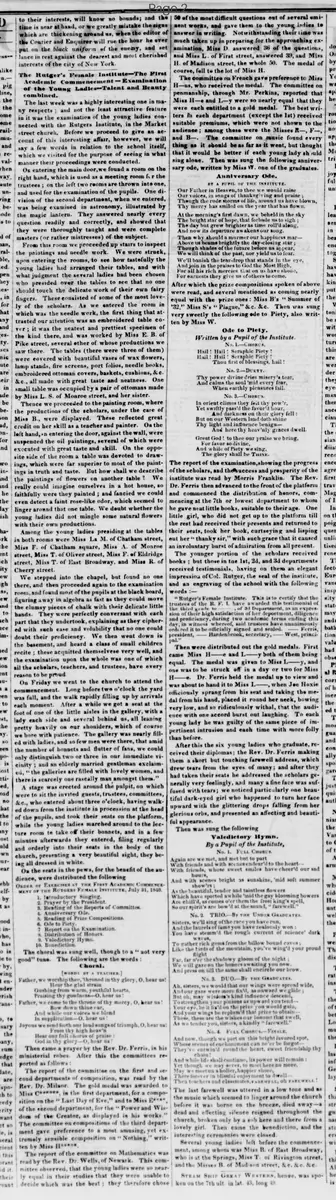
The last week was a highly interesting one in many respects; and not the least attractive feature in it was the examination of the young ladies connected with the Rutgers Institute, in the Market street church. Before we proceed to give an account of this interesting affair, however, we will say a few words in relation to the school itself, which we visited for the purpose of seeing in what manner their proceedings were conducted.
On entering the main door, we found a room on the right hand, which is used as a meeting room for the trustees; on the left two rooms are thrown into one, and used for the examination of the pupils. One division of the second department, when we entered, was being examined in astronomy, illustrated by the magic lantern. They answered nearly every question readily and correctly, and showed that they were thoroughly taught and were complete masters (or rather mistresses) of the subject.
From this room we proceeded up stairs to inspect the paintings and needle work. We were struck, upon entering the rooms, to see how tastefully the young ladies had arranged their tables, and with what judgment the several ladies had been chosen who presided over the tables to see that no one should touch the delicate work of their own fairy fingers. These consisted of some of the most lovely of the scholars. As we entered the room in which was the needle work, the first thing that attracted our attention was an embroidered table cover; it was the neatest and prettiest specimen of the kind there, and was worked by Miss E. B. of Pike street, several other of whose productions we saw there. The tables (there were three of them) were covered with beautiful vases of wax flowers, lamp stands, fire screens, port folios, needle books, embroidered ottoman covers, baskets, cushions, &c. &c., all made with great taste and neatness. One small table was occupied by a pair of ottomans made by Miss L. S. of Monroe street, and her sister.
Thence we proceeded to the painting room, where the productions of the scholars, under the care of Miss B., were displayed. These reflected great credit on her skill as a teacher and painter. On the left hand, on entering the door, against the wall, were suspended the oil paintings, several of which were executed with great taste and skill. On the opposite side of the room a table was devoted to drawings, which were far superior to most of the paintings in truth and taste. But how shall we describe the paintings of flowers on another table? We really could imagine ourselves in a hot house, so faithfully were they painted; and fancied we could even detect a faint rose-like odor, which seemed to linger around that one table. We doubt whether the young ladies did not mingle some natural flowers with their own productions.
Among the young ladies presiding at the tables in both rooms were Miss La M. of Chatham street, Miss F. of Chatham square, Miss A. of Monroe street, Miss T. of Oliver street, Miss F. of Eldridge street, Miss T. of East Broadway, and Miss R. of Cherry street.
We stepped into the chapel, but found no one there, and then proceeded again to the examination room, and found most of the pupils at the black board, figuring away in algebra as fast as they could move the clumsy pieces of chalk with their delicate little hands. They were perfectly conversant with each part that they undertook, explaining as they ciphered with such ease and volubility that no one could doubt their proficiency. We then went down in the basement, and heard a class of small children recite; these acquitted themselves very well, and the examination upon the whole was one of which all the scholars, teachers, and trustees, have every reason to be proud.
On Friday we went to the church to attend the commencement. Long before two o'clock the yard was full, and the walk rapidly filling up by arrivals each moment. After a while we got a seat at the foot of one of the little aisles in the gallery, with a lady each side and several behind us, all leaning pretty heavily on our shoulders, which of course we bore with patience. The gallery was nearly filled with ladies, and so few men were there, that amid the number of bonnets and flutter of fans, we could only distinguish two or three in our immediate vicinity; and an elderly married gentleman exclaimed, "the galleries are filled with lovely women, and there is scarcely one rascally man amongst them."
A stage was erected around the pulpit, on which were to sit the invited guests, trustees, committees, &c., who entered about three o'clock, having walked down from the institute in procession at the head of the pupils, and took their seats on the platform, while the young ladies marched around to the lecture room to take off their bonnets, and in a few minutes afterwards they entered, filing regularly and orderly into their seats in the body of the church, presenting a very beautiful sight, they being all dressed in white.
On the seats in the pews, for the benefit of the audience, were distributed the following Order of Exercises at the First Academic Commencement of the Rutgers Female Institute, July 31, 1840.
1. Introductory Singing
2. Prayer by the President.
3. Reading of the Reports of Committees.
4. Anniversary Ode.
5. Reading of Prize Compositions.
Ode to Piety.
6. Report on the Examination.
7. Distribution of Honors.
8. Valedictory Hymn.
9. Benediction.
The choral was sung well, though to a "not very good" tune. The following are the words:
Choral.
[WORDS BY A TEACHER.]
Father, we worship thee, throned in thy glory, O, hear us!
Hear the glad strain
Gushing from warm, youthful hearts,
Praising thy goodness—O, hear us!
Father, we come to the throne of thy mercy, O, hear us!
Bow down thine ear,
And while our voices we blend
In supplication—O, hear us!
Joyous we send forth our loud songs of triumph, O, hear us!
From thy high heaven
Hear our full chorus of praise:
God in thy glory—O, hear us!
Then came a prayer by the Rev. Dr. Ferris, in his ministerial robes. After this the committees reported as follows:
The report of the committee on the first and second departments of composition, was read by the Rev. Dr. Milnor. The gold medal was awarded to Miss C. E. E. S., in the first department, for a composition on the "Last Day of Eve," and to Miss E. V. of the second department, for the "Power and Wisdom of the Creator, as displayed in his works."
The committee on compositions of the third department gave preference to a most amusing, yet extremely sensible composition on "Nothing," written by Miss H. H. S.
The report of the committee on Mathematics was read by the Rev. Dr. Wells, of Newark. This committee observed, that the young ladies were so nearly equal in their studies that they were unable to decide which was the best; they therefore chose 50 of the most difficult questions out of several eminent works, and gave them to the young ladies to answer in writing. Notwithstanding their time was much taken up in preparing for the approaching examination, Miss D. answered 36 of the questions, and Miss L. of First street, answered 39, and Miss H. of Madison street, the whole 50. The medal of course, fell to the lot of Miss H.
The committee on French gave preference to Miss H. H. S., who received the medal. The committee on penmanship, through Mr. Perkins, reported that Miss H. E. and L. Y. were so nearly equal that they were each entitled to a gold medal. The best writers in each department (except the 1st) received suitable premiums, which were not shown to the audience; among these were the Misses R., F., and B. The committee on music found every thing as it should be as far as it went, but thought that it would be better if each young lady should sing alone. Then was sung the following anniversary ode, written by Miss W., one of the graduates.
Anniversary Ode.
THE INSTITUTE.
Our Father in Heaven, to thee we would raise
Our voices, in songs of thanksgiving and praise;
Though the rude storms of life, around us have blown,
Thy mercy has smiled on the year that has flow'n.
At the morning's first dawn, we beheld in the sky
The bright star of hope, that forbade us to sigh;
The day but grew brighter as time roll'd along,
And now its departure awakens our song.
Then why should a murmur our happiness mar-
Above us beams brightly the day-closing star;
Though shades of the future before us appear,
We will think of the past, nor yield us to fear.
We'll banish the tear-drop that stands in the eye,
And join in the praises to God the Most High,
For all his rich mercies that on us have shone,
For earnests they give us of others to come.
After which the prize compositions spoken of above were read, and several mentioned as coming nearly equal with the prize ones: Miss B.'s "Summer of '32." Miss S.'s "Plague," &c. &c. Then was sung very sweetly the following ode to Piety, also written by Miss W.
Ode to Piety.
Written by a Pupil of the Institute.
No.1.—CHORUS.
Hail! Hail! Seraphic Piety!
Hail! Hail! Seraphic Piety
Thou first of blessings, hail!
No. 2.—DUETT.
Thy power divine dries misery's tear.
And calms the soul 'mid every fear,
When earthly pleasures fail.
No. 3.—CHORUS.
In orient climes they felt thy pow'r,
Yet swiftly pass'd the favor'd hour,
And darkness on their glory fell:
But on our Western land doth shine
Thy light and influence benign—
And here thy heav'nly graces dwell.
Great God! to thee our praise we bring,
For favor so divine,
And while of Piety we sing,
The glory shall be Thine.
The report of the examination, showing the progress of the scholars, and the success and prosperity of the institute was read by Morris Franklin. The Rev. Dr. Ferris then advanced to the front of the platform and commenced the distribution of honors, commencing at the 7th or lowest department to whom he gave neat little books, suitable to their age. One little girl, who did not get up to the platform till the rest had received their presents and returned to their seats, took her book, curtseying and lisping out her "thank you sir," with such grace that it caused an involuntary burst of admiration from all present.
The younger portion of the scholars received books; but those in the 1st, 2d, and 3d departments received testimonials, having on them an elegant impression of Col. Rutgers, the seal of the institute, and an engraving of the school with the following words:-
"Rutgers Female Institute. This is to certify that the trustees of the R. F. I. have awarded this testimonial of the third grade to [name], of [ ] Department, as an expression of their high satisfaction of her deportment, diligence and proficiency, during two academic terms ending this day, in witness whereof, said trustees have unanimously ordered it to be officially signed and sealed. Ferris, president, Hardenbrook, secretary, West, principal."
Then were distributed the gold medals. First came Miss H. E. and L. Y. both of them being equal. The medal was given to Miss L. Y., and one was to be struck off in a day or two for Miss H. E. Dr. Ferris held the medal up to view and was about to hand it to Miss L. Y., when J. E. Hoxie officiously sprang from his seat and taking the medal from his hand, placed it round her neck, bowing very low, and so ridiculously withal, that the audience with one accord burst out laughing. To each young lady he was guilty of the same piece of impertinent intrusion and each time with more folly than before.
After this the six young ladies who graduate, received their diplomas: the Rev. Dr. Ferris making them a short but touching farewell address, which drew tears from the eyes of many; and after they had taken their seats he addressed the scholars generally very feelingly, and many a fine face was suffused with tears; we noticed particularly one beautiful dark-eyed girl who happened to turn her face upward with the glittering drops falling from her glorious orbs, and presented an affecting and beautiful appearance.
Then was sung the following Valedictory Hymn.
By a Pupil of the Institute.
No. 1. FULL CHORUS.
Again are we met, and met but to part
With friends and with scenes endear'd to the heart—
With friends, whose sweet smiles have cheer'd our sad hours,
And with scenes bright sunshine, 'mid soft summer show'rs;
As the beautiful, tender and taintless flowers
Which have sported awhile 'mid the gay blooming bowers
Are chill'd, as comes o'er them the frost king's spell.
So our spirit's are bow'd at the sound, "farewell."
No. 2. TRIO.—By the Under Graduates.
Sisters, we'll sing of the race you have run,
And the laurels of fame you have zealously won:
You have stemm'd the rough current of science' dark waves,
To gather rich gems from the billow bound caves:
Like the birds of the mountain, you've wing'd your proud flight
Far, far o'er the shadowy gloom of the night:
We will gaze on the honors awaiting you now.
And press on till the same shall encircle our brow.
No. 3. DUO.—By the Graduates.
Ah, sisters, we would that our wings were spread wide,
And our gaze were more fix'd, as onward we glide;
But oh, may wisdom's kind influence descend.
To strengthen your pinions as upward you tend—
Your eye, be it fix'd on the prize you would gain.
And your wings be replum'd that prize to obtain—
These, these are the wishes our bosoms that swell.
As we tender you, sisters, a kindly "farewell."
No. 4. FULL CHORUS.—FINALE.
And now, though we part on this bright favored spot,
Whose scenes of enchantment can ne'er be forgot—
They've entwin'd round the heart, sweet friendship's thy chain!
And while life shall continue, its power will remain:
Yet though we may sever, to meet here no more,
May we meet on a holier, happier shore,
There forever in blissful enjoyment to dwell—
The teachers and classmates, FAREWELL, Oh FAREWELL!
The last farewell was uttered in a low tone and as the music which seemed to linger around the church before it was borne on the breeze, died away—a dead and affecting silence reigned throughout the church, broken only by a sob here and there from a lovely girl. Then came the benediction, and the interesting ceremonies were closed.
Several young ladies left before the commencement, among whom was Miss B. of East Broadway, who is at the Springs, Miss T. of Rivington street, and the Misses B. of Madison street, &c. &c. &c.
Steam Ship Great Western, hence, was spoken on the 7th ult. in lat. 13, long 49.
What sub-type of article is it?
What themes does it cover?
What keywords are associated?
What entities or persons were involved?
Where did it happen?
Story Details
Key Persons
Location
Rutgers Female Institute, Market Street Church, New York City
Event Date
July 31, 1840
Story Details
The article describes the examination of pupils in astronomy, algebra, and arts like needlework and painting, followed by the commencement ceremony with prayers, reports, odes, prize readings, honor distributions including gold medals for composition, mathematics, French, and penmanship, and emotional farewells to graduates.