Thank you for visiting SNEWPapers!
Sign up free
Buckeye Valley News And Buckeye Review
Buckeye, Maricopa County, Arizona
What is this article about?
The Atomic Energy Commission announced a $9 million project to build a new, more powerful cyclotron at the University of California in Berkeley to advance atomic research. The machine will be 20 times stronger than the current one and take five years to complete.
Clipping
OCR Quality
Full Text
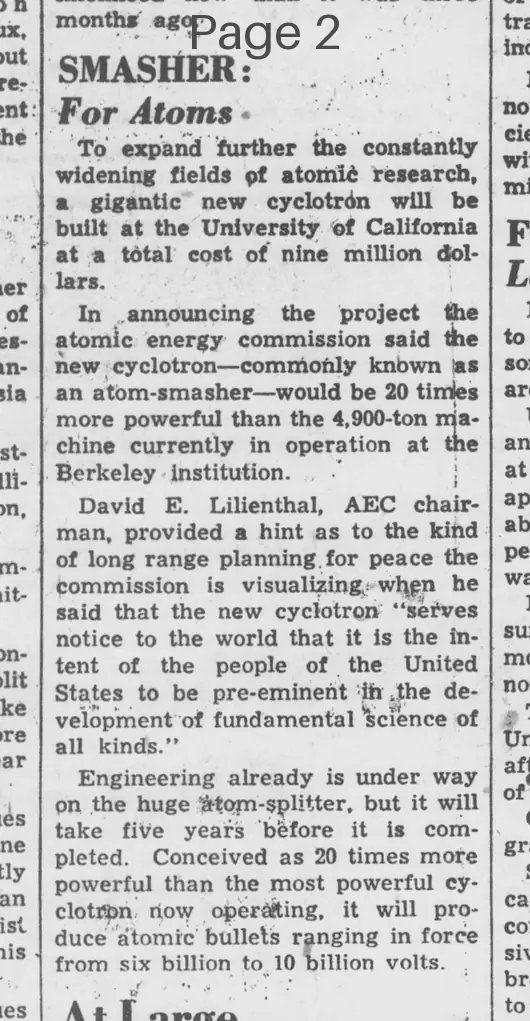
For Atoms
To expand further the constantly widening fields of atomic research, a gigantic new cyclotron will be built at the University of California at a total cost of nine million dollars.
In announcing the project the atomic energy commission said the new cyclotron—commonly known as an atom-smasher—would be 20 times more powerful than the 4,900-ton machine currently in operation at the Berkeley institution.
David E. Lilienthal, AEC chairman, provided a hint as to the kind of long range planning for peace the commission is visualizing: when he said that the new cyclotron "serves notice to the world that it is the intent of the people of the United States to be pre-eminent in the development of fundamental science of all kinds."
Engineering already is under way on the huge atom-splitter, but it will take five years before it is completed. Conceived as 20 times more powerful than the most powerful cyclotron now operating, it will produce atomic bullets ranging in force from six billion to 10 billion volts.
What sub-type of article is it?
What keywords are associated?
What entities or persons were involved?
Where did it happen?
Domestic News Details
Primary Location
University Of California, Berkeley
Key Persons
Outcome
the cyclotron will be completed in five years at a cost of nine million dollars and will be 20 times more powerful than the current machine.
Event Details
The Atomic Energy Commission announced plans to build a new cyclotron at the University of California to expand atomic research. The machine, known as an atom-smasher, will produce atomic bullets from six billion to 10 billion volts. Engineering is underway.