Thank you for visiting SNEWPapers!
Sign up free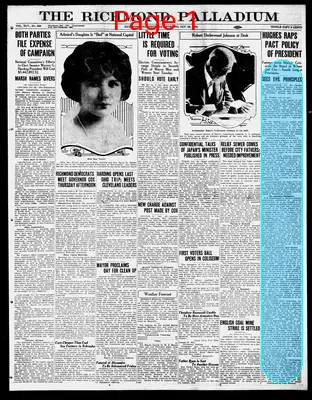
The Richmond Palladium And Sun Telegram
Richmond, Wayne County, Indiana
What is this article about?
Charles E. Hughes, in a speech before the Columbia club in Indianapolis on Oct. 28, sharply criticizes President Wilson and Governor Cox's insistence on the League of Nations covenant, particularly Article X, arguing it contains vicious principles and that Wilson rejected reservations impairing it.
Clipping

OCR Quality
Full Text
SEES EVIL PRINCIPLES
INDIANAPOLIS, Oct. 28—Charles E. Hughes, speaking before the Columbia club today, sharply criticized the league of nations and the stand of President Wilson and Governor Cox.
Mr. Hughes said in part:
With respect to the league of nations, the issue submitted to the people in this great and solemn referendum was perfectly clear and definite. It was whether the covenant on which Mr. Wilson insisted should have been accepted by the senate. It was not whether the covenant had certain good features, but whether it had bad provisions which made it unacceptable.
In the opinion of its author and champion, the distinctive feature of the covenant was Article X. Mr. Wilson said that Article X was "undoubtedly the foundation of the whole structure." Certainly the Republican party cannot be blamed for testing the structure by its foundation.
Vicious Principles in Article X.
What is meant when it is said that Mr. Wilson did not insist on the covenant without change? Is it meant simply that Mr. Wilson was willing to agree to reservations or interpretations which did not affect the substance or true import of the covenant as he submitted it?
If so, the issue remains precisely the same, for the Republican party objects to the covenant in substance as he submitted it, and especially because that covenant contained in Article X a provision vicious in its substance and true import. Is it meant that Mr. Wilson was willing to agree to reservations which eliminated the obligation to be assumed by Article X? If so, to use their own mode of expression, the assertion is false, demonstrably false.
I understand that the basis of the assertion is, that President Wilson wrote to Senator Hitchcock, stating that he was willing to accept reservations, and it is now pretended that "these reservations met every objection sincerely urged by Republican critics."
No Analysis Necessary.
It is unnecessary to analyze Senator Hitchcock's statements or proposed reservations, or to go through a detailed argument showing their purport, for we have the high and conclusive authority of Mr. Wilson himself as to the reservations which he was willing to accept and as to the utmost limit to which he would go. Our friends on the other side cannot complain that in determining Mr. Wilson's attitude by Senator Hitchcock's reservations, we should measure these reservations by Mr. Wilson's own yard-stick. Nor is it necessary to review the discussion in the senate, for we have Mr. Wilson's letter to Senator Hitchcock as late as March 8, 1920, which so clearly states his position that it is beyond any possibility of cavil. Did his letter state that Mr. Wilson was willing to accept a reservation which in any way impaired the obligation to be assumed under Article X? Not at all. He stated the exact contrary.
Heart of Covenant, Said Wilson.
Let me refer to what Mr. Wilson explicitly said about Article X in this letter, written almost at the close of the debate. He said: "Any reservation which seeks to deprive the League of Nations of the force of Article X cuts at the very heart and life of the Covenant itself." Again, "If Article X is not adopted and acted upon, the governments which reject it will, I think, be guilty of bad faith in their people." Again, "If we were to reject Article X or so to weaken it as to take its full force out of it, it would mark us as desiring to return to the old world of jealous rivalry and misunderstandings." Again, "I hold the doctrine of Article X as the essence of Americanism. We cannot repudiate it or weaken it without at the same time repudiating our own principles." Again, "The enemies of a League of Nations have by every true instinct centred their efforts against Article X, for it is undoubtedly the foundation of the whole structure."
After reading these assertions, not the less emphatic because seriously mistaken, we are prepared to find that Mr. Wilson was not willing to agree to any reservation which would impair the obligation of Article X. Do his supporters say that he was willing to sacrifice "the heart and life of the Covenant?" To weaken or destroy its "foundation"? To repudiate "the essence of Americanism"? To be guilty of "bad faith" with respect to a matter in which he had been the principal actor? Those who most strenuously oppose Mr. Wilson will not lay this charge at his door. They are content to show his serious error, but do not impute to him such an attempt to deceive the people as would be involved in the pretense that he favored a reservation eliminating the obligation of Article X. Upon this Article, as his own child, he centred his affection. From his determination to compel the American people to accept it he has never wavered for a moment. It is this determination which, as Mr. Hoover has said, shows the most serious failure in statesmanship that we have had since the Civil War.
When we come to the reservations which Mr. Cox is willing to adopt, we find exactly the same attitude as that of Mr. Wilson, a willingness to state the unnecessary and superfluous, but a determination not to impair the obligation of Article X. Mr. Cox says that he is willing "to accept reservations that will clarify, or will be helpful, that will reassure the American people." Does he think, now that this issue has been presented, to escape...
What sub-type of article is it?
What keywords are associated?
What entities or persons were involved?
Where did it happen?
Domestic News Details
Primary Location
Indianapolis
Event Date
Oct. 28
Key Persons
Event Details
Charles E. Hughes, speaking before the Columbia club, sharply criticized the league of nations and the stand of President Wilson and Governor Cox, focusing on the covenant's Article X as vicious in substance and arguing that Wilson rejected reservations impairing its obligations, quoting Wilson's letter to Senator Hitchcock from March 8, 1920.