Thank you for visiting SNEWPapers!
Sign up free
Daily National Intelligencer
Washington, District Of Columbia
What is this article about?
Report defends the permanence of the republican revolution in Pernambuco, Paraiba, and Rio Grande do Norte provinces of Brazil against Portuguese rule, based on accounts up to April 1817. Counters claims of opposition and blockade, highlighting local enthusiasm and Portuguese naval weakness.
Clipping
OCR Quality
Full Text
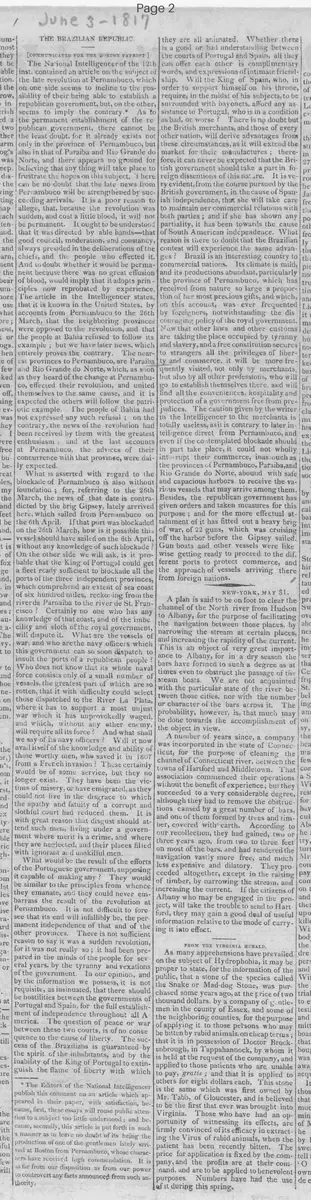
THE BRAZILIAN REPUBLIC
[COMMUNICATED FOR THE BOSTON PATRIOT]
The National Intelligencer of the 12th inst. contained an article on the subject of the late revolution at Pernambuco, which on one side seems to incline to the possibility of their being able to establish a republican government, but, on the other, seems to imply the contrary.* As to the permanent establishment of the republican government, there cannot be the least doubt, for it already exists not only in the province of Pernambuco, but also in that of Paraiba and Rio Grande do Norte, and there appears no ground for believing that any thing will take place to frustrate the hopes on this subject. There can be no doubt that the late news from Pernambuco will be strengthened by succeeding arrivals. It is a poor reason to allege, that, because the revolution was sudden, and cost a little blood, it will not be permanent. It ought to be understood that it was directed by able hands--that good council, moderation, and constancy, always presided in the deliberations of the chiefs, and the people who effected it. And to doubt whether it would be permanent because there was no great effusion of blood, would imply that it adopts principles now reprobated by experience.
The article in the Intelligencer states, that it is known in the United States, by accounts from Pernambuco to the 26th March, that the neighboring provinces were opposed to the revolution, and that the people at Bahia refused to follow its example: but we have later news, which entirely proves the contrary. The nearest provinces to Pernambuco, are Paraiba and Rio Grande do Norte, which, as soon as they heard of the change at Pernambuco, effected their revolution, and united themselves to the same cause, and it is expected the others will follow the patriotic example. The people of Bahia had not expressed any such refusal; on the contrary, the news of the revolution had been received by them with the greatest enthusiasm; and at the last accounts at Pernambuco, the advices of their concurrence with that province, were daily expected.
What is asserted with regard to the blockade of Pernambuco is also without foundation: for, referring to the 26th March, the news of that date is contradicted by the brig Gipsey, lately arrived here, which sailed from Pernambuco on the 6th April. If that port was blockaded on the 26th March, how is it possible this vessel should have sailed on the 6th April, without any knowledge of such blockade?
On the other side we will ask, is it probable that the King of Portugal could get a fleet ready sufficient to blockade all the ports of the three independent provinces, which comprehend an extent of sea coast of six hundred miles, reckoning from the river da Parnaiba to the river de St. Francisco? Certainly no one who has any knowledge of that coast, and of the imbecility and sloth of the royal government, will dispute it. What are the vessels of war, and who are the navy officers which this government can so soon dispatch to insult the ports of a republican people? Who does not know that its whole naval force consists only of a small number of vessels, the greatest part of which are so rotten, that it with difficulty could select those dispatched to the River La Plata, where it has to support a most unjust war which it has unprovokedly waged, and which, without any other enemy, will require all its force? And what shall we say of its navy officers? Will it now avail itself of the knowledge and ability of those worthy men, who saved it in 1807 from a French invasion? These certainly would be of some service, but they no longer exist. They have been the victims of misery, or have emigrated, as they could not live in the disgrace to which the apathy and fatuity of a corrupt and slothful court had reduced them. It is with great reason that disgust should attend such men, living under a government where merit is a crime, and where they are neglected, and their places filled with ignorant and unskilful men.
What would be the result of the efforts of the Portuguese government, supposing it capable of making any? They would be similar to the principles from whence they emanate, and they could never embarrass the result of the revolution at Pernambuco. It is not difficult to foresee that its end will infallibly be, the permanent independence of that and of the other provinces. There is not sufficient reason to say it was a sudden revolution, for it was not really so; it had been prepared in the minds of the people for several years, by the tyranny and vexations of the government. In our opinion, and by the information we possess, it is not requisite, as insinuated, that there should be hostilities between the governments of Portugal and Spain, for the full establishment of independence throughout all America. The question of peace or war between these two courts, is of no consequence to the cause of liberty. The success of the Brazilians is guaranteed by the spirit of the inhabitants, and by the inability of the King of Portugal to extinguish the flame of liberty with which they are all animated. Whether there is a good or bad understanding between the courts of Portugal and Spain, all they can offer each other is complimentary words, and expressions of intimate friendship. Will the King of Spain, who, in order to support himself on his throne, require, in the midst of his subjects, to be surrounded with bayonets, afford any assistance to Portugal, who is in a condition as bad, or worse? There is no doubt but the British merchants, and those of every other nation, will derive advantages from these circumstances, as it will extend the market for their manufactures; therefore, it can never be expected that the British government should take a part in foreign dissentions of this nature. It is very evident, from the course pursued by the British government, in the cause of Spanish independence, that she will take care to maintain her commercial relations with both parties; and if she has shown any partiality, it has been towards the cause of South American independence. What reason is there to doubt that the Brazilian contest will experience the same advantages? Brazil is an interesting country to commercial nations. Its climate is mild, and its productions abundant, particularly the province of Pernambuco, which has received from nature so large a proportion of her most precious gifts, and which, on this account, was ever frequented by foreigners, notwithstanding the discouraging policy of the royal government. Now that other laws and other customs are taking the place occupied by tyranny and slavery, and a free constitution secures to strangers all the privileges of liberty and commerce, it will be more frequently visited, not only by merchants, but also by all other professions, who will go to establish themselves there, and will find all the conveniences, hospitality and protection of a government free from prejudices. The caution given by the writer in the Intelligencer to the merchants is totally useless, as it is contrary to later intelligence direct from Pernambuco, and even if the contemplated blockade should in part take place, it could not wholly interrupt their commerce, inasmuch as the provinces of Pernambuco, Paraiba, and Rio Grande do Norte, abound with safe and capacious harbors to receive the various vessels that may arrive among them. Besides, the republican government has given orders and taken measures for this purpose; and for the more effectual attainment of it has fitted out a heavy brig of war, of 22 guns, which was cruising off the harbor before the Gipsey sailed. Gun boats and other vessels were likewise getting ready to proceed to the different ports to protect commerce, and the approach of vessels arriving there from foreign nations.
* The Editors of the National Intelligencer publish this comment on an article which appeared in their paper, with satisfaction, because, first, these essays will rouse public attention to a subject too little understood; and because, secondly, this article is put forth in such a manner as to leave no doubt of its being the production of one of the gentlemen lately arrived at Boston from Pernambuco, whose characters have received high commendation. It is as far from our disposition as from our power to controvert any facts announced from such authority.
What sub-type of article is it?
What keywords are associated?
What entities or persons were involved?
Where did it happen?
Foreign News Details
Primary Location
Pernambuco
Event Date
Accounts To 26th March 1817; Sailed 6th April 1817
Key Persons
Outcome
minimal bloodshed; successful establishment of republican government in pernambuco, paraiba, and rio grande do norte; expected spread to other provinces; no effective portuguese blockade or counteraction due to naval weakness.
Event Details
The revolution in Pernambuco, prepared over years due to Portuguese tyranny, has established a permanent republican government with moderation and able leadership. Neighboring provinces of Paraiba and Rio Grande do Norte quickly joined, with Bahia showing enthusiasm. No blockade occurred, as evidenced by the brig Gipsey's departure on April 6. Portuguese naval forces are inadequate and decayed, unable to suppress the independence movement. British neutrality favors commerce with the new republics.