Thank you for visiting SNEWPapers!
Sign up free
Trainman News
Indianapolis, Marion County, Indiana
What is this article about?
In 1952, American factory workers' spendable pay averaged $66.26 weekly for a family of four, falling short of the $81.52 needed for a modest adequate budget amid rising costs. Data from 1939-1952 shows wages lagging behind inflation, with income inequality evident as the top fifth received nearly half of national income.
Merged-components note: Continuation of article across pages 1 and 5.
Clippings
1 of 2
OCR Quality
Full Text
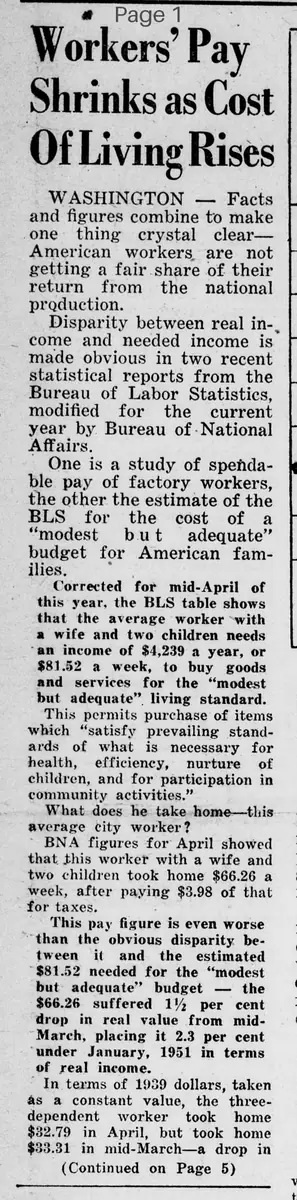
WASHINGTON - Facts and figures combine to make one thing crystal clear-- American workers are not getting a fair share of their return from the national production.
Disparity between real income and needed income is made obvious in two recent statistical reports from the Bureau of Labor Statistics, modified for the current year by Bureau of National Affairs.
One is a study of spendable pay of factory workers, the other the estimate of the BLS for the cost of a "modest but adequate" budget for American families.
Corrected for mid-April of this year, the BLS table shows that the average worker with a wife and two children needs an income of $4,239 a year, or $81.52 a week, to buy goods and services for the "modest but adequate" living standard.
This permits purchase of items which "satisfy prevailing standards of what is necessary for health, efficiency, nurture of children, and for participation in community activities."
What does he take home-this average city worker?
BNA figures for April showed that this worker with a wife and two children took home $66.26 a week, after paying $3.98 of that for taxes.
This pay figure is even worse "than the obvious disparity between it and the estimated $81.52 needed for the "modest but adequate" budget - the $66.26 suffered 1½ per cent drop in real value from mid-March, placing it 2.3 per cent under January, 1951 in terms of real income.
In terms of 1939 dollars. taken as a constant value. the three-dependent worker took home $32.79 in April, but took home $33.31 in mid-March-a drop in
(Continued on Page 5)
Workers' Pay
Shrinks as Cost
Of Living Rises
(Continued from Page 1)
buying power in that month.
Here's what happened from 1939 to 1952, in terms of the constant dollar of 1939:
Cost of living index was at 100 in 1939. A three-dependent worker took home $23.62. In January, 1951, he took home $33.17 in terms of the 1939 dollar, but cost of living was at 182.6--cost of living up 82 per cent, wages less than a third.
In April, 1952, the worker takes home $32.79 less than in January, 1951--and cost of living index is at 189.8, or up over seven per cent from January, 1951.
The "modest but adequate" budget as estimated by the BLS as corrected for 1952 by the BNA shows a 12.7 per cent rise in estimated needed income over October, 1950. At that time, the worker needed (for a family of four) $3,761 or $72.33 a week.
What did he get?
That's a question for the U. S. Census to answer. The 1950 census showed some discouraging statistics regarding what is needed and what is received.
Of the nation's 40 million families, 10 million had incomes of less than $2,000 a year: 31 million families had less than $5,000 a year.
The average family got $3,300 a year. The average veteran earned $3,008 and the average non-veteran $2.626 in 1950.
Those figures don't compare comfortably to the estimated $3,761 needed for a "modest but adequate" budget as figured by the Bureau of Labor Statistics for 1950.
Further matter for contemplation, but hard for understanding, is another fact, disclosed by the 1951 Statistical Abstract of the U. S.--the table of income received by each fifth of the nation's population.
The figures are for the year 1947, but appear in the current abstract. The lowest fifth of the population by income received four per cent of total money income; the second fifth got 9.8 per cent; the third fifth got 15.4: the fourth fifth got 22.6 per cent; the top fifth got 48.2 per cent of the total national income for the year.
In other words, the top fifth of the income ladder got just about as much as the rest of the population together.
Another difficult fact for the average worker to absorb is the tendency of the nation's law-makers to place ridiculously low floors on such measures as minimum wage laws--75 cents an hour is the legal minimum - somewhere around $30 or $40 a week, depending on overtime or sixth-day work. Yet the government's own estimators say that a family of four needs $81.52 a week for adequate living.
What sub-type of article is it?
What themes does it cover?
What keywords are associated?
Where did it happen?
Story Details
Location
United States
Event Date
April 1952
Story Details
Statistical reports reveal that average factory workers' spendable pay of $66.26 weekly falls short of the $81.52 needed for a modest adequate budget for a family of four, with wages declining in real value since 1939 while costs rise, highlighting income inequality where the top fifth receives nearly half of national income.