Thank you for visiting SNEWPapers!
Sign up free
The National Intelligencer And Washington Advertiser
Washington, District Of Columbia
What is this article about?
In the English House of Lords on 21 January 1808, several peers protested against a motion approving the seizure of the Danish fleet and attack on Copenhagen, arguing it violated international law and British principles without proof of Danish hostility.
Clipping
OCR Quality
Full Text
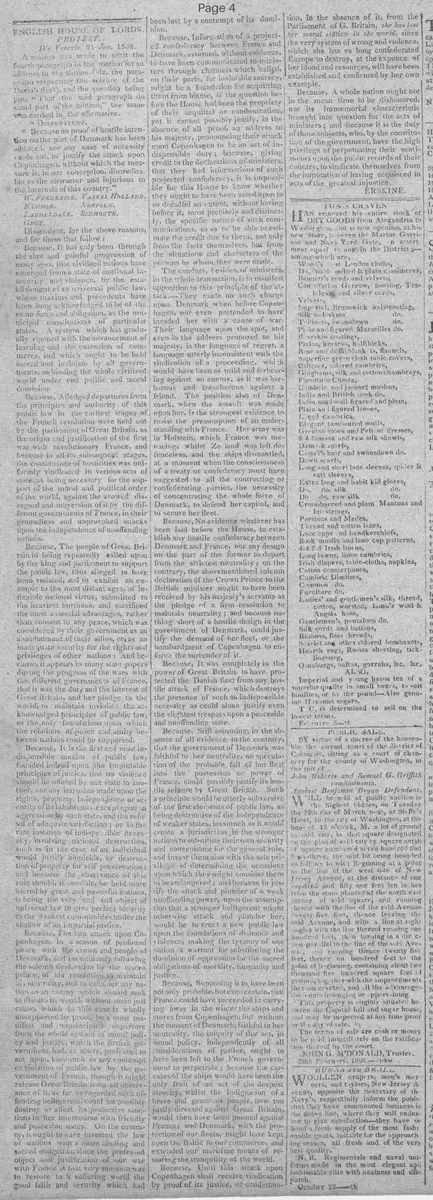
PROTEST.
Die Veneris, 21 Jan. 1808.
A motion was made to omit the fourth paragraph in the motion for an address to the throne (viz. the paragraph respecting the seizure of the Danish fleet), and the question being put, "That the said paragraph do stand part of the motion," the same was carried in the affirmative.
"DISSENTIENT,
Because no proof of hostile intention on the part of Denmark has been adduced, nor any case of necessity made out, to justify the attack upon Copenhagen, without which the measure is, in our conception, discreditable to the character and injurious to the interests of this country."
W. FREDERICK. VASSAL HOLLAND.
RAWSON.
NORFOLK.
LAUDERDALE. SIDMOUTH.
GREY.
Dissentient, for the above reasons, and for those that follow:
Because, It has only been through the slow and painful progression of many ages, that civilized nations have emerged from a state of continual insecurity and violence, by the establishment of an universal public law, whose maxims and precedents have been long acknowledged to be of the same force and obligation, as the municipal constitutions of particular states. A system which has gradually ripened with the advancement of learning and the extension of commerce, and which ought to be held sacred and inviolate by all governments, as binding the whole civilized world under one politic and moral dominion,
Because, Alleged departures from the principles and authority of this public law in the earliest stages of the French revolution were held out by the parliament of Great Britain, as the origin and justification of the first war with revolutionary France, and because in all its subsequent stages, the continuance of hostilities was uniformly vindicated in various acts of state, as being necessary for the support of the moral and political order of the world, against the avowed disregard and subversion of it by the different governments of France, in their groundless and unprovoked attacks upon the independence of unoffending nations.
Because, The people of Great Britain in being repeatedly called upon by the king and parliament to support the public law, thus alleged to have been violated, and to exhibit an example to the most distant ages, of inflexible national virtue, submitted to the heaviest burdens, and sacrificed the most essential advantages, rather than consent to any peace, which was considered by their government as an abandonment of their allies, or as an inadequate security for the rights and privileges of other nations: And because, it appears in many state papers during the progress of the wars with the different governments of France, that it was the duty and the interest of Great Britain, and her pledge to the world, to maintain inviolate the acknowledged principles of public law, as the only foundations upon which the relations of peace and amity between nations could be supported.
Because, It is the first and most indispensable maxim of public law, founded indeed upon the immutable principles of justice, that no violence should be offered by one state to another, nor any intrusion made upon the rights, property, independence or security of its inhabitants, except upon aggression by such state, and the refusal of adequate satisfaction; or in the rare instance of indispensable necessity, involving national destruction, such as in the case of an individual would justify homicide, or destruction of property for self preservation: and because the observance of this rule should, if possible, be held more sacred by great and powerful nations, it being the very end and object of universal law to give perfect security to the weakest communities under the shadow of an impartial justice.
Because, The late attack upon Copenhagen, in a season of profound peace with the crown and people of Denmark, and immediately following the solemn declaration by the crown prince, of his resolution to maintain his neutrality, and to consider any nation as an enemy which should seek to disturb it, would, without some just cause, which in this case is wholly unsupported by proof, be a most manifest and unprincipled departure from the whole system of moral policy and justice, which the British government had, as above, professed to act upon, inasmuch as any contempt or violation of public law by the government of France, though it might release Great Britain from all observance of it, as far as regarded such offending belligerent, could not possibly destroy or affect its protective sanctions in her intercourse with friendly and peaceable states. On the contrary, it ought to have invested the law of nations with a more binding and sacred obligation, since the professed object and justification of our war with France at that very moment was to restore to a suffering world the good faith and security which had been lost by a contempt of its dominion.
Because, Information of a projected confederacy between France and Denmark, assumed, without evidence, to have been communicated to ministers through channels which called, on their parts, for inviolable secrecy, might be a foundation for acquitting them from blame, if the question before the House had been the propriety of their acquittal or condemnation, yet it cannot possibly justify, in the absence of all proof, an address to his majesty, pronouncing their attack upon Copenhagen to be an act of indispensable duty; because, giving credit to the declarations of ministers, that they had informations of such projected confederacy, it is impossible for this House to know whether they ought to have been acted upon to so dreadful an extent, without having before it, most precisely and distinctly, the specific nature of such communications, so as to be able to estimate the credit due to them, not only from the facts themselves, but from the situations and characters of the persons by whom they were made.
The conduct, besides, of ministers, in the whole transaction, is in manifest opposition to this principle of the attack. They made no such charge upon Denmark when before Copenhagen, nor even pretended to have invaded her with a cause of war. Their language upon the spot, and even in the address proposed to his majesty, is the language of regret, a language utterly inconsistent with the vindication of a proceeding, which would have been as mild and forbearing against an enemy, as it was barbarous and treacherous against a friend. The position also of Denmark, when the assault was made upon her, is the strongest evidence to resist the presumption of an understanding with France. Her army was in Holstein, which France was menacing, whilst Zealand was left defenceless, and the ships dismantled, at a moment when the consciousness of a treaty or confederacy must have suggested to all the contracting or confederating parties, the necessity of concentrating the whole force of Denmark, to defend her capitol, and to secure her fleet.
Because, No evidence whatever has been laid before the House, to establish any hostile confederacy between Denmark and France, nor any design on the part of the former to depart from the strictest neutrality; on the contrary, the abovementioned solemn declaration of the Crown Prince to the British minister ought to have been received by his majesty's servants as the pledge of a firm resolution to maintain neutrality; and because nothing short of a hostile design in the government of Denmark, could justify the demand of her fleet, or the bombardment of Copenhagen to enforce the surrender of it.
Because, It was completely in the power of Great Britain to have protected the Danish fleet from any hostile attack of France, which destroys the pretence of such an indispensable necessity as could alone justify even the slightest trespass upon a peaceable and unoffending state.
Because, Still assuming, in the absence of all evidence to the contrary, that the government of Denmark was faithful to her neutrality, no speculation of the probable fall of her fleet into the possession or power of France, could possibly justify its hostile seizure by Great Britain. Such a principle would be utterly subversive of the first elements of public law, as being destructive of the independence of weaker states, inasmuch as it would create a jurisdiction in the stronger nations to substitute their own security and convenience for the general rule, and invest them also with the sole privilege of determining the occasions upon which they might consider themselves to be endangered: and because to justify the attack and plunder of a weak unoffending power, upon the assumption that a stronger belligerent might otherwise attack and plunder her, would be to erect a new public law upon the foundations of dishonor and violence, making the tyranny of one nation a warrant for substituting the dominion of oppression for the sacred obligations of morality, humanity and justice.
Because, Supposing it to have been not only probable, but even certain, that France could have succeeded in carrying away in the winter the ships and stores from Copenhagen, but without the consent of Denmark, faithful to her neutrality, the iniquity of that act, in sound policy, independently of all considerations of justice, ought to have been left to the French government to perpetrate; because the carcasses of the ships would have been the only fruit of an act of the deepest atrocity, whilst the indignation of a brave and generous people, now too justly directed against Great Britain, would then have been pointed against France; and Denmark, with the protection of our fleets, might have kept open the Baltic to our commerce, and extended our maritime means of restoring the tranquility of the world.
Because, Until this attack upon Copenhagen shall receive vindication by proof of its justice, or condemnation, in the absence of it, from the Parliament of G. Britain, she has lost her moral station in the world, since the very system of wrong and violence, which she has so long confederated Europe to destroy, at the expense of her blood and resources, will have been established and confirmed by her own example.
Because, A whole nation ought not in the mean time to be dishonored, nor its immemorial characteristic brought into question for the acts of ministers; and because it is the duty of those subjects, who, by the constitution of the government, have the high privilege of perpetuating their sentiments upon the public records of their country, to vindicate themselves from the imputation of having acquiesced in acts of the greatest injustice.
ERSKINE.
What sub-type of article is it?
What keywords are associated?
What entities or persons were involved?
Where did it happen?
Foreign News Details
Primary Location
Copenhagen
Event Date
21 Jan. 1808 (Protest On Late Attack)
Key Persons
Outcome
motion carried in affirmative; dissent recorded by several peers protesting violation of public law and lack of proof of danish hostility.
Event Details
Protest in House of Lords against approving seizure of Danish fleet and attack on Copenhagen, citing absence of proof of Danish aggression, violation of international law, and inconsistency with British war principles against France.