Thank you for visiting SNEWPapers!
Sign up free
The Liberator
Boston, Suffolk County, Massachusetts
What is this article about?
Rev. Mr. Givens details the horrors of Liberia colony to the 1833 Anti-Slavery Convention: false promises by American Colonization Society led to disease, starvation, and deaths among emigrants, including his family; no support, rocky land, and trade in rum and arms instead of aid.
Clipping
OCR Quality
Full Text
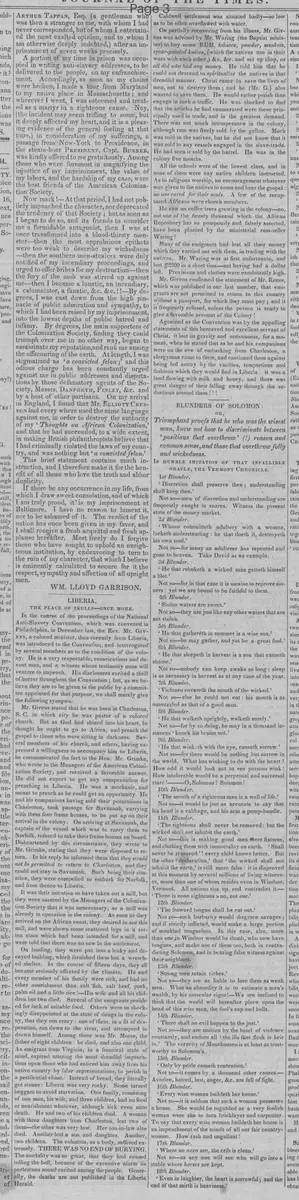
In the course of the proceedings of the National Anti-Slavery Convention, which was convened in Philadelphia, in December last, the Rev. Mr. Givens, a colored minister, then recently from Liberia, was introduced to the Convention, and interrogated by several members as to the condition of the colony. He is a very respectable, conscientious and devout man, and a witness whose testimony none will venture to impeach. His disclosures excited a thrill of horror throughout the Convention; but, as we believe they are to be given to the public by a committee appointed for that purpose, we shall merely give the following synopsis.
Mr. Givens stated that he was born in Charleston, S. C. in which city he was pastor of a colored church. But as God had shined into his heart, he thought he ought to go to Africa, and preach the gospel to those who were sitting in darkness. Several members of his church, and others, having expressed a willingness to accompany him to Liberia, he communicated the fact to the Hon. Mr. Grimke, who wrote to the Managers of the American Colonization Society, and received a favorable answer. He did not expect to get any compensation for preaching in Liberia. He was a mechanic, and meant to preach as he could get an opportunity. He and his companions having sold their possessions in Charleston, took passage for Savannah, carrying with them four frame houses, to be put up on their arrival in the colony. On arriving at Savannah, the captain of the vessel which was to carry them to Norfolk, refused to take their frame houses on board. Disheartened by this circumstance, they wrote to Mr. Grimke, stating that they were disposed to return. In his reply he informed them that they would not be permitted to return to Charleston, and they could not stay in Savannah. Such being their situation, they were compelled to embark for Norfolk, and from thence to Liberia.
It was their intention to have taken out a mill, but they were assured by the Managers of the Colonization Society that it was unnecessary, as a mill was already in operation in the colony. As soon as they arrived on the African coast, they desired to see this mill, and were shown some scattered logs in a rotten state which had been intended for a mill, and were told that there was no saw in the settlement.
On landing, they were put into a leaky and decayed building, which furnished them but a wretched shelter. In the course of fifteen days, they all became seriously affected by the climate. He and every member of his family were sick, and had no other nourishment than salt fish, salt beef, pork, palm oil and a little rice!—His wife and all his children but two died. Several of the emigrants perished for lack of suitable food. Others were so shockingly disappointed at the state of things in the colony, that they run crazy: one of them, in a fit of desperation, ran down to the river, and attempted to drown himself. Among these was Mr. Morse, the father of eight children: he died, and also one child. An emigrant from Virginia, in a frenzical state of mind, expired uttering the most dreadful imprecations upon those who had enticed him away from his native country by false representations, to perish in a pestilential clime. Instead of bread, they literally got stones: Liberia was very rocky. Some turned beggars to avoid starvation. One family, consisting of one man, his wife, and three children, had no food or nourishment whatever, although sick even unto death. He and two of his children died. A woman with three daughters from Charleston, lost two of them—the other was very low. Her son-in-law also died. Another lost a son and daughter. Another, two children. The colonists, as a body, suffered extremely. THERE WAS NO END OF BURYING.
The mortality was so great, that they had ceased tolling the bell, because of the excessive alarm its portentous sound excited among the people. Generally, the deaths are not published in the Liberia Herald.
Caldwell settlement was situated badly—so low as to be often overflowed with water.
On partially recovering from his illness, Mr. Givens was advised by Mr. Waring (the Baptist minister) to buy some rum, tobacco, powder, muskets, spear-pointed knives, (which the natives use in their wars with each other,) &c. &c. and set up shop, as all did who had any money. He told him that he could not descend to spiritualize the natives in that dreadful manner. Christ came to save the lives of men, not to destroy them; and he (Mr. G.) also wanted to save them. He would rather perish than engage in such a traffic. He was shocked to find that the articles he had enumerated were those principally used in trade, and in the greatest demand.
There was not much intemperance in the colony, although rum was freely sold by the gallon. Much was sold to the natives, but he did not know that it was sold to any vessels engaged in the slave-trade. He had seen it sold by the barrel. He was in the colony five months.
All the schools were of the lowest class, and in none of them were any native children instructed. As to religious worship, no encouragement whatever was given to the natives to come and hear the gospel: no one cared for their souls. A few of the recaptured Africans were church members.
He saw no coffee trees growing in the colony—no, not one of the twenty thousand which the African Repository has so pompously and falsely asserted have been planted by the ministerial rum-seller Waring!
Many of the emigrants had lost all their money which they carried out with them, in trading with the natives. Mr. Waring was at first unfortunate, and lost £2200 in a short time—not having had a dollar left. Provisions and clothes were exorbitantly high.
Mr. Givens confirmed the statement of Mr. Reese, which was published in our last number, that emigrants are not permitted to return to this country without a passport, for which they must pay; and it is frequently refused, unless the person is ready to give a favorable account of the Colony!
Agonized as the Convention was by the appalling statements of this bereaved and excellent servant of Christ, it lost its gravity and seriousness, for a moment, when he stated that as he and his companions were on the eve of embarking from Charleston, a clergyman came to them, and cautioned them against being led astray by the vanities, temptations and fashions which they would find in Liberia: it was a land flowing with milk and honey, and there was great danger of their falling away through the seductions around them!!!
What sub-type of article is it?
What themes does it cover?
What keywords are associated?
What entities or persons were involved?
Where did it happen?
Story Details
Key Persons
Location
Liberia, Charleston S.C., Savannah, Norfolk, Caldwell Settlement
Event Date
December Last (Convention), Recently From Liberia
Story Details
Rev. Mr. Givens, a colored minister from Charleston, emigrated to Liberia with companions to preach the gospel, but faced betrayal by the American Colonization Society's false assurances. Upon arrival, they encountered no operational mill, poor shelter, disease, starvation, and high mortality; Givens lost his wife and most children, many others died or went mad, leading to widespread suffering and burials without announcement.