Thank you for visiting SNEWPapers!
Sign up free
Literary
June 15, 1912
Frostburg Mining Journal
Frostburg, Allegany County, Maryland
What is this article about?
Owen Cuthbert overhears his fiancée Marjorie and friend George plotting what he believes is her betrayal, leading him to nobly end their engagement, fund George's marriage, and embark on a perilous African hunt. Rescued near death, he learns it was a scheme with his sister to secure his approval for their union.
Clipping
OCR Quality
95%
Excellent
Full Text
(Copyright, 1912, by Associated Literary Press)
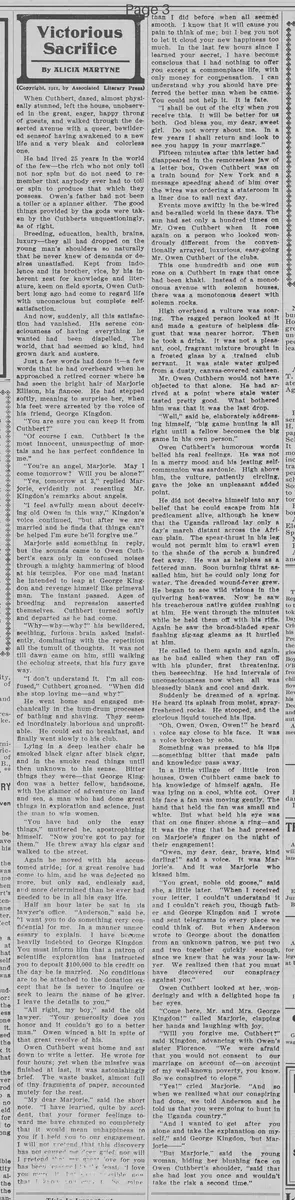
Victorious Sacrifice
By ALICIA MARTYNE
When Cuthbert, dazed, almost physically stunned, left the house, unobserved in the great, eager, happy throng of guests, and walked through the deserted avenue with a queer, bewildered sense of having awakened to a new life and a very bleak and colorless one.
He had lived 25 years in the world of the few—the rich who not only toil not nor spin but do not need to remember that anybody ever had to toil or spin to produce that which they possess. Owen's father had not been a toiler or a spinner either. The good things provided by the gods were taken by the Cuthberts unquestioningly as of right.
Breeding, education, health, brains, luxury—they all had dropped on the young man's shoulders so naturally that he never knew of demands or desires unsatisfied. Kept from indolence and its brother, vice, by his inherent zest for knowledge and literature, keen on field sports, Owen Cuthbert long ago had come to regard life with unconscious but complete self-satisfaction.
And now, suddenly, all this satisfaction had vanished. His serene consciousness of having everything he wanted had been dispelled. The world, that had seemed so kind, had grown dark and austere.
Just a few words had done it—a few words that he had overheard when he approached a retired corner where he had seen the bright hair of Marjorie Ellison, his fiancee. He had stepped softly, meaning to surprise her, when his feet were arrested by the voice of his friend, George Kingdon.
"You are sure you can keep it from Cuthbert?"
"Of course I can. Cuthbert is the most innocent, unsuspecting of mortals and he has perfect confidence in me."
"You're an angel, Marjorie. May I come tomorrow? Will you be alone?"
"Yes, tomorrow at 3," replied Marjorie, evidently not resenting Mr. Kingdon's remarks about angels.
"I feel awfully mean about deceiving old Owen in this way." Kingdon's voice continued, "but after we are married and he finds that things can't be helped I'm sure he'll forgive me."
Marjorie said something in reply, but the sounds came to Owen Cuthbert's ears only in confused noises through a mighty hammering of blood at his temples. For one mad instant he intended to leap at George Kingdon and revenge himself like primeval man. The instant passed. Ages of breeding and repression asserted themselves. Cuthbert turned softly and departed as he had come.
"Why—why—why?" his bewildered, seething, furious brain asked insistently, dominating with the repetition all the tumult of thoughts. It was not till dawn came on him, still walking the echoing streets, that his fury gave way.
"I don't understand it. I'm all confused," Cuthbert groaned. "When did she stop loving me and why?"
He went home and engaged mechanically in the hum-drum processes of bathing and shaving. They seemed inordinately laborious and unprofitable. He could eat no breakfast, and finally went slowly to his club.
Lying in a deep leather chair he smoked black cigar after black cigar and in the smoke read things until then unknown to his sense. Bitter things they were that George Kingdon was a better fellow, handsome with the glamor of adventure on land and sea, a man who had done great things in exploration and science, just the man to win women.
"You have had only the easy things," muttered he, apostrophizing himself. "Now you've got to pay for them." He threw away his cigar and walked to the street.
Again he moved with his accustomed stride; for a great resolve had come to him, and he was dejected no more, but only sad, endlessly sad and more determined than he ever had needed to be in all his easy life.
Half an hour later he sat in his lawyer's office. "Anderson," said he, "I want you to do something very confidential for me. In a manner unnecessary to explain, I have become heavily indebted to George Kingdon. You must inform him that a patron of scientific exploration has instructed you to deposit $100,000 to his credit on the day he is married. No conditions are to be attached to the donation except that he is never to inquire or seek to learn the name of the giver. I leave the details to you."
"All right, my boy," said the old lawyer. "Your generosity does you honor and it couldn't go to a better man." Owen winced a bit in spite of that great resolve of his.
Owen Cuthbert went home and sat down to write a letter. He wrote for four hours; yet when the missive was finished at last, it was astonishingly brief. The waste basket, almost full of tiny fragments of paper, accounted mutely for the rest.
"My dear Marjorie," said the short note, "I have learned, quite by accident, that your former feelings toward me have changed so completely that it would mean unhappiness to you if I held you to our engagement. I will not pretend that this discovery has not caused me deep grief, nor will I pretend that my great love for you has become less in the least. I love you more than I did before when all seemed smooth. I know that it will cause you pain to think of me; but I beg you not to let it cloud your new happiness too much. In the last few hours since I learned your secret, I have become conscious that I had nothing to offer you except a commonplace life, with only money for compensation. I can understand why you should have preferred the better man when he came. You could not help it. It is fate.
"I shall be out of the city when you receive this. It will be better for us both. God bless you, my dear, sweet girl. Do not worry about me. In a few years I shall return and look to see you happy in your marriage."
Fifteen minutes after this letter had disappeared in the remorseless jaw of a letter box, Owen Cuthbert was on a train bound for New York and a message speeding ahead of him over the wires was ordering a stateroom in a liner due to sail next day.
Events move swiftly in the be-wired and be-railed world in these days. The sun had set only a hundred times on Mr. Owen Cuthbert when it rose again on a person who looked wondrously different from the conventionally arrayed, luxurious, easy-going Mr. Owen Cuthbert of the clubs.
This one hundredth and one sun rose on a Cuthbert in rags that once had been khaki. Instead of a monotonous avenue with solemn houses there was a monotonous desert with solemn rocks.
High overhead a vulture was soaring. The ragged person looked at it and made a gesture of helpless disgust that was nearer horror. Then he took a drink. It was not a pleasant, cool, fragrant mixture brought in a frosted glass by a trained club servant. It was stale water gulped from a dusty, canvas-covered canteen. Mr. Owen Cuthbert would not have objected to that alone. He had arrived at a point where stale water tasted pretty good. What bothered him was that it was the last drop.
"Well," said he, elaborately addressing himself, "big game hunting is all right until a fellow becomes the big game in his own person."
Owen Cuthbert's humorous words belied his real feelings. He was not in a merry mood and his jesting self-communion was sardonic. High above him, the vulture, patiently circling, gave the joke an unpleasant added point.
He did not deceive himself into any belief that he could escape from his predicament alive, although he knew that the Uganda railroad lay only a day's march distant across the African plain. The spear-thrust in his leg would not permit him to crawl even to the shade of the scrub a hundred feet away. He was as helpless as a fettered man. Soon burning thirst assailed him, but he could only long for water. The dreaded wound-fever grew. He began to see wild visions in the quivering heat-waves. Now he saw his treacherous native guides rushing at him. He went through the minutes while he held them off with his rifle. Again he saw the broad-bladed spear flashing zig-zag gleams as it hurtled at him.
He called to them again and again, as he had called when they ran off with his plunder, first threatening, then beseeching. He had intervals of unconsciousness now when all was blessedly blank and cool and dark.
Suddenly he dreamed of a spring. He heard its splash from moist, spray-freshened rocks. He stooped, and the glorious liquid touched his lips.
"Oh, Owen, Owen, Owen!" he heard a voice say close to his face. It was a voice broken by sobs.
Something was pressed to his lips—something bitter that made pain and knowledge pass away.
In a little village of little iron houses, Owen Cuthbert came back to his knowledge of himself again. He was lying on a cool, white cot. Over his face a fan was moving gently. The hand that held the fan was small and white. But what held his eye was that on one finger shone a ring—and it was the ring that he had pressed on Marjorie's finger on the night of their engagement!
"Owen, my dear, dear, brave, kind darling!" said a voice. It was Marjorie's. And it was Marjorie who kissed him.
"You great, noble old goose," said she, a little later. "When I received your letter, I couldn't understand it and I couldn't reach you, though father and George Kingdon and I wrote and sent telegrams to every place we could think of. But when Anderson wrote to George about the donation from an unknown patron, we put two and two together quickly enough, since we knew that he was your lawyer. We realized then that you must have discovered our conspiracy against you."
Owen Cuthbert looked at her wonderingly and with a delighted hope in her eyes.
"Come here, Mr. and Mrs. George Kingdon!" called Marjorie, clapping her hands and laughing with joy.
"Will you forgive me, Cuthbert?" said Kingdon, advancing with Owen's sister Florence. "We were afraid that you would not consent to our marriage on account of—on account of my well-known poverty, you know. So we conspired to elope."
"Yes!" cried Marjorie. "And so when we realized what our conspiring had done, we told Anderson and he told us that you were going to hunt in the Uganda country."
"And I wanted to get after you alone and take the explanation on my self," said George Kingdon, "but Marjorie—"
"But Marjorie," said the young woman, hiding her blushing face on Owen Cuthbert's shoulder, "said that she had lost you once and wouldn't take the risk a second time."
Victorious Sacrifice
By ALICIA MARTYNE
When Cuthbert, dazed, almost physically stunned, left the house, unobserved in the great, eager, happy throng of guests, and walked through the deserted avenue with a queer, bewildered sense of having awakened to a new life and a very bleak and colorless one.
He had lived 25 years in the world of the few—the rich who not only toil not nor spin but do not need to remember that anybody ever had to toil or spin to produce that which they possess. Owen's father had not been a toiler or a spinner either. The good things provided by the gods were taken by the Cuthberts unquestioningly as of right.
Breeding, education, health, brains, luxury—they all had dropped on the young man's shoulders so naturally that he never knew of demands or desires unsatisfied. Kept from indolence and its brother, vice, by his inherent zest for knowledge and literature, keen on field sports, Owen Cuthbert long ago had come to regard life with unconscious but complete self-satisfaction.
And now, suddenly, all this satisfaction had vanished. His serene consciousness of having everything he wanted had been dispelled. The world, that had seemed so kind, had grown dark and austere.
Just a few words had done it—a few words that he had overheard when he approached a retired corner where he had seen the bright hair of Marjorie Ellison, his fiancee. He had stepped softly, meaning to surprise her, when his feet were arrested by the voice of his friend, George Kingdon.
"You are sure you can keep it from Cuthbert?"
"Of course I can. Cuthbert is the most innocent, unsuspecting of mortals and he has perfect confidence in me."
"You're an angel, Marjorie. May I come tomorrow? Will you be alone?"
"Yes, tomorrow at 3," replied Marjorie, evidently not resenting Mr. Kingdon's remarks about angels.
"I feel awfully mean about deceiving old Owen in this way." Kingdon's voice continued, "but after we are married and he finds that things can't be helped I'm sure he'll forgive me."
Marjorie said something in reply, but the sounds came to Owen Cuthbert's ears only in confused noises through a mighty hammering of blood at his temples. For one mad instant he intended to leap at George Kingdon and revenge himself like primeval man. The instant passed. Ages of breeding and repression asserted themselves. Cuthbert turned softly and departed as he had come.
"Why—why—why?" his bewildered, seething, furious brain asked insistently, dominating with the repetition all the tumult of thoughts. It was not till dawn came on him, still walking the echoing streets, that his fury gave way.
"I don't understand it. I'm all confused," Cuthbert groaned. "When did she stop loving me and why?"
He went home and engaged mechanically in the hum-drum processes of bathing and shaving. They seemed inordinately laborious and unprofitable. He could eat no breakfast, and finally went slowly to his club.
Lying in a deep leather chair he smoked black cigar after black cigar and in the smoke read things until then unknown to his sense. Bitter things they were that George Kingdon was a better fellow, handsome with the glamor of adventure on land and sea, a man who had done great things in exploration and science, just the man to win women.
"You have had only the easy things," muttered he, apostrophizing himself. "Now you've got to pay for them." He threw away his cigar and walked to the street.
Again he moved with his accustomed stride; for a great resolve had come to him, and he was dejected no more, but only sad, endlessly sad and more determined than he ever had needed to be in all his easy life.
Half an hour later he sat in his lawyer's office. "Anderson," said he, "I want you to do something very confidential for me. In a manner unnecessary to explain, I have become heavily indebted to George Kingdon. You must inform him that a patron of scientific exploration has instructed you to deposit $100,000 to his credit on the day he is married. No conditions are to be attached to the donation except that he is never to inquire or seek to learn the name of the giver. I leave the details to you."
"All right, my boy," said the old lawyer. "Your generosity does you honor and it couldn't go to a better man." Owen winced a bit in spite of that great resolve of his.
Owen Cuthbert went home and sat down to write a letter. He wrote for four hours; yet when the missive was finished at last, it was astonishingly brief. The waste basket, almost full of tiny fragments of paper, accounted mutely for the rest.
"My dear Marjorie," said the short note, "I have learned, quite by accident, that your former feelings toward me have changed so completely that it would mean unhappiness to you if I held you to our engagement. I will not pretend that this discovery has not caused me deep grief, nor will I pretend that my great love for you has become less in the least. I love you more than I did before when all seemed smooth. I know that it will cause you pain to think of me; but I beg you not to let it cloud your new happiness too much. In the last few hours since I learned your secret, I have become conscious that I had nothing to offer you except a commonplace life, with only money for compensation. I can understand why you should have preferred the better man when he came. You could not help it. It is fate.
"I shall be out of the city when you receive this. It will be better for us both. God bless you, my dear, sweet girl. Do not worry about me. In a few years I shall return and look to see you happy in your marriage."
Fifteen minutes after this letter had disappeared in the remorseless jaw of a letter box, Owen Cuthbert was on a train bound for New York and a message speeding ahead of him over the wires was ordering a stateroom in a liner due to sail next day.
Events move swiftly in the be-wired and be-railed world in these days. The sun had set only a hundred times on Mr. Owen Cuthbert when it rose again on a person who looked wondrously different from the conventionally arrayed, luxurious, easy-going Mr. Owen Cuthbert of the clubs.
This one hundredth and one sun rose on a Cuthbert in rags that once had been khaki. Instead of a monotonous avenue with solemn houses there was a monotonous desert with solemn rocks.
High overhead a vulture was soaring. The ragged person looked at it and made a gesture of helpless disgust that was nearer horror. Then he took a drink. It was not a pleasant, cool, fragrant mixture brought in a frosted glass by a trained club servant. It was stale water gulped from a dusty, canvas-covered canteen. Mr. Owen Cuthbert would not have objected to that alone. He had arrived at a point where stale water tasted pretty good. What bothered him was that it was the last drop.
"Well," said he, elaborately addressing himself, "big game hunting is all right until a fellow becomes the big game in his own person."
Owen Cuthbert's humorous words belied his real feelings. He was not in a merry mood and his jesting self-communion was sardonic. High above him, the vulture, patiently circling, gave the joke an unpleasant added point.
He did not deceive himself into any belief that he could escape from his predicament alive, although he knew that the Uganda railroad lay only a day's march distant across the African plain. The spear-thrust in his leg would not permit him to crawl even to the shade of the scrub a hundred feet away. He was as helpless as a fettered man. Soon burning thirst assailed him, but he could only long for water. The dreaded wound-fever grew. He began to see wild visions in the quivering heat-waves. Now he saw his treacherous native guides rushing at him. He went through the minutes while he held them off with his rifle. Again he saw the broad-bladed spear flashing zig-zag gleams as it hurtled at him.
He called to them again and again, as he had called when they ran off with his plunder, first threatening, then beseeching. He had intervals of unconsciousness now when all was blessedly blank and cool and dark.
Suddenly he dreamed of a spring. He heard its splash from moist, spray-freshened rocks. He stooped, and the glorious liquid touched his lips.
"Oh, Owen, Owen, Owen!" he heard a voice say close to his face. It was a voice broken by sobs.
Something was pressed to his lips—something bitter that made pain and knowledge pass away.
In a little village of little iron houses, Owen Cuthbert came back to his knowledge of himself again. He was lying on a cool, white cot. Over his face a fan was moving gently. The hand that held the fan was small and white. But what held his eye was that on one finger shone a ring—and it was the ring that he had pressed on Marjorie's finger on the night of their engagement!
"Owen, my dear, dear, brave, kind darling!" said a voice. It was Marjorie's. And it was Marjorie who kissed him.
"You great, noble old goose," said she, a little later. "When I received your letter, I couldn't understand it and I couldn't reach you, though father and George Kingdon and I wrote and sent telegrams to every place we could think of. But when Anderson wrote to George about the donation from an unknown patron, we put two and two together quickly enough, since we knew that he was your lawyer. We realized then that you must have discovered our conspiracy against you."
Owen Cuthbert looked at her wonderingly and with a delighted hope in her eyes.
"Come here, Mr. and Mrs. George Kingdon!" called Marjorie, clapping her hands and laughing with joy.
"Will you forgive me, Cuthbert?" said Kingdon, advancing with Owen's sister Florence. "We were afraid that you would not consent to our marriage on account of—on account of my well-known poverty, you know. So we conspired to elope."
"Yes!" cried Marjorie. "And so when we realized what our conspiring had done, we told Anderson and he told us that you were going to hunt in the Uganda country."
"And I wanted to get after you alone and take the explanation on my self," said George Kingdon, "but Marjorie—"
"But Marjorie," said the young woman, hiding her blushing face on Owen Cuthbert's shoulder, "said that she had lost you once and wouldn't take the risk a second time."
What sub-type of article is it?
Prose Fiction
What themes does it cover?
Love Romance
Moral Virtue
Friendship
What keywords are associated?
Romantic Misunderstanding
Self Sacrifice
Betrayal Plot
Forgiveness
African Adventure
What entities or persons were involved?
By Alicia Martyne
Literary Details
Title
Victorious Sacrifice
Author
By Alicia Martyne
Key Lines
"You Are Sure You Can Keep It From Cuthbert?"
"Of Course I Can. Cuthbert Is The Most Innocent, Unsuspecting Of Mortals And He Has Perfect Confidence In Me."
"My Dear Marjorie," Said The Short Note, "I Have Learned, Quite By Accident, That Your Former Feelings Toward Me Have Changed So Completely That It Would Mean Unhappiness To You If I Held You To Our Engagement."
"You Great, Noble Old Goose," Said She, A Little Later. "When I Received Your Letter, I Couldn't Understand It And I Couldn't Reach You..."
"Will You Forgive Me, Cuthbert?" Said Kingdon, Advancing With Owen's Sister Florence. "We Were Afraid That You Would Not Consent To Our Marriage On Account Of—On Account Of My Well Known Poverty, You Know."