Thank you for visiting SNEWPapers!
Sign up free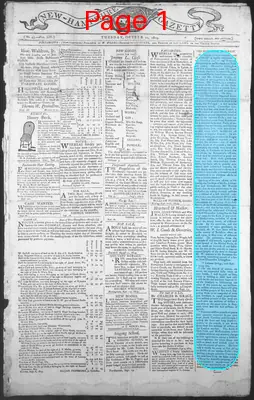
The New Hampshire Gazette
Portsmouth, Rockingham County, New Hampshire
What is this article about?
Article on introducing Merino sheep breed to Northern US states for wool production, led by Chancellor Livingston, Col. Humphreys, and Elkanah Watson. Details imports from Spain and France, propagation in Massachusetts, and economic potential to rival Southern cotton exports.
Clipping

OCR Quality
Full Text
The subject of improving the breed
of SHEEP is highly important to
our Farmers and to our Country,
particularly to the Northern and Eastern
States. Chancellor Livingston
and Col. Humphreys have the honor
of taking the lead in introducing the
celebrated Merino breed into the country;
and Mr. Elkanah Watson, of
Pittsfield, of propagating it in Massachusetts.
Mr. Watson, in a communication
to the Editor of the Berkshire
Reporter, makes a concise statement
of the beginning and progress of
this patriotic business. He says,
"Col. Humphreys imported about
six years ago a large and a very valuable
stock of the pure bloods direct from
Spain, via Portugal: a few months
previous to which, Chancellor Livingston
had sent over from France, a
small number of pure bloods, selected
from the large and improved breed of
one of the national flocks; and has
since imported a ram from Rambouillet.
He has a national farm near Paris, of uncommon
size and beauty, and bearing
a large fleece, (viz. nine pounds unwashed
wool, which he sold for 18
dollars) of singular fineness. In addition
to which he procured in France
last year, at a great expense 10 or
12 very fine merinos: one of which
gave a fleece of 16 pounds; but unfortunately
the whole were seized in
June last, at Bordeaux on board the
ship Hope, by Bonaparte's officers,
which may be considered a great national
loss. Both these gentlemen
have not only immortalized themselves,
but have also so greatly promoted
their individual interests, by
their steady and successful efforts in a
pursuit so honorable to themselves, and
so beneficial in its ultimate effects to
their common country."
Speaking of his own efforts in following
the footsteps of Messrs. Livingston
and Humphreys, Mr. Watson
states, that he was unfortunate in his
first essay, by taking through mistake
a 3/4 instead of a full-blooded ram,
which was not discovered till last winter;
but that part of his stocks were
nevertheless the offspring of the full-bloods
of the flocks of both those gentlemen;
and that he has lately procured
from the celebrated Clermont
flock of Chancellor Livingston six fine
large rams for his flock of 200 excellent
selected ewes, exclusive of about
50 of the mixed breed, of different
grades. By his exertions, and the
co-operation of other gentlemen in
Pittsfield, Mr. W. says, there will be
in the county of Berkshire alone, at
least 1500, in May next, of different
grades. He anticipates, from the
principle of self interest, a great and
rapid spread of the Merino flocks, so
as to cause an increase of our factories
for fine cloths, and also in time to
export largely of the wool to Europe.
Mr. W. annexes to his statement the
following interesting extract of a letter
from Chancellor Livingston.
"Lebanon Springs, 12th Sept.
"DEAR SIR,
"On the subject of cotton, on
which we conversed fully when at
your house, I will suggest an idea,
which is striking to shew how easy
it will be for the northern states to rival
the southern in substituting the
value of the cotton by our merinos.
One million of merino sheep will give
five million pounds of fine wool, supposing
them to be composed of ewes
and weathers in equal proportions.
Five million pounds of fine wool are
worth now ten millions of dollars;
and even at the peace price in England,
seven and one half millions of
dollars.
"Fourteen million pounds of cotton
(the quantity exported in one year
from South Carolina and Georgia,)
taking the short and long staple together,
at the utmost, is not worth
more than five millions of dollars at
the London market. The states of
New York, and Massachusetts, either
of them, without any material change
in their agriculture, except a substitution
of merinos for other sheep, can
raise as much wool as shall equal in
value the export of cotton. But how
easy it would be, once at that point,
to double all our merino flocks -thus
leaving a larger quantity of wool, than
we now have from the same number
of sheep for domestic purposes, of fine
wool instead of coarse-and all the
surplus for exportation, or to go into
future home manufactories."
What sub-type of article is it?
What themes does it cover?
What keywords are associated?
What entities or persons were involved?
Where did it happen?
Story Details
Key Persons
Location
Northern And Eastern States, Massachusetts, Berkshire County
Story Details
Chancellor Livingston and Col. Humphreys imported pure Merino sheep from France and Spain around six years ago. Elkanah Watson propagates the breed in Pittsfield, Massachusetts, acquiring rams from Livingston's flock and anticipating 1500 sheep in Berkshire County by May next. Livingston's letter compares wool value to cotton exports, suggesting Northern states can rival Southern economies.