Thank you for visiting SNEWPapers!
Sign up free
Story
November 20, 1913
The Beatrice Daily Express
Beatrice, Gage County, Nebraska
What is this article about?
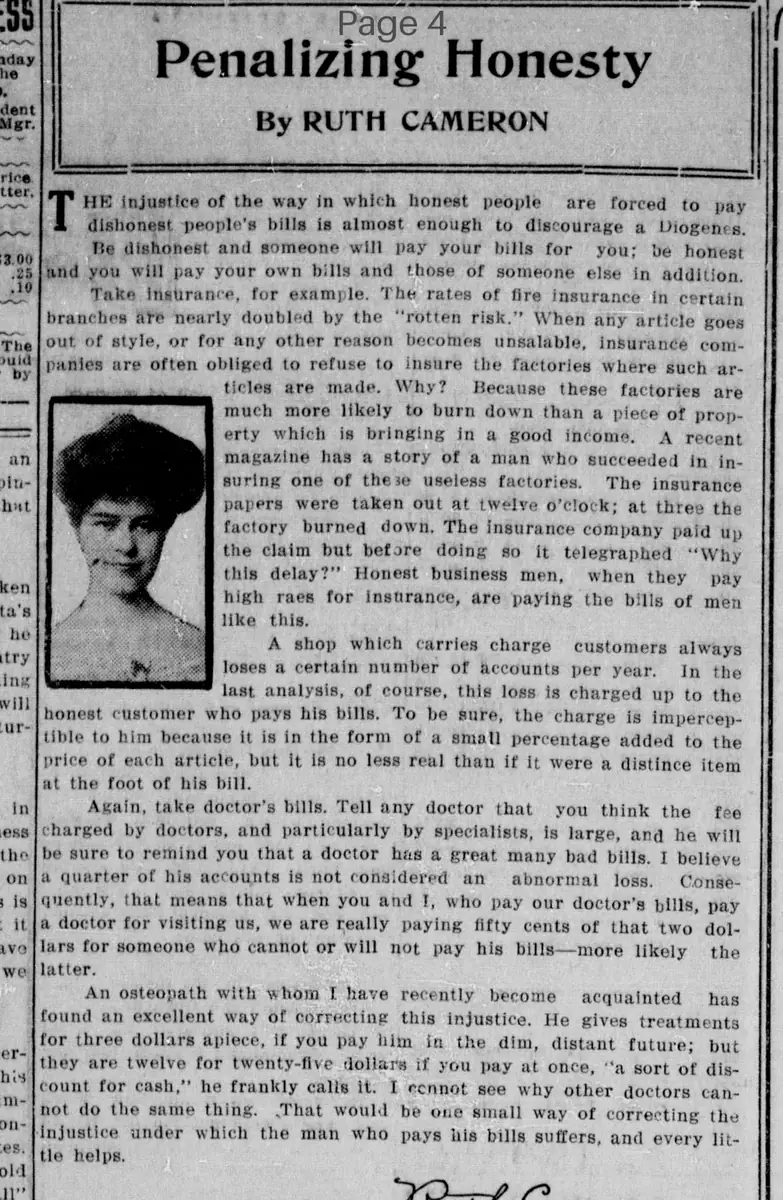
Essay by Ruth Cameron on how honest individuals bear the financial burdens of the dishonest via inflated insurance premiums, retail markups for bad accounts, and medical fees covering unpaid bills, suggesting cash discounts as a remedy.
Clipping
OCR Quality
95%
Excellent
Full Text
Penalizing Honesty
By RUTH CAMERON
THE injustice of the way in which honest people are forced to pay dishonest people's bills is almost enough to discourage a Diogenes.
Be dishonest and someone will pay your bills for you; be honest and you will pay your own bills and those of someone else in addition.
Take insurance, for example. The rates of fire insurance in certain branches are nearly doubled by the "rotten risk." When any article goes out of style, or for any other reason becomes unsalable, insurance companies are often obliged to refuse to insure the factories where such articles are made. Why? Because these factories are much more likely to burn down than a piece of property which is bringing in a good income. A recent magazine has a story of a man who succeeded in insuring one of these useless factories. The insurance papers were taken out at twelve o'clock; at three the factory burned down. The insurance company paid up the claim but before doing so it telegraphed "Why this delay?" Honest business men, when they pay high rates for insurance, are paying the bills of men like this.
A shop which carries charge customers always loses a certain number of accounts per year. In the last analysis, of course, this loss is charged up to the honest customer who pays his bills. To be sure, the charge is imperceptible to him because it is in the form of a small percentage added to the price of each article, but it is no less real than if it were a distinct item at the foot of his bill.
Again, take doctor's bills. Tell any doctor that you think the fee charged by doctors, and particularly by specialists, is large, and he will be sure to remind you that a doctor has a great many bad bills. I believe a quarter of his accounts is not considered an abnormal loss. Consequently, that means that when you and I, who pay our doctor's bills, pay a doctor for visiting us, we are really paying fifty cents of that two dollars for someone who cannot or will not pay his bills—more likely the latter.
An osteopath with whom I have recently become acquainted has found an excellent way of correcting this injustice. He gives treatments for three dollars apiece, if you pay him in the dim and distant future; but they are twelve for twenty-five dollars if you pay at once, "a sort of discount for cash," he frankly calls it. I cannot see why other doctors cannot do the same thing. That would be one small way of correcting the injustice under which the man who pays his bills suffers, and every little helps.
By RUTH CAMERON
THE injustice of the way in which honest people are forced to pay dishonest people's bills is almost enough to discourage a Diogenes.
Be dishonest and someone will pay your bills for you; be honest and you will pay your own bills and those of someone else in addition.
Take insurance, for example. The rates of fire insurance in certain branches are nearly doubled by the "rotten risk." When any article goes out of style, or for any other reason becomes unsalable, insurance companies are often obliged to refuse to insure the factories where such articles are made. Why? Because these factories are much more likely to burn down than a piece of property which is bringing in a good income. A recent magazine has a story of a man who succeeded in insuring one of these useless factories. The insurance papers were taken out at twelve o'clock; at three the factory burned down. The insurance company paid up the claim but before doing so it telegraphed "Why this delay?" Honest business men, when they pay high rates for insurance, are paying the bills of men like this.
A shop which carries charge customers always loses a certain number of accounts per year. In the last analysis, of course, this loss is charged up to the honest customer who pays his bills. To be sure, the charge is imperceptible to him because it is in the form of a small percentage added to the price of each article, but it is no less real than if it were a distinct item at the foot of his bill.
Again, take doctor's bills. Tell any doctor that you think the fee charged by doctors, and particularly by specialists, is large, and he will be sure to remind you that a doctor has a great many bad bills. I believe a quarter of his accounts is not considered an abnormal loss. Consequently, that means that when you and I, who pay our doctor's bills, pay a doctor for visiting us, we are really paying fifty cents of that two dollars for someone who cannot or will not pay his bills—more likely the latter.
An osteopath with whom I have recently become acquainted has found an excellent way of correcting this injustice. He gives treatments for three dollars apiece, if you pay him in the dim and distant future; but they are twelve for twenty-five dollars if you pay at once, "a sort of discount for cash," he frankly calls it. I cannot see why other doctors cannot do the same thing. That would be one small way of correcting the injustice under which the man who pays his bills suffers, and every little helps.
What sub-type of article is it?
Curiosity
What themes does it cover?
Moral Virtue
Justice
Misfortune
What keywords are associated?
Penalizing Honesty
Insurance Fraud
Bad Debts
Doctor Bills
Cash Discount
What entities or persons were involved?
Ruth Cameron
Story Details
Key Persons
Ruth Cameron
Story Details
Honest people pay higher costs to cover losses from dishonest individuals in insurance, retail, and medical services; an osteopath offers discounts for prompt payment to address this injustice.