Thank you for visiting SNEWPapers!
Sign up free
Editorial
February 8, 1863
Winchester Daily Bulletin
Winchester, Franklin County, Tennessee
What is this article about?
This editorial critiques a rival newspaper's insistence that the Civil War can only restore the Union through force, questioning if subduing the South is feasible and arguing against prolonging a hopeless conflict, while accusing the paper of shifting war aims toward abolition.
Clipping
OCR Quality
98%
Excellent
Full Text
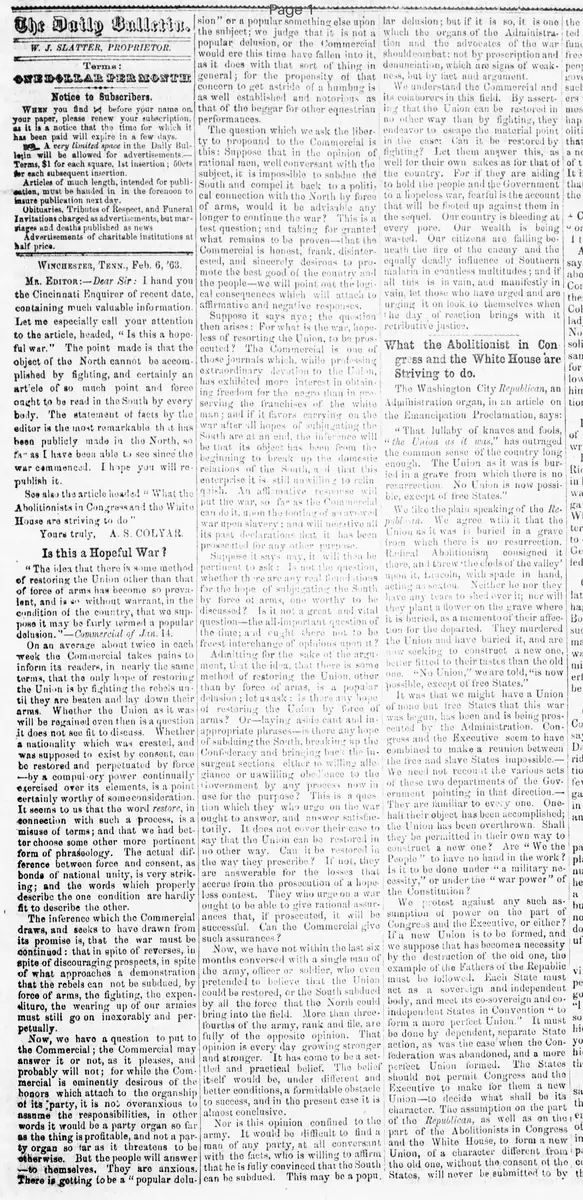
Is this a Hopeful War?
"The idea that there is some method of restoring the Union other than that of force of arms has become so prevalent, and is so without warrant, in the condition of the country, that we suppose it may be fairly termed a popular delusion."--Commercial of Jan. 14.
On an average about twice in each week the Commercial takes pains to inform its readers, in nearly the same terms, that the only hope of restoring the Union is by fighting the rebels until they are beaten and lay down their arms. Whether the Union as it was will be regained even then is a question it does not see fit to discuss. Whether a nationality which was created, and was supposed to exist by consent, can be restored and perpetuated by force---by a compulsory power continually exercised over its elements, is a point certainly worthy of some consideration.
It seems to us that the word restore, in connection with such a process, is a misuse of terms; and that we had better choose some other more pertinent form of phraseology. The actual difference between force and consent, as bonds of national unity, is very striking; and the words which properly describe the one condition are hardly fit to describe the other.
The inference which the Commercial draws, and seeks to have drawn from its premise is, that the war must be continued: that in spite of reverses, in spite of discouraging prospects, in spite of what approaches a demonstration that the rebels cannot be subdued, by force of arms, the fighting, the expenditure, the wearing up of our armies must still go on inexorably and perpetually.
Now, we have a question to put to the Commercial: the Commercial may answer it or not, as it pleases, and probably will not; for while the Commercial is eminently desirous of the honors which attach to the organship of its party, it is not over-anxious to assume the responsibilities, in other words it would be a party organ so far as the thing is profitable, and not a party organ so far as it threatens to be otherwise. But the people will answer,--to themselves. They are anxious.
There is getting to be a "popular delusion" or a popular something else upon the subject; we judge that it is not a popular delusion, or the Commercial would ere this time have fallen into it, as it does with that sort of thing in general; for the propensity of that concern to get astride of a humbug is as well established and notorious as that of the beggar for other equestrian performances.
The question which we ask the liberty to propound to the Commercial is this: Suppose that in the opinion of rational men, well conversant with the subject, it is impossible to subdue the South and compel it back to a political connection with the North by force of arms, would it be advisable any longer to continue the war? This is a test question; and taking for granted what remains to be proven--that the Commercial is honest, frank, disinterested, and sincerely desirous to promote the best good of the country and the people-we will point out the logical consequences which will attach to affirmative and negative responses.
Suppose it says aye: the question then arises: For what is the war, hopeless of restoring the Union, to be prosecuted? The Commercial is one of those journals which, while professing extraordinary devotion to the Union, has exhibited more interest in obtaining freedom for the negro than in preserving the franchises of the white man; and if it favors carrying on the war after all hopes of subjugating the South are at an end, the inference will be that its object has been from the beginning to break up the domestic relations of the South, and that this enterprise it is still unwilling to relinquish. An affirmative response will put the war, so far as the Commercial can do it, upon the footing of an avowed war upon slavery: and will negative all its past declarations that it has been prosecuted for any other purpose.
Suppose it says nay, it will then be pertinent to ask: Is not the question, whether there are any real foundations for the hope of subjugating the South by force of arms, one worthy to be discussed? Is it not a great and vital question-the all-important question of the time; and ought there not to be freest interchange of opinions upon it?
Admitting for the sake of the argument, that the idea, that there is some method of restoring the Union, other than by force of arms, is a popular delusion: let us ask: is there any hope of restoring the Union by force of arms? Or-leaving aside cant and inappropriate phrases-is there any hope of subduing the South, breaking up the Confederacy and bringing back the insurgent sections either to willing allegiance or unwilling obedience to the government by any process now in use for the purpose? This is a question which they who urge on the war ought to answer, and answer satisfactorily. It does not cover their case to say that the Union can be restored in no other way. Can it be restored in the way they prescribe? If not, they are answerable for the losses that accrue from the prosecution of a hopeless contest. They who urge on a war ought to be able to give rational assurances that, if prosecuted, it will be successful. Can the Commercial give such assurances?
Now, we have not within the last six months conversed with a single man of the army, officer or soldier, who even pretended to believe that the Union could be restored, or the South subdued by all the force that the North could bring into the field. More than three-fourths of the army, rank and file, are fully of the opposite opinion. That opinion is every day growing stronger and stronger. It has come to be a settled and practical belief. The belief itself would be, under different and better conditions, a formidable obstacle to success, and in the present case it is almost conclusive.
Nor is this opinion confined to the army. It would be difficult to find a man of any party, at all conversant with the facts, who is willing to affirm that he is fully convinced that the South can be subdued. This may be a popular delusion; but if it is so, it is one which the organs of the Administration and the advocates of the war should combat: not by proscription and denunciation, which are signs of weakness, but by fact and argument.
We understand the Commercial and its colaborers in this field. By asserting that the Union can be restored in no other way than by fighting, they endeavor to escape the material point in the case: Can it be restored by fighting? Let them answer this, as well for their own sakes as for that of the country. For if they are aiding to hold the people and the Government to a hopeless war, fearful is the account that will be footed up against them in the sequel. Our country is bleeding at every pore. Our wealth is being wasted. Our citizens are falling beneath the fire of the enemy and the equally deadly influence of Southern malaria in countless multitudes; and if all this is in vain, and manifestly in vain, let those who have urged and are urging it on look to themselves when the day of reaction brings with it retributive justice.
"The idea that there is some method of restoring the Union other than that of force of arms has become so prevalent, and is so without warrant, in the condition of the country, that we suppose it may be fairly termed a popular delusion."--Commercial of Jan. 14.
On an average about twice in each week the Commercial takes pains to inform its readers, in nearly the same terms, that the only hope of restoring the Union is by fighting the rebels until they are beaten and lay down their arms. Whether the Union as it was will be regained even then is a question it does not see fit to discuss. Whether a nationality which was created, and was supposed to exist by consent, can be restored and perpetuated by force---by a compulsory power continually exercised over its elements, is a point certainly worthy of some consideration.
It seems to us that the word restore, in connection with such a process, is a misuse of terms; and that we had better choose some other more pertinent form of phraseology. The actual difference between force and consent, as bonds of national unity, is very striking; and the words which properly describe the one condition are hardly fit to describe the other.
The inference which the Commercial draws, and seeks to have drawn from its premise is, that the war must be continued: that in spite of reverses, in spite of discouraging prospects, in spite of what approaches a demonstration that the rebels cannot be subdued, by force of arms, the fighting, the expenditure, the wearing up of our armies must still go on inexorably and perpetually.
Now, we have a question to put to the Commercial: the Commercial may answer it or not, as it pleases, and probably will not; for while the Commercial is eminently desirous of the honors which attach to the organship of its party, it is not over-anxious to assume the responsibilities, in other words it would be a party organ so far as the thing is profitable, and not a party organ so far as it threatens to be otherwise. But the people will answer,--to themselves. They are anxious.
There is getting to be a "popular delusion" or a popular something else upon the subject; we judge that it is not a popular delusion, or the Commercial would ere this time have fallen into it, as it does with that sort of thing in general; for the propensity of that concern to get astride of a humbug is as well established and notorious as that of the beggar for other equestrian performances.
The question which we ask the liberty to propound to the Commercial is this: Suppose that in the opinion of rational men, well conversant with the subject, it is impossible to subdue the South and compel it back to a political connection with the North by force of arms, would it be advisable any longer to continue the war? This is a test question; and taking for granted what remains to be proven--that the Commercial is honest, frank, disinterested, and sincerely desirous to promote the best good of the country and the people-we will point out the logical consequences which will attach to affirmative and negative responses.
Suppose it says aye: the question then arises: For what is the war, hopeless of restoring the Union, to be prosecuted? The Commercial is one of those journals which, while professing extraordinary devotion to the Union, has exhibited more interest in obtaining freedom for the negro than in preserving the franchises of the white man; and if it favors carrying on the war after all hopes of subjugating the South are at an end, the inference will be that its object has been from the beginning to break up the domestic relations of the South, and that this enterprise it is still unwilling to relinquish. An affirmative response will put the war, so far as the Commercial can do it, upon the footing of an avowed war upon slavery: and will negative all its past declarations that it has been prosecuted for any other purpose.
Suppose it says nay, it will then be pertinent to ask: Is not the question, whether there are any real foundations for the hope of subjugating the South by force of arms, one worthy to be discussed? Is it not a great and vital question-the all-important question of the time; and ought there not to be freest interchange of opinions upon it?
Admitting for the sake of the argument, that the idea, that there is some method of restoring the Union, other than by force of arms, is a popular delusion: let us ask: is there any hope of restoring the Union by force of arms? Or-leaving aside cant and inappropriate phrases-is there any hope of subduing the South, breaking up the Confederacy and bringing back the insurgent sections either to willing allegiance or unwilling obedience to the government by any process now in use for the purpose? This is a question which they who urge on the war ought to answer, and answer satisfactorily. It does not cover their case to say that the Union can be restored in no other way. Can it be restored in the way they prescribe? If not, they are answerable for the losses that accrue from the prosecution of a hopeless contest. They who urge on a war ought to be able to give rational assurances that, if prosecuted, it will be successful. Can the Commercial give such assurances?
Now, we have not within the last six months conversed with a single man of the army, officer or soldier, who even pretended to believe that the Union could be restored, or the South subdued by all the force that the North could bring into the field. More than three-fourths of the army, rank and file, are fully of the opposite opinion. That opinion is every day growing stronger and stronger. It has come to be a settled and practical belief. The belief itself would be, under different and better conditions, a formidable obstacle to success, and in the present case it is almost conclusive.
Nor is this opinion confined to the army. It would be difficult to find a man of any party, at all conversant with the facts, who is willing to affirm that he is fully convinced that the South can be subdued. This may be a popular delusion; but if it is so, it is one which the organs of the Administration and the advocates of the war should combat: not by proscription and denunciation, which are signs of weakness, but by fact and argument.
We understand the Commercial and its colaborers in this field. By asserting that the Union can be restored in no other way than by fighting, they endeavor to escape the material point in the case: Can it be restored by fighting? Let them answer this, as well for their own sakes as for that of the country. For if they are aiding to hold the people and the Government to a hopeless war, fearful is the account that will be footed up against them in the sequel. Our country is bleeding at every pore. Our wealth is being wasted. Our citizens are falling beneath the fire of the enemy and the equally deadly influence of Southern malaria in countless multitudes; and if all this is in vain, and manifestly in vain, let those who have urged and are urging it on look to themselves when the day of reaction brings with it retributive justice.
What sub-type of article is it?
War Or Peace
Constitutional
Partisan Politics
What keywords are associated?
Civil War
Union Restoration
Force Vs Consent
Subduing South
War Criticism
Slavery Aims
Popular Delusion
What entities or persons were involved?
Commercial
The South
The Union
The Rebels
Administration
Editorial Details
Primary Topic
Questioning The Feasibility Of Restoring The Union By Force In The Civil War
Stance / Tone
Skeptical And Critical Of Prolonging The War
Key Figures
Commercial
The South
The Union
The Rebels
Administration
Key Arguments
The Only Way To Restore The Union Is By Force Is A Popular Delusion
Restoring The Union By Force Misuses The Term 'Restore' As It Contradicts Consent Based Unity
The War Cannot Subdue The South Despite Reverses And Discouraging Prospects
The Commercial Avoids Discussing If The Union Can Truly Be Regained Even By Force
If Subjugation Is Impossible, Continuing The War Would Shift Aims To Abolishing Slavery
Army Personnel And Informed Civilians Doubt The South Can Be Subdued
Advocates Of War Must Prove Success Is Possible Or Bear Responsibility For Losses