Thank you for visiting SNEWPapers!
Sign up free
Story
January 24, 1826
Rhode Island American And Providence Gazette
Providence, Providence County, Rhode Island
What is this article about?
An 1818 account of the Jesuit settlement at Conewago, Pennsylvania, detailing the order's history, suppression in 1773 by Pope Clement XIV, restoration, and the author's visit to the picturesque farm and church founded by a German Jesuit in 1741.
Clipping
OCR Quality
98%
Excellent
Full Text
JESUITS IN PENNSYLVANIA.
The following is taken from an extract, from notes of a short excursion in Pennsylvania, in 1818, published in a late number of the Boston Monthly Magazine:
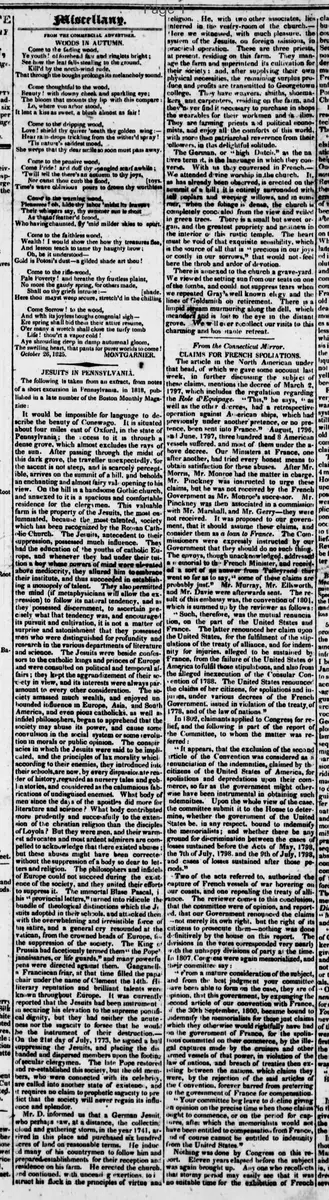
It would be impossible for language to describe the beauty of Conewago. It is situated about four miles east of Oxford, in the state of Pennsylvania; the access to it is through a dense grove, which almost excludes the rays of the sun. After passing through the midst of this dark grove, the traveller unexpectedly, for the ascent is not steep, and is scarcely perceptible, arrives on the summit of a hill, and beholds an enchanting and almost fairy vale opening to his view. On the hill is a handsome Gothic church, and annexed to it is a spacious and comfortable residence for the clergymen. This valuable farm is the property of the Jesuits, the most illuminated, because the most-talented, society which has been recognized by the Roman Catholic Church. The Jesuits, antecedent to their suppression, possessed much influence. They had the education of the youths of catholic Europe, and whenever they had under their tuition a boy whose powers of mind were elevated above mediocrity, they allured him to embrace their institute, and thus succeeded in establishing a monopoly of talent. They also permitted the mind (if metaphysicians will allow the expression) to follow its natural tendency, and as they possessed discernment, to ascertain precisely what that tendency was, and encouraged its pursuit and cultivation, it is not a matter of surprise and astonishment that they possessed men who were distinguished for profundity and research in the various departments of literature and science. The Jesuits were beside confessors to the catholic kings and princes of Europe and were consulted on political and temporal affairs; they kept the aggrandizement of their society in view, and its interests were always paramount to every other consideration. The society amassed much wealth, and enjoyed unbounded influence in Europe, Asia, and South America, and even pious catholics, as well as infidel philosophers, began to apprehend that the society may abuse its power, and cause some convulsion in the social system or some revolution in morals or public opinion. The conspiracies in which the Jesuits were said to be implicated, and the principles of lax morality which, according to their enemies, they introduced into their schools, are now, by every dispassionate reader of history, regarded as nursery tales and goblin stories, and considered as the calumnious fabrications of undisguised enemies. What body of men since the days of the apostles did more for literature and science? What body contributed more prudently and successfully to the extension of the christian religion than the disciples of Loyola? But they were men, and their warmest advocates and most ardent admirers are compelled to acknowledge that there existed abuses; but these abuses might have been corrected without the suppression of a body so dear to letters and religion. The philosophers and infidels of Europe could not succeed during the existence of the society, and they united their efforts to suppress it. The immortal Blaise Pascal, in his 'provincial letters,' turned into ridicule the bundle of theological distinctions which the Jesuits adopted in their schools, and attacked them with the overwhelming and irresistible force of his satire, and a general cry resounded at the Vatican, from the crowned heads of Europe, for the suppression of the society. The King of Prussia had facetiously termed them 'the Pope's janissaries, or life guards,' and many powerful pens were directed against them. Ganganelli, Franciscan friar, at that time filled the papal chair under the name of Clement the 14th. His literary reputation and brilliant talents were known throughout Europe. It was currently reported that the Jesuits had been instrumental in securing his elevation to the supreme pontifical dignity, but they had neither the acuteness nor the sagacity to foresee that he would be the instrument of their destruction. On the 21st day of July, 1773, he signed a bull suppressing the Jesuits, and placing the disbanded and dispersed members upon the footing of secular clergymen. The late Pope restored and re-established this society, but the old members, who were connected with its celebrity, are called into another state of existence, and it requires no claim to prophetic sagacity to predict that the society will never regain its influence and splendor.
Mr. D. informed us that a German Jesuit, who perhaps saw, at a distance, the collecting cloud and gathering storm, in the year 1741, arrived in this place and purchased six hundred acres of land on reasonable terms. He induced many of his countrymen to follow him and prepared establishments for their reception and residence on his farm. He erected the church, and continued, with unceasing exertions, to instruct his flock in the principles of virtue and religion. He, with two other associates, lies interred in the vestry-room of the church. There we witnessed, with much pleasure, the system of the Jesuits, on foreign missions, in practical operation. There are three priests, at present, residing on this farm. They manage the farm and superintend its cultivation for their society: and, after supplying their own physical necessities, the remaining surplus produce and profits are transmitted to Georgetown college. They have weavers, smiths, shoemakers, and carpenters, residing on the farm, and they never find it necessary to purchase in shops the wearables for their workmen and families. They are farming priests and political economists, and enjoy all the comforts of this world, with more than patriarchal reverence from their followers, in this delightful solitude. The German, or 'high Dutch,' as the natives term it, is the language in which they converse. With us they conversed in French. We attended divine worship in the church. It, as has already been observed, is erected on the summit of a hill; it is entirely surrounded with tall poplars and weeping willows, and in summer, when the foliage is dense, the church is completely concealed from the view and veiled in green trees. There is a small but sweet organ, and the greatest propriety and neatness in the interior of this rustic temple. The heart must be void of that exquisite sensibility, which is the source of all that is precious in our joys or costly in our sorrows, that would not feel here the throb and ardor of devotion. There is annexed to the church a grave-yard. We viewed the setting sun from our seats on one of the tombs, and could not suppress tears when we repeated Gray's well known elegy and the lines of Goldsmith on retirement. There is a limpid stream murmuring along the dell, which meanders and is lost to the eye in the distant grove. We will ever recollect our visits to this charming and hospitable retreat.
The following is taken from an extract, from notes of a short excursion in Pennsylvania, in 1818, published in a late number of the Boston Monthly Magazine:
It would be impossible for language to describe the beauty of Conewago. It is situated about four miles east of Oxford, in the state of Pennsylvania; the access to it is through a dense grove, which almost excludes the rays of the sun. After passing through the midst of this dark grove, the traveller unexpectedly, for the ascent is not steep, and is scarcely perceptible, arrives on the summit of a hill, and beholds an enchanting and almost fairy vale opening to his view. On the hill is a handsome Gothic church, and annexed to it is a spacious and comfortable residence for the clergymen. This valuable farm is the property of the Jesuits, the most illuminated, because the most-talented, society which has been recognized by the Roman Catholic Church. The Jesuits, antecedent to their suppression, possessed much influence. They had the education of the youths of catholic Europe, and whenever they had under their tuition a boy whose powers of mind were elevated above mediocrity, they allured him to embrace their institute, and thus succeeded in establishing a monopoly of talent. They also permitted the mind (if metaphysicians will allow the expression) to follow its natural tendency, and as they possessed discernment, to ascertain precisely what that tendency was, and encouraged its pursuit and cultivation, it is not a matter of surprise and astonishment that they possessed men who were distinguished for profundity and research in the various departments of literature and science. The Jesuits were beside confessors to the catholic kings and princes of Europe and were consulted on political and temporal affairs; they kept the aggrandizement of their society in view, and its interests were always paramount to every other consideration. The society amassed much wealth, and enjoyed unbounded influence in Europe, Asia, and South America, and even pious catholics, as well as infidel philosophers, began to apprehend that the society may abuse its power, and cause some convulsion in the social system or some revolution in morals or public opinion. The conspiracies in which the Jesuits were said to be implicated, and the principles of lax morality which, according to their enemies, they introduced into their schools, are now, by every dispassionate reader of history, regarded as nursery tales and goblin stories, and considered as the calumnious fabrications of undisguised enemies. What body of men since the days of the apostles did more for literature and science? What body contributed more prudently and successfully to the extension of the christian religion than the disciples of Loyola? But they were men, and their warmest advocates and most ardent admirers are compelled to acknowledge that there existed abuses; but these abuses might have been corrected without the suppression of a body so dear to letters and religion. The philosophers and infidels of Europe could not succeed during the existence of the society, and they united their efforts to suppress it. The immortal Blaise Pascal, in his 'provincial letters,' turned into ridicule the bundle of theological distinctions which the Jesuits adopted in their schools, and attacked them with the overwhelming and irresistible force of his satire, and a general cry resounded at the Vatican, from the crowned heads of Europe, for the suppression of the society. The King of Prussia had facetiously termed them 'the Pope's janissaries, or life guards,' and many powerful pens were directed against them. Ganganelli, Franciscan friar, at that time filled the papal chair under the name of Clement the 14th. His literary reputation and brilliant talents were known throughout Europe. It was currently reported that the Jesuits had been instrumental in securing his elevation to the supreme pontifical dignity, but they had neither the acuteness nor the sagacity to foresee that he would be the instrument of their destruction. On the 21st day of July, 1773, he signed a bull suppressing the Jesuits, and placing the disbanded and dispersed members upon the footing of secular clergymen. The late Pope restored and re-established this society, but the old members, who were connected with its celebrity, are called into another state of existence, and it requires no claim to prophetic sagacity to predict that the society will never regain its influence and splendor.
Mr. D. informed us that a German Jesuit, who perhaps saw, at a distance, the collecting cloud and gathering storm, in the year 1741, arrived in this place and purchased six hundred acres of land on reasonable terms. He induced many of his countrymen to follow him and prepared establishments for their reception and residence on his farm. He erected the church, and continued, with unceasing exertions, to instruct his flock in the principles of virtue and religion. He, with two other associates, lies interred in the vestry-room of the church. There we witnessed, with much pleasure, the system of the Jesuits, on foreign missions, in practical operation. There are three priests, at present, residing on this farm. They manage the farm and superintend its cultivation for their society: and, after supplying their own physical necessities, the remaining surplus produce and profits are transmitted to Georgetown college. They have weavers, smiths, shoemakers, and carpenters, residing on the farm, and they never find it necessary to purchase in shops the wearables for their workmen and families. They are farming priests and political economists, and enjoy all the comforts of this world, with more than patriarchal reverence from their followers, in this delightful solitude. The German, or 'high Dutch,' as the natives term it, is the language in which they converse. With us they conversed in French. We attended divine worship in the church. It, as has already been observed, is erected on the summit of a hill; it is entirely surrounded with tall poplars and weeping willows, and in summer, when the foliage is dense, the church is completely concealed from the view and veiled in green trees. There is a small but sweet organ, and the greatest propriety and neatness in the interior of this rustic temple. The heart must be void of that exquisite sensibility, which is the source of all that is precious in our joys or costly in our sorrows, that would not feel here the throb and ardor of devotion. There is annexed to the church a grave-yard. We viewed the setting sun from our seats on one of the tombs, and could not suppress tears when we repeated Gray's well known elegy and the lines of Goldsmith on retirement. There is a limpid stream murmuring along the dell, which meanders and is lost to the eye in the distant grove. We will ever recollect our visits to this charming and hospitable retreat.
What sub-type of article is it?
Historical Event
Biography
Curiosity
What themes does it cover?
Moral Virtue
Fortune Reversal
Providence Divine
What keywords are associated?
Jesuits
Pennsylvania
Coneawago
Suppression
Restoration
Catholic Church
Historical Account
Mission Farm
What entities or persons were involved?
German Jesuit
Blaise Pascal
Clement Xiv
Ganganelli
Mr. D.
Loyola
Where did it happen?
Conewago, Pennsylvania, Four Miles East Of Oxford
Story Details
Key Persons
German Jesuit
Blaise Pascal
Clement Xiv
Ganganelli
Mr. D.
Loyola
Location
Conewago, Pennsylvania, Four Miles East Of Oxford
Event Date
1818
Story Details
An account of a visit to the Jesuit farm at Conewago in 1818, founded by a German Jesuit in 1741; includes history of the Jesuit order's influence, suppression by Pope Clement XIV on July 21, 1773, and later restoration, praising their contributions to education, science, and religion.