Thank you for visiting SNEWPapers!
Sign up free
Literary
January 17, 1854
Daily National Era
Washington, District Of Columbia
What is this article about?
In this epistolary travel narrative, Bell Smith describes a glimpse of Napoleon III and the Empress in Paris, critiques aristocracy, and recounts forming a friendship with Jean Baptiste, the jolly Archbishop's cook known for his charity and jests, while noting the ward's forbidden love for a Protestant Englishman.
Clipping
OCR Quality
98%
Excellent
Full Text
LITERARY MISCELLANY.
For the National Era.
BELL SMITH ABROAD.
No. XI.
THE ARCHBISHOP'S COOK.
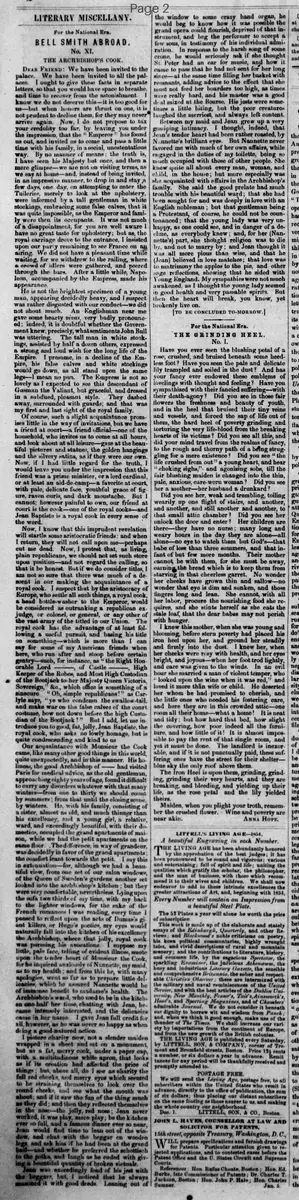
Dear Friend: We have been invited to the palace. We have been invited to all the palaces. I ought to give these facts in separate letters, so that you would have space to breathe and time to recover from the astonishment. I know we do not deserve this—it is too good for us—but when honors are thrust on one, it is not prudent to decline them, for they may never arrive again. Now, I do not propose to tax your credulity too far, by leaving you under the impression that the "Emperor" has found us out, and invited us to come and pass a little time with his family, in a social, unostentatious way. By no manner of means; the truth is, I have seen his Majesty but once, and then a mere glimpse—we are not on visiting terms, as we say at home—and, instead of being invited, in an impressive manner, to drop in and stay a few days, one day, on attempting to enter the Tuileries, merely to look at the upholstery, we were informed by a tall gentleman in white stockings, embracing some false calves, that it was quite impossible, as the Emperor and family were then its occupants. It was not much of a disappointment, for you are well aware I have no great taste for upholstery; but as the royal carriage drove to the entrance, I insisted upon our party remaining to see France on an airing. We did not have a pleasant time while waiting, for we withdrew to the railing, where a crowd of idlers were gathered, and peered through the bars. After a little while, Napoleon, accompanied by the Empress, made his appearance. He is not the brightest specimen of a young man, appearing decidedly heavy, and I suspect was rather disgusted with our conduct—we did not shout much. An Englishman near me gave some hearty vivas, very badly pronounced; indeed, it is doubtful whether the Government knew, precisely, what sentiments John Bull was uttering. The tall man in white stockings, assisted by half a dozen others, expressed a strong and loud wish for the long life of the Empire. I presume, in a decline of the Empire, his false calves and white stockings would go down, as all stand upon the same legs—I mean no pun. The Empress is not so lovely as I expected to see this descendant of Guzman the Valiant, but graceful, and dressed in a subdued, pleasant style. They dashed away, surrounded with guards; and that was my first and last sight of the royal family. Of course, such a slight acquaintance promises little in the way of invitations, but we have a friend at court—a friend official—one of the household, who invites us to come at all hours, and look about at all leisure—gaze at the beautiful pictures and statues, the golden hangings and the silvery satins, as if they were our own. Now, if I had little regard for the truth, I would leave you under the impression that this friend was a prime minister, or a lord cardinal, or at least an aide-de-camp—a favorite at court, with pale, delicate face, youthful grace of figure, raven curls, and dark moustache. But I cannot; however painful to own, our friend at court is the cook—one of the royal cooks—and Jean Baptiste is a royal cook in every sense of the word. Now, I know that this imprudent revelation will startle some aristocratic friends; and when I return, they will not call upon me—perhaps cut me dead. Now, I protest that, as living plain republicans, we should not set such store upon position—and not regard the calling, so that it be honest. But if we do consider titles, I am not so sure that there was much of a descent in our making the acquaintance of a royal cook. I suspect that by the aristocracy of Europe, who settle all such things, a royal cook, a head bottle-washer to the Emperor, would be considered as outranking a republican ex-judge, or colonel, or general, or any other of the vast army of the titled in our Union. The royal cook has the advantage of at least following a useful pursuit, and basing his title on something—which is more than I can say for some of my American friends when here, who run after and stoop before certain gentry—such, for instance, as "the Right Honorable Lord of Castle High Keeper of the Robes, and Most High Custodian of the Bootjack to her Majesty Queen Victoria, Sovereign," &c., which office is something of a sinecure. "Oh, simple republicans!" as Carlyle says, "ye who condemn the swallow-tail, and make war on the false calves of the court costume, bow not down before the high Custodian of the Bootjack!" But I add, let me introduce you to good, fat, jolly Jean Baptiste, the royal cook, who asks no lowly homage, but is quite condescending and kind to us. Our acquaintance with Monsieur the Cook came, like many other good things in this world, quite unexpectedly, and in this manner. His Holiness, the good Archbishop of — had visited Paris for medical advice, as the old gentleman, approaching eighty years of age, found it difficult to carry any disorders whatever with that many winters—from one to thirty we should count by summers; from that until the closing scene, by winters. He, with his family, consisting of a sister, almost as old, and much thinner than his excellency, and a young girl, a relative, ward, and exceedingly beautiful, with their domestics, occupied the grand apartments of maison, while we had the petit apartments on the same floor. The difference, in way of grandeur, was decidedly in favor of the grand apartments; the comfort leant towards the petit. I say this in extenuation—or, although we had a beautiful view, from one set of our salon windows, of the Queen of Sweden's gardens, another set looked into the archbishop's kitchen; but they were very comfortable, nevertheless. Lying upon the sofa two thirds of my time, with my back to the lighter windows, for the sake of the French romances I was reading, every time I paused to reflect upon the acts of Dumas's giant killers, or Hugo's poetics, my eyes would naturally fall into the kitchen of his excellency the Archbishop, where that jolly, royal cook was pursuing his avocations. I suppose my little, pale face, telling of evident illness, smote upon the tender heart of Monsieur the Cook, for he inquired anxiously of Nanette, my maid, as to my health; and from this he, with many apologies, went so far as to prepare little delicacies, which he assured Nanette would be of immense benefit to madame's health. The Archbishop's ward, who used to be in the kitchen one-half her time, chatting with Jean, became intensely interested, and the delicacies came in her name. I gave Jean full credit for all, however, as he was never so happy as when doing a good-natured action. I picture charity now, not as a slender maiden wrapped in a sheet and set on a monument, but as a fat, merry cook, under a paper cap, with a multitudinous white apron, that looks as if its creation had affected the price of things; but, above all, do I see as charity the full red cheeks, and merry eyes which seemed to be straining themselves to look over the round cheeks, and see what the mouth was about; and if it saw the fun of the thing much as they did; and then they reflected themselves in the nose—the jolly, red nose; Jean never worked, it was play, more play; be the kitchen ever so full, and a famous dinner ever so near, Jean would find time to lean out of the window, and chat with the beggar on wooden legs, and ask him if he had been at the grand ball—and whether he preferred the schottische to the polka, and laugh as he ended with giving a bountiful quantity of broken victuals. Jean was exceedingly fond of his jest with the beggars, but, I noticed that he always seasoned it with good deeds. Leaning out of the window to some crazy hand organ, he would beg to know how it was possible the grand opera could flourish, deprived of that instrument, and beg the performer to accept a few sous, in testimony of his individual admiration. In response to the harsh song of some crone, he would seriously ask if she thought St. Peter had an ear for music, and how it came to pass that he had not sent for her long since—at the same time filling her basket with remnants, adding advice to the effect that she must not feed her boarders too high, as times were really hard, and his master was a good deal mixed at the Bourse. His jests were sometimes a little biting, but the poor creatures laughed the merriest, and always left content. Between my maid and Jean grew up a very gossiping intimacy. I thought, indeed, that Jean's tender heart had been rather roasted, by Nanette's brilliant eyes. But Nanette never favored me with much of her own affairs, while engaged in the duties of my toilette, being so much occupied with those of other people. She knew quite all about every man, woman, and child, in the house; but more especially was she acquainted with affairs in the Archbishop's family. She said the good prelate had much trouble with his beautiful ward; that she had been sought for and was deeply in love with an English nobleman; but that gentleman being a Protestant, of course, he could not be countenanced; that the young lady was very unhappy, as one could see, and in danger of a decline, as everybody knew; and, for her (Nanette's) part, she thought religion was to die by, and not to marry by; and Jean thought it was all more pious than wise, and that he (Jean) believed in love matches; that love was to matrimony the apples to the pie, and other sage reflections, showing that he sided with Young England. My sympathies were not much awakened, as I thought the young lady seemed in good health and very passable spirits. But then the heart will break, you know, yet brokenly live on.
TO BE CONCLUDED TO-MORROW.
For the National Era.
BELL SMITH ABROAD.
No. XI.
THE ARCHBISHOP'S COOK.
Dear Friend: We have been invited to the palace. We have been invited to all the palaces. I ought to give these facts in separate letters, so that you would have space to breathe and time to recover from the astonishment. I know we do not deserve this—it is too good for us—but when honors are thrust on one, it is not prudent to decline them, for they may never arrive again. Now, I do not propose to tax your credulity too far, by leaving you under the impression that the "Emperor" has found us out, and invited us to come and pass a little time with his family, in a social, unostentatious way. By no manner of means; the truth is, I have seen his Majesty but once, and then a mere glimpse—we are not on visiting terms, as we say at home—and, instead of being invited, in an impressive manner, to drop in and stay a few days, one day, on attempting to enter the Tuileries, merely to look at the upholstery, we were informed by a tall gentleman in white stockings, embracing some false calves, that it was quite impossible, as the Emperor and family were then its occupants. It was not much of a disappointment, for you are well aware I have no great taste for upholstery; but as the royal carriage drove to the entrance, I insisted upon our party remaining to see France on an airing. We did not have a pleasant time while waiting, for we withdrew to the railing, where a crowd of idlers were gathered, and peered through the bars. After a little while, Napoleon, accompanied by the Empress, made his appearance. He is not the brightest specimen of a young man, appearing decidedly heavy, and I suspect was rather disgusted with our conduct—we did not shout much. An Englishman near me gave some hearty vivas, very badly pronounced; indeed, it is doubtful whether the Government knew, precisely, what sentiments John Bull was uttering. The tall man in white stockings, assisted by half a dozen others, expressed a strong and loud wish for the long life of the Empire. I presume, in a decline of the Empire, his false calves and white stockings would go down, as all stand upon the same legs—I mean no pun. The Empress is not so lovely as I expected to see this descendant of Guzman the Valiant, but graceful, and dressed in a subdued, pleasant style. They dashed away, surrounded with guards; and that was my first and last sight of the royal family. Of course, such a slight acquaintance promises little in the way of invitations, but we have a friend at court—a friend official—one of the household, who invites us to come at all hours, and look about at all leisure—gaze at the beautiful pictures and statues, the golden hangings and the silvery satins, as if they were our own. Now, if I had little regard for the truth, I would leave you under the impression that this friend was a prime minister, or a lord cardinal, or at least an aide-de-camp—a favorite at court, with pale, delicate face, youthful grace of figure, raven curls, and dark moustache. But I cannot; however painful to own, our friend at court is the cook—one of the royal cooks—and Jean Baptiste is a royal cook in every sense of the word. Now, I know that this imprudent revelation will startle some aristocratic friends; and when I return, they will not call upon me—perhaps cut me dead. Now, I protest that, as living plain republicans, we should not set such store upon position—and not regard the calling, so that it be honest. But if we do consider titles, I am not so sure that there was much of a descent in our making the acquaintance of a royal cook. I suspect that by the aristocracy of Europe, who settle all such things, a royal cook, a head bottle-washer to the Emperor, would be considered as outranking a republican ex-judge, or colonel, or general, or any other of the vast army of the titled in our Union. The royal cook has the advantage of at least following a useful pursuit, and basing his title on something—which is more than I can say for some of my American friends when here, who run after and stoop before certain gentry—such, for instance, as "the Right Honorable Lord of Castle High Keeper of the Robes, and Most High Custodian of the Bootjack to her Majesty Queen Victoria, Sovereign," &c., which office is something of a sinecure. "Oh, simple republicans!" as Carlyle says, "ye who condemn the swallow-tail, and make war on the false calves of the court costume, bow not down before the high Custodian of the Bootjack!" But I add, let me introduce you to good, fat, jolly Jean Baptiste, the royal cook, who asks no lowly homage, but is quite condescending and kind to us. Our acquaintance with Monsieur the Cook came, like many other good things in this world, quite unexpectedly, and in this manner. His Holiness, the good Archbishop of — had visited Paris for medical advice, as the old gentleman, approaching eighty years of age, found it difficult to carry any disorders whatever with that many winters—from one to thirty we should count by summers; from that until the closing scene, by winters. He, with his family, consisting of a sister, almost as old, and much thinner than his excellency, and a young girl, a relative, ward, and exceedingly beautiful, with their domestics, occupied the grand apartments of maison, while we had the petit apartments on the same floor. The difference, in way of grandeur, was decidedly in favor of the grand apartments; the comfort leant towards the petit. I say this in extenuation—or, although we had a beautiful view, from one set of our salon windows, of the Queen of Sweden's gardens, another set looked into the archbishop's kitchen; but they were very comfortable, nevertheless. Lying upon the sofa two thirds of my time, with my back to the lighter windows, for the sake of the French romances I was reading, every time I paused to reflect upon the acts of Dumas's giant killers, or Hugo's poetics, my eyes would naturally fall into the kitchen of his excellency the Archbishop, where that jolly, royal cook was pursuing his avocations. I suppose my little, pale face, telling of evident illness, smote upon the tender heart of Monsieur the Cook, for he inquired anxiously of Nanette, my maid, as to my health; and from this he, with many apologies, went so far as to prepare little delicacies, which he assured Nanette would be of immense benefit to madame's health. The Archbishop's ward, who used to be in the kitchen one-half her time, chatting with Jean, became intensely interested, and the delicacies came in her name. I gave Jean full credit for all, however, as he was never so happy as when doing a good-natured action. I picture charity now, not as a slender maiden wrapped in a sheet and set on a monument, but as a fat, merry cook, under a paper cap, with a multitudinous white apron, that looks as if its creation had affected the price of things; but, above all, do I see as charity the full red cheeks, and merry eyes which seemed to be straining themselves to look over the round cheeks, and see what the mouth was about; and if it saw the fun of the thing much as they did; and then they reflected themselves in the nose—the jolly, red nose; Jean never worked, it was play, more play; be the kitchen ever so full, and a famous dinner ever so near, Jean would find time to lean out of the window, and chat with the beggar on wooden legs, and ask him if he had been at the grand ball—and whether he preferred the schottische to the polka, and laugh as he ended with giving a bountiful quantity of broken victuals. Jean was exceedingly fond of his jest with the beggars, but, I noticed that he always seasoned it with good deeds. Leaning out of the window to some crazy hand organ, he would beg to know how it was possible the grand opera could flourish, deprived of that instrument, and beg the performer to accept a few sous, in testimony of his individual admiration. In response to the harsh song of some crone, he would seriously ask if she thought St. Peter had an ear for music, and how it came to pass that he had not sent for her long since—at the same time filling her basket with remnants, adding advice to the effect that she must not feed her boarders too high, as times were really hard, and his master was a good deal mixed at the Bourse. His jests were sometimes a little biting, but the poor creatures laughed the merriest, and always left content. Between my maid and Jean grew up a very gossiping intimacy. I thought, indeed, that Jean's tender heart had been rather roasted, by Nanette's brilliant eyes. But Nanette never favored me with much of her own affairs, while engaged in the duties of my toilette, being so much occupied with those of other people. She knew quite all about every man, woman, and child, in the house; but more especially was she acquainted with affairs in the Archbishop's family. She said the good prelate had much trouble with his beautiful ward; that she had been sought for and was deeply in love with an English nobleman; but that gentleman being a Protestant, of course, he could not be countenanced; that the young lady was very unhappy, as one could see, and in danger of a decline, as everybody knew; and, for her (Nanette's) part, she thought religion was to die by, and not to marry by; and Jean thought it was all more pious than wise, and that he (Jean) believed in love matches; that love was to matrimony the apples to the pie, and other sage reflections, showing that he sided with Young England. My sympathies were not much awakened, as I thought the young lady seemed in good health and very passable spirits. But then the heart will break, you know, yet brokenly live on.
TO BE CONCLUDED TO-MORROW.
What sub-type of article is it?
Epistolary
Prose Fiction
Essay
What themes does it cover?
Social Manners
Political
Moral Virtue
What keywords are associated?
Travel Letter
Paris Palaces
Napoleon Iii
Royal Cook
Archbishop Ward
Charity
Aristocracy
Republican Views
What entities or persons were involved?
Bell Smith
Literary Details
Title
The Archbishop's Cook.
Author
Bell Smith
Subject
Travel Observations In Paris
Form / Style
Letter Narrative On Royalty And Domestic Life
Key Lines
Dear Friend: We Have Been Invited To The Palace. We Have Been Invited To All The Palaces.
Our Friend At Court Is The Cook—One Of The Royal Cooks—And Jean Baptiste Is A Royal Cook In Every Sense Of The Word.
I Picture Charity Now, Not As A Slender Maiden Wrapped In A Sheet And Set On A Monument, But As A Fat, Merry Cook, Under A Paper Cap, With A Multitudinous White Apron...
Jean Was Exceedingly Fond Of His Jest With The Beggars, But, I Noticed That He Always Seasoned It With Good Deeds.
She Said The Good Prelate Had Much Trouble With His Beautiful Ward; That She Had Been Sought For And Was Deeply In Love With An English Nobleman; But That Gentleman Being A Protestant, Of Course, He Could Not Be Countenanced...