Thank you for visiting SNEWPapers!
Sign up free
Editorial
March 19, 1870
The Sun
New York, New York County, New York
What is this article about?
Editorial opposes US Senate ratification of treaty annexing Dominican Republic, arguing it risks civil war with rebels under Cabral, lacks genuine consent via fraudulent election under Baez, and involves unclear finances with debts and lands swindled to speculators for US to cover.
Clipping
OCR Quality
95%
Excellent
Full Text
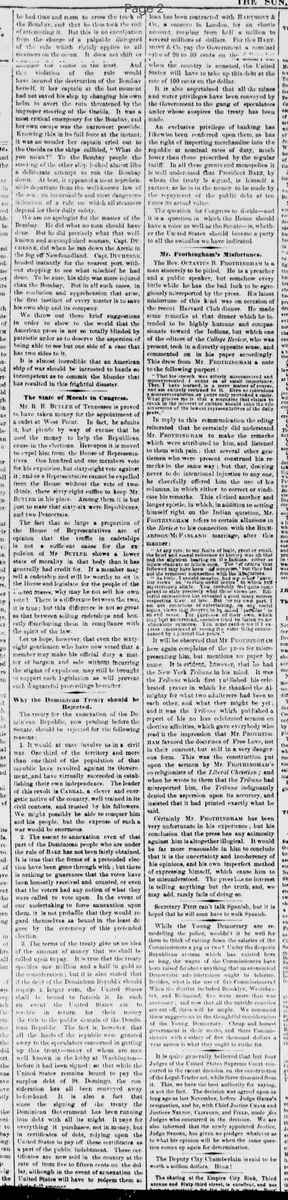
Why the Dominican Treaty should be Rejected.
The treaty for the annexation of the Dominican Republic, now pending before the Senate, should be rejected for the following reasons:
1. It would at once involve us in a civil war. One third of the territory and more than one third of the population of that republic have revolted against its Government, and have virtually succeeded in establishing their own independence. The leader of this revolt is CABRAL, a clever and energetic native of the country, well trained in its civil contests, and trusted by his followers. We might possibly be able to conquer him and his people, but the expense of such a war would be enormous.
2. The assent to annexation even of that part of the Dominican people who are under the rule of BAEZ has not been fairly obtained. It is true that the forms of a pretended election have been gone through with; but there is nothing to guarantee that the votes have been honestly received and counted, or even that the voters had any notion of what they were called to vote upon. In the event of our undertaking to force annexation upon them, it is not probable that they would regard themselves as bound in the least degree by the ceremony of this pretended election.
3. The terms of the treaty give us no idea of the amount of money that we shall be called upon to pay. It is true that the treaty specifies one million and a half in gold as the consideration; but it is also stated that if the debt of the Dominican Republic should require a larger sum, the United States shall be bound to furnish it. In such an event the United States are to receive in return for their money the title to the public domain of the Dominican Republic. The fact is, however, that all the lands of the republic were granted away to the speculators concerned in getting up this treaty—many of whom are men well known in the lobby at Washington—before it had been signed; so that while the United States remain bound to pay the surplus debt of St. Domingo, the consideration has all been conveyed away beforehand. It is also a fact that since the signing of the treaty the Dominican Government has been running into debt with all its might. It pays for everything it purchases, not in money, but in certificates of debt, relying upon the United States to pay off these certificates as a part of the public indebtedness. These certificates are now sold in the country at the rate of from five to fifteen cents on the dollar, although in the event of annexation the United States will have to redeem them at par.
A loan has been contracted with Hainimost & Co., a concern in London, for an elastic amount, ranging from half a million to several millions of dollars. For this Hainimost & Co. pay the Government a nominal price of 20 to 30 cents on the dollar; when the country is annexed, the United States will have to take up this debt at the rate of 100 cents on the dollar.
It is also ascertained that all the mines and water privileges have been conveyed by the Government to the gang of speculators under whose auspices the treaty has been made. An exclusive privilege of banking has likewise been conferred upon them, as has the right of importing merchandise into the republic at nominal rates of duty, much lower than those prescribed by the regular tariff. In all these grants and monopolies it is well understood that President BAEZ, by whom the treaty is signed, is himself a partner, as he is in the money to be made by the repayment of the public debt at ten times its actual value.
The question for Congress to decide—and it is a question in which the House should have a voice as well as the Senate—is, whether the United States should become a party to all the swindles we have indicated.
The treaty for the annexation of the Dominican Republic, now pending before the Senate, should be rejected for the following reasons:
1. It would at once involve us in a civil war. One third of the territory and more than one third of the population of that republic have revolted against its Government, and have virtually succeeded in establishing their own independence. The leader of this revolt is CABRAL, a clever and energetic native of the country, well trained in its civil contests, and trusted by his followers. We might possibly be able to conquer him and his people, but the expense of such a war would be enormous.
2. The assent to annexation even of that part of the Dominican people who are under the rule of BAEZ has not been fairly obtained. It is true that the forms of a pretended election have been gone through with; but there is nothing to guarantee that the votes have been honestly received and counted, or even that the voters had any notion of what they were called to vote upon. In the event of our undertaking to force annexation upon them, it is not probable that they would regard themselves as bound in the least degree by the ceremony of this pretended election.
3. The terms of the treaty give us no idea of the amount of money that we shall be called upon to pay. It is true that the treaty specifies one million and a half in gold as the consideration; but it is also stated that if the debt of the Dominican Republic should require a larger sum, the United States shall be bound to furnish it. In such an event the United States are to receive in return for their money the title to the public domain of the Dominican Republic. The fact is, however, that all the lands of the republic were granted away to the speculators concerned in getting up this treaty—many of whom are men well known in the lobby at Washington—before it had been signed; so that while the United States remain bound to pay the surplus debt of St. Domingo, the consideration has all been conveyed away beforehand. It is also a fact that since the signing of the treaty the Dominican Government has been running into debt with all its might. It pays for everything it purchases, not in money, but in certificates of debt, relying upon the United States to pay off these certificates as a part of the public indebtedness. These certificates are now sold in the country at the rate of from five to fifteen cents on the dollar, although in the event of annexation the United States will have to redeem them at par.
A loan has been contracted with Hainimost & Co., a concern in London, for an elastic amount, ranging from half a million to several millions of dollars. For this Hainimost & Co. pay the Government a nominal price of 20 to 30 cents on the dollar; when the country is annexed, the United States will have to take up this debt at the rate of 100 cents on the dollar.
It is also ascertained that all the mines and water privileges have been conveyed by the Government to the gang of speculators under whose auspices the treaty has been made. An exclusive privilege of banking has likewise been conferred upon them, as has the right of importing merchandise into the republic at nominal rates of duty, much lower than those prescribed by the regular tariff. In all these grants and monopolies it is well understood that President BAEZ, by whom the treaty is signed, is himself a partner, as he is in the money to be made by the repayment of the public debt at ten times its actual value.
The question for Congress to decide—and it is a question in which the House should have a voice as well as the Senate—is, whether the United States should become a party to all the swindles we have indicated.
What sub-type of article is it?
Imperialism
Foreign Affairs
Economic Policy
What keywords are associated?
Dominican Treaty
Annexation Rejection
Civil War Risk
Election Fraud
Financial Swindle
Speculators
Bae Z
Cabral
What entities or persons were involved?
Cabral
Baez
Dominican Republic
United States
Senate
Congress
Hainimost & Co.
Editorial Details
Primary Topic
Rejection Of Dominican Annexation Treaty
Stance / Tone
Strongly Opposed
Key Figures
Cabral
Baez
Dominican Republic
United States
Senate
Congress
Hainimost & Co.
Key Arguments
Annexation Would Involve The Us In A Civil War Against Revolted Territory Led By Cabral, With Enormous Expense.
Assent To Annexation Under Baez's Rule Obtained Through A Pretended Election Without Guarantees Of Honesty Or Voter Understanding.
Treaty Terms Obscure Financial Obligations; Us Bound To Pay Dominican Debts, But Lands And Privileges Already Granted To Speculators Including Baez.
Dominican Government Issuing Debt Certificates And Loans At Discount, To Be Redeemed By Us At Par, Benefiting Speculators.
Grants Of Mines, Water Privileges, Banking Monopoly, And Low Duty Imports To Speculators Involved In The Treaty.