Thank you for visiting SNEWPapers!
Sign up free
Editorial
December 27, 1883
The Bossier Banner
Benton, Bellevue, Bossier County, Louisiana
What is this article about?
The editorial argues against allowing children to develop whining and fault-finding habits, which begin in infancy and persist into adulthood if uncorrected, leading to family strife. It urges parents to instill positive traits early for a harmonious life, drawing on moral and agricultural metaphors.
Clipping
OCR Quality
98%
Excellent
Full Text
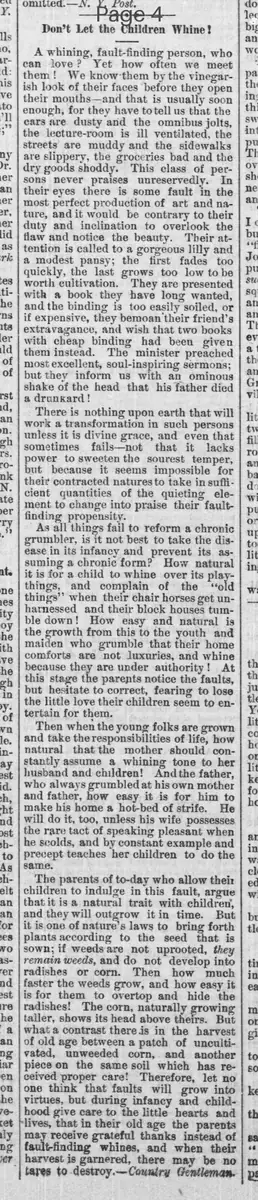
Don't Let the Children Whine!
A whining, fault-finding person, who can love? Yet how often we meet them! We know them by the vinegarish look of their faces before they open their mouths—and that is usually soon enough, for they have to tell us that the cars are dusty and the omnibus jolts, the lecture-room is ill ventilated, the streets are muddy and the sidewalks slippery, the groceries bad and the dry goods shoddy. This class of persons never praises unreservedly. In their eyes there is some fault in the most perfect production of art and nature, and it would be contrary to their duty and inclination to overlook the flaw and notice the beauty. Their attention is called to a gorgeous lily and a modest pansy; the first fades too quickly, the last grows too low to be worth cultivation. They are presented with a book they have long wanted, and the binding is too easily soiled, or if expensive, they bemoan their friend's extravagance, and wish that two books with cheap binding had been given them instead. The minister preached most excellent, soul-inspiring sermons; but they inform us with an ominous shake of the head that his father died a drunkard!
There is nothing upon earth that will work a transformation in such persons unless it is divine grace, and even that sometimes fails—not that it lacks power to sweeten the sourest temper, but because it seems impossible for their contracted natures to take in sufficient quantities of the quieting element to change into praise their fault-finding propensity.
As all things fail to reform a chronic grumbler, is it not best to take the disease in its infancy and prevent its assuming a chronic form? How natural it is for a child to whine over its playthings, and complain of the "old things" when their chair horses get unharnessed and their block houses tumble down! How easy and natural is the growth from this to the youth and maiden who grumble that their home comforts are not luxuries, and whine because they are under authority! At this stage the parents notice the faults, but hesitate to correct, fearing to lose the little love their children seem to entertain for them.
Then when the young folks are grown and take the responsibilities of life, how natural that the mother should constantly assume a whining tone to her husband and children! And the father, who always grumbled at his own mother and father, how easy it is for him to make his home a hot-bed of strife. He will do it, too, unless his wife possesses the rare tact of speaking pleasant when he scolds, and by constant example and precept teaches her children to do the same.
The parents of to-day who allow their children to indulge in this fault, argue that it is a natural trait with children, and they will outgrow it in time. But it is one of nature's laws to bring forth plants according to the seed that is sown; if weeds are not uprooted, they remain weeds, and do not develop into radishes or corn. Then how much faster the weeds grow, and how easy it is for them to overtop and hide the radishes! The corn, naturally growing taller, shows its head above theirs. But what a contrast there is in the harvest of old age between a patch of uncultivated, unweeded corn, and another piece on the same soil which has received proper care! Therefore, let no one think that faults will grow into virtues, but during infancy and childhood give care to the little hearts and lives, that in their old age the parents may receive grateful thanks instead of fault-finding whines, and when their harvest is garnered, there may be no tares to destroy.—Country Gentleman.
A whining, fault-finding person, who can love? Yet how often we meet them! We know them by the vinegarish look of their faces before they open their mouths—and that is usually soon enough, for they have to tell us that the cars are dusty and the omnibus jolts, the lecture-room is ill ventilated, the streets are muddy and the sidewalks slippery, the groceries bad and the dry goods shoddy. This class of persons never praises unreservedly. In their eyes there is some fault in the most perfect production of art and nature, and it would be contrary to their duty and inclination to overlook the flaw and notice the beauty. Their attention is called to a gorgeous lily and a modest pansy; the first fades too quickly, the last grows too low to be worth cultivation. They are presented with a book they have long wanted, and the binding is too easily soiled, or if expensive, they bemoan their friend's extravagance, and wish that two books with cheap binding had been given them instead. The minister preached most excellent, soul-inspiring sermons; but they inform us with an ominous shake of the head that his father died a drunkard!
There is nothing upon earth that will work a transformation in such persons unless it is divine grace, and even that sometimes fails—not that it lacks power to sweeten the sourest temper, but because it seems impossible for their contracted natures to take in sufficient quantities of the quieting element to change into praise their fault-finding propensity.
As all things fail to reform a chronic grumbler, is it not best to take the disease in its infancy and prevent its assuming a chronic form? How natural it is for a child to whine over its playthings, and complain of the "old things" when their chair horses get unharnessed and their block houses tumble down! How easy and natural is the growth from this to the youth and maiden who grumble that their home comforts are not luxuries, and whine because they are under authority! At this stage the parents notice the faults, but hesitate to correct, fearing to lose the little love their children seem to entertain for them.
Then when the young folks are grown and take the responsibilities of life, how natural that the mother should constantly assume a whining tone to her husband and children! And the father, who always grumbled at his own mother and father, how easy it is for him to make his home a hot-bed of strife. He will do it, too, unless his wife possesses the rare tact of speaking pleasant when he scolds, and by constant example and precept teaches her children to do the same.
The parents of to-day who allow their children to indulge in this fault, argue that it is a natural trait with children, and they will outgrow it in time. But it is one of nature's laws to bring forth plants according to the seed that is sown; if weeds are not uprooted, they remain weeds, and do not develop into radishes or corn. Then how much faster the weeds grow, and how easy it is for them to overtop and hide the radishes! The corn, naturally growing taller, shows its head above theirs. But what a contrast there is in the harvest of old age between a patch of uncultivated, unweeded corn, and another piece on the same soil which has received proper care! Therefore, let no one think that faults will grow into virtues, but during infancy and childhood give care to the little hearts and lives, that in their old age the parents may receive grateful thanks instead of fault-finding whines, and when their harvest is garnered, there may be no tares to destroy.—Country Gentleman.
What sub-type of article is it?
Moral Or Religious
Social Reform
Education
What keywords are associated?
Whining
Fault Finding
Child Rearing
Moral Reform
Family Harmony
Parental Duty
Grumbling
What entities or persons were involved?
Parents
Children
Chronic Grumblers
Editorial Details
Primary Topic
Preventing Whining And Fault Finding In Children
Stance / Tone
Advisory And Exhortative Against Tolerating Complaining Habits
Key Figures
Parents
Children
Chronic Grumblers
Key Arguments
Whining And Fault Finding Prevent Love And Appreciation
Such Habits Start In Childhood With Complaints Over Toys And Grow Into Adult Discontent
Parents Often Fail To Correct Early Due To Fear Of Losing Affection
Unchecked, It Leads To Family Strife In Adulthood
Divine Grace May Help But Early Prevention Is Key
Like Weeds, Bad Habits Persist Unless Uprooted Young
Proper Upbringing Yields Gratitude In Old Age