Thank you for visiting SNEWPapers!
Sign up free
Editorial
July 31, 1826
The Virginian
Lynchburg, Virginia
What is this article about?
Editorial in The Virginian defends Henry Clay against corruption accusations from the Charlottesville Gazette for voting John Quincy Adams into presidency over Andrew Jackson in 1824, arguing the Secretary of State role was no reward but a sacrifice, and criticizes Jacksonian partisanship.
Clipping
OCR Quality
98%
Excellent
Full Text
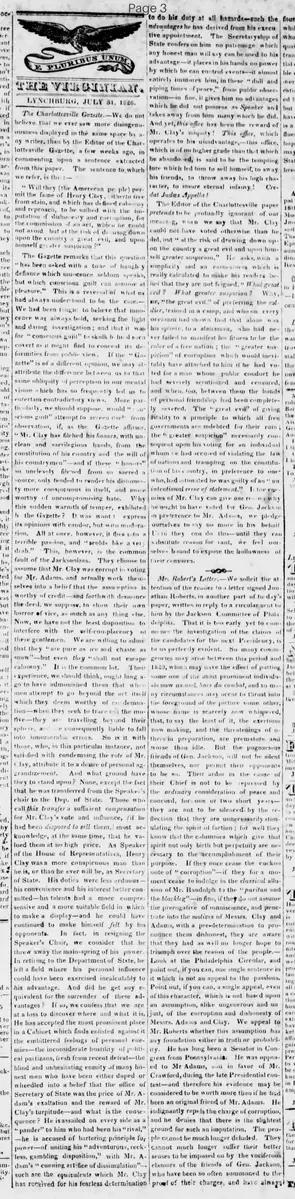
THE VIRGINIAN.
LYNCHBURG, JULY 31, 1826.
The Charlottesville Gazette.—We do not believe that we ever saw more disingenuousness displayed in the same space by any writer, than by the Editor of the Charlottesville Gazette, a few weeks ago, in commenting upon a sentence extracted from this paper. The sentence to which we refer, is this:—
'Will they (the American people) permit the fame of Henry Clay, hitherto free from stain, and which has defied calumny and reproach, to be sullied with the imputation of dishonesty and corruption, for the commission of an act, which he could not avoid, but at the risk of drawing down upon the country a great evil, and upon himself greater suspicion?'
The Gazette remarks that this question 'has been asked with a tone of haughty defiance which innocence seldom speaks, but which conscious guilt can assume at pleasure.' This is a reversal of what we had always understood to be the case.—We had been taught to believe that innocence was always bold, seeking the light and daring investigation; and that it was for 'conscious guilt' to skulk behind some covert as it might find to conceal its deformities from public view. If the 'Gazette' is of a different opinion, we may attribute the difference between us to that same obliquity of perception in our mental vision which has so frequently led us to entertain contradictory views. More particularly, we should suppose, would 'conscious guilt' attempt to screen itself from observation, if, as the Gazette affirms, 'Mr. Clay has filched his honors, with unclean and sacrilegious hands, from the constitution of his country and the will of his countrymen'—and if these 'honors' so uncleanly filched from so sacred a source, only tended to render his dishonesty more conspicuous in itself, and more worthy of uncompromising hate. Why this sudden warmth of temper, exhibited by the Gazette? It was wont to express its opinions with candor, but with moderation. All at once, however, it flies into a terrible passion, and 'scolds like a very drab.' This, however, is the common fault of the Jacksonians. They choose to assume that Mr. Clay was corrupt in voting for Mr. Adams, and actually work themselves into a belief that the assumption is worthy of credit—and forthwith denounce the deed, we suppose, to show their own horror of vice, as much as any thing else.
Now, we have not the least disposition to interfere with the self-complacency of these gentlemen. We are willing to admit that they 'are pure as ice and chaste as snow'—but even they 'shall not escape calumny.' It is the common lot. Their experience, we should think, ought long ago to have admonished them that when men attempt to go beyond the act itself which they deem worthy of condemnation—when they seek to trace out the motive—they are travelling beyond their sphere, and are consequently liable to fall into innumerable errors. So is it with those, who, in this particular instance, not satisfied with condemning the vote of Mr. Clay, attribute it to a desire of personal aggrandizement. And what ground have they to stand upon? None, except the fact that he was transferred from the Speaker's chair to the Dept. of State. Those who call this transfer a sufficient compensation for Mr. Clay's vote and influence, (if he had been disposed to sell them,) must acknowledge, at the same time, that he valued them at no high price. As Speaker of the House of Representatives, Henry Clay was a more conspicuous man than he is, or than he ever will be, as Secretary of State. His duties were less arduous—his convenience and his interest better consulted—his talents had a more comprehensive and a more suitable field in which to make a display—and he could have continued to make himself felt by his opponents. In fact, in resigning the Speaker's Chair, we consider that he threw away the main-spring of his power. In retiring to the Department of State, he left a field where his personal influence could have been exercised incalculably to his advantage. And did he get any equivalent for the surrender of these advantages? If so, we confess that we are at a loss to discover where and what it is. He has accepted the most prominent place in a Cabinet which finds enlisted against it the embittered feelings of personal enemies—the inconsiderate hostility of political partisans, fresh from recent defeat—the blind and unhesitating enmity of many honest men who have been either duped or wheedled into a belief that the office of Secretary of State was the price of Mr. Adams's exaltation and the reward of Mr. Clay's turpitude—and what is the consequence? He is assailed on every side as a 'pander' to him who had been his 'rival,'—he is accused of bartering principle for power—of uniting his 'adventurous, reckless, gambling disposition,' with Mr. Adams's 'cunning artifice of dissimulation'—such are the equivalents which Mr. Clay has received for his fearless determination to do his duty at all hazards—such the advantages he has derived from his executive appointment. The Secretaryship of State confers on him no patronage which any honest man will say can be used to his advantage—it places in his hands no power by which he can control events—it almost entirely immures him, in these 'dull and piping times of peace,' from public observation—in fine, it gives him no advantages which he did not possess as Speaker and takes away from him many which he did. And yet, this office has been the reward of Mr. Clay's iniquity! This office, which operates to his disadvantage,—this office, which is of no higher grade than that which he abandoned, is said to be the tempting lure which led him to sell himself, to sway his friends, to throw away his high character, to insure eternal infamy! Credat Judaeus Apella!
The Editor of the Charlottesville paper pretends to be profoundly ignorant of our meaning, when we say that Mr. Clay could not have voted otherwise than he did, but 'at the risk of drawing down upon the country a great evil and upon himself greater suspicion.' He asks, with a simplicity and an earnestness which is really calculated to make his readers believe that they are not feigned. 'What great evil? What greater suspicion? Why, sir, 'the great evil,' of preferring the soldier, trained in a camp, and who on every occasion had shown that that alone was his sphere, to a statesman, who had never failed to manifest his fitness to be the ruler of a free nation; the 'greater suspicion' of corruption which would inevitably have attached to him if he had voted for a man whose public conduct he had severely scrutinized and censured, and when, too, between them the bonds of personal friendship had been completely severed. The 'great evil' of giving vitality to a principle to which all free governments are indebted for their ruin; the 'greater suspicion' necessarily consequent upon his voting for an individual whom he had accused of violating the law of nations and trampling on the constitution of his country, in preference to one who, had only committed an 'unintentional error of statement.' If the enemies of Mr. Clay can give one reason why he ought to have voted for Gen. Jackson in preference to Mr. Adams, we pledge ourselves to say no more in his behalf. Or if they can do this—until they can substitute reason for rant, we feel ourselves bound to expose the hollowness of their censures.
LYNCHBURG, JULY 31, 1826.
The Charlottesville Gazette.—We do not believe that we ever saw more disingenuousness displayed in the same space by any writer, than by the Editor of the Charlottesville Gazette, a few weeks ago, in commenting upon a sentence extracted from this paper. The sentence to which we refer, is this:—
'Will they (the American people) permit the fame of Henry Clay, hitherto free from stain, and which has defied calumny and reproach, to be sullied with the imputation of dishonesty and corruption, for the commission of an act, which he could not avoid, but at the risk of drawing down upon the country a great evil, and upon himself greater suspicion?'
The Gazette remarks that this question 'has been asked with a tone of haughty defiance which innocence seldom speaks, but which conscious guilt can assume at pleasure.' This is a reversal of what we had always understood to be the case.—We had been taught to believe that innocence was always bold, seeking the light and daring investigation; and that it was for 'conscious guilt' to skulk behind some covert as it might find to conceal its deformities from public view. If the 'Gazette' is of a different opinion, we may attribute the difference between us to that same obliquity of perception in our mental vision which has so frequently led us to entertain contradictory views. More particularly, we should suppose, would 'conscious guilt' attempt to screen itself from observation, if, as the Gazette affirms, 'Mr. Clay has filched his honors, with unclean and sacrilegious hands, from the constitution of his country and the will of his countrymen'—and if these 'honors' so uncleanly filched from so sacred a source, only tended to render his dishonesty more conspicuous in itself, and more worthy of uncompromising hate. Why this sudden warmth of temper, exhibited by the Gazette? It was wont to express its opinions with candor, but with moderation. All at once, however, it flies into a terrible passion, and 'scolds like a very drab.' This, however, is the common fault of the Jacksonians. They choose to assume that Mr. Clay was corrupt in voting for Mr. Adams, and actually work themselves into a belief that the assumption is worthy of credit—and forthwith denounce the deed, we suppose, to show their own horror of vice, as much as any thing else.
Now, we have not the least disposition to interfere with the self-complacency of these gentlemen. We are willing to admit that they 'are pure as ice and chaste as snow'—but even they 'shall not escape calumny.' It is the common lot. Their experience, we should think, ought long ago to have admonished them that when men attempt to go beyond the act itself which they deem worthy of condemnation—when they seek to trace out the motive—they are travelling beyond their sphere, and are consequently liable to fall into innumerable errors. So is it with those, who, in this particular instance, not satisfied with condemning the vote of Mr. Clay, attribute it to a desire of personal aggrandizement. And what ground have they to stand upon? None, except the fact that he was transferred from the Speaker's chair to the Dept. of State. Those who call this transfer a sufficient compensation for Mr. Clay's vote and influence, (if he had been disposed to sell them,) must acknowledge, at the same time, that he valued them at no high price. As Speaker of the House of Representatives, Henry Clay was a more conspicuous man than he is, or than he ever will be, as Secretary of State. His duties were less arduous—his convenience and his interest better consulted—his talents had a more comprehensive and a more suitable field in which to make a display—and he could have continued to make himself felt by his opponents. In fact, in resigning the Speaker's Chair, we consider that he threw away the main-spring of his power. In retiring to the Department of State, he left a field where his personal influence could have been exercised incalculably to his advantage. And did he get any equivalent for the surrender of these advantages? If so, we confess that we are at a loss to discover where and what it is. He has accepted the most prominent place in a Cabinet which finds enlisted against it the embittered feelings of personal enemies—the inconsiderate hostility of political partisans, fresh from recent defeat—the blind and unhesitating enmity of many honest men who have been either duped or wheedled into a belief that the office of Secretary of State was the price of Mr. Adams's exaltation and the reward of Mr. Clay's turpitude—and what is the consequence? He is assailed on every side as a 'pander' to him who had been his 'rival,'—he is accused of bartering principle for power—of uniting his 'adventurous, reckless, gambling disposition,' with Mr. Adams's 'cunning artifice of dissimulation'—such are the equivalents which Mr. Clay has received for his fearless determination to do his duty at all hazards—such the advantages he has derived from his executive appointment. The Secretaryship of State confers on him no patronage which any honest man will say can be used to his advantage—it places in his hands no power by which he can control events—it almost entirely immures him, in these 'dull and piping times of peace,' from public observation—in fine, it gives him no advantages which he did not possess as Speaker and takes away from him many which he did. And yet, this office has been the reward of Mr. Clay's iniquity! This office, which operates to his disadvantage,—this office, which is of no higher grade than that which he abandoned, is said to be the tempting lure which led him to sell himself, to sway his friends, to throw away his high character, to insure eternal infamy! Credat Judaeus Apella!
The Editor of the Charlottesville paper pretends to be profoundly ignorant of our meaning, when we say that Mr. Clay could not have voted otherwise than he did, but 'at the risk of drawing down upon the country a great evil and upon himself greater suspicion.' He asks, with a simplicity and an earnestness which is really calculated to make his readers believe that they are not feigned. 'What great evil? What greater suspicion? Why, sir, 'the great evil,' of preferring the soldier, trained in a camp, and who on every occasion had shown that that alone was his sphere, to a statesman, who had never failed to manifest his fitness to be the ruler of a free nation; the 'greater suspicion' of corruption which would inevitably have attached to him if he had voted for a man whose public conduct he had severely scrutinized and censured, and when, too, between them the bonds of personal friendship had been completely severed. The 'great evil' of giving vitality to a principle to which all free governments are indebted for their ruin; the 'greater suspicion' necessarily consequent upon his voting for an individual whom he had accused of violating the law of nations and trampling on the constitution of his country, in preference to one who, had only committed an 'unintentional error of statement.' If the enemies of Mr. Clay can give one reason why he ought to have voted for Gen. Jackson in preference to Mr. Adams, we pledge ourselves to say no more in his behalf. Or if they can do this—until they can substitute reason for rant, we feel ourselves bound to expose the hollowness of their censures.
What sub-type of article is it?
Partisan Politics
What keywords are associated?
Henry Clay
John Quincy Adams
Andrew Jackson
Corrupt Bargain
1824 Election
Secretary Of State
Jacksonians
What entities or persons were involved?
Henry Clay
John Quincy Adams
Andrew Jackson
Charlottesville Gazette
Jacksonians
Editorial Details
Primary Topic
Defense Of Henry Clay Against Corruption Charges In 1824 Election
Stance / Tone
Strongly Pro Clay, Anti Jacksonian
Key Figures
Henry Clay
John Quincy Adams
Andrew Jackson
Charlottesville Gazette
Jacksonians
Key Arguments
Innocence Speaks Boldly, Guilt Conceals Itself
Clay's Appointment As Secretary Of State Was A Downgrade From Speaker, Not A Corrupt Reward
Voting For Jackson Would Risk Greater National Evil And Personal Suspicion For Clay
Accusations Stem From Partisan Bias Rather Than Evidence
Clay Acted Out Of Duty, Not Personal Gain