Thank you for visiting SNEWPapers!
Sign up free
The Virginian
Lynchburg, Virginia
What is this article about?
Sketch of a wounded Aragonese guerilla who lost his family to French atrocities: father executed, home burned, mother grieved to death, wife raped and died in Saragossa hospital while he volunteered with Palafox. He serves without discipline, joining enterprises on foot or horse, vowing not to farm until French are expelled from Spain, exemplifying guerilla hatred and formation.
Merged-components note: Continuation of the extract from a letter describing Rio de Janeiro, with narrative flow from entering the church scene.
Clipping
OCR Quality
Full Text
This is Event 2 of 2. The full text below covers all events in this component.
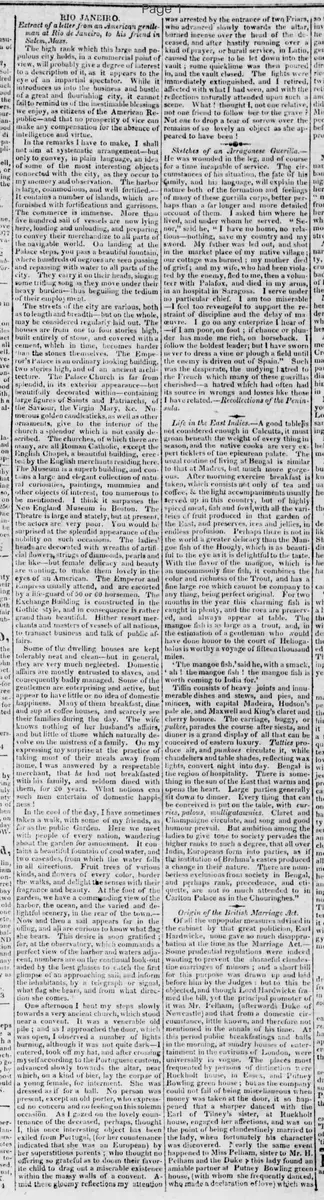
Extract of a letter from an American gentleman at Rio de Janeiro, to his friend in Salem, Mass.
The high rank which this large and populous city holds, in a commercial point of view, will probably give a degree of interest to a description of it, as it appears to the eye of an impartial spectator. While it introduces us into the business and bustle of a great and flourishing city, it cannot fail to remind us of the inestimable blessings we enjoy, as citizens of the American Republic—and that no prosperity of vice can make any compensation for the absence of intelligence and virtue.
In the remarks I have to make, I shall not aim at systematic arrangement—but only to convey, in plain language, an idea of some of the most interesting objects connected with the city, as they occur to my memory and observation. The harbor is large, commodious, and well fortified.— It contains a number of islands, which are furnished with fortifications and garrisons. The commerce is immense. More than five hundred sail of vessels are now lying here, loading and unloading, and preparing to convey their merchandize to all parts of the navigable world. On landing at the Palace steps, you pass a beautiful fountain, where hundreds of negroes are seen passing and repassing with water to all parts of the city. They carry it on their heads, singing some trifling song as they move under their heavy burden—thus beguiling the tedium of their employment.
The streets of the city are various, both as to length and breadth—but on the whole, may be considered regularly laid out. The houses are from one to four stories high, built entirely of stone, and covered with a cement, which in time, becomes harder than the stones themselves. The Emperor's Palace is an ordinary looking building. two stories high, and of an ancient architecture. The Palace Church is far from splendid, in its exterior appearance—but beautifully decorated within—containing large figures of Saints and Patriarchs, of the Saviour, the Virgin Mary, &c. Numerous golden candlesticks, as well as other ornaments, give to the interior of the church a splendor which is not easily described. The churches, of which there are many, are all Roman Catholic, except the English Chapel, a beautiful building, erected by the English merchants residing here. The Museum is a superb building, and contains a large and elegant collection of natural curiosities. paintings, mummies and other objects of interest, too numerous to be mentioned. I think it surpasses the New England Museum in Boston. The Theatre is large and stately, but at present, the actors are very poor. You would be surprised at the splendid appearance of the nobility on such occasions. The ladies' heads are decorated with wreaths of artificial flowers, strings of diamonds, pearls and the like—but female delicacy and beauty are wanting, to make them lovely in the eyes of an American. The Emperor and Empress usually attend, and are escorted by a life-guard of 50 or 60 horsemen. The Exchange Building is constructed in the Gothic style, and in consequence is rather grand than beautiful. Hither resort merchants and masters of vessels of all nations, to transact business and talk of public affairs.
Some of the dwelling houses are kept tolerably neat and clean—but in general, they are very much neglected. Domestic affairs are mostly entrusted to slaves, and consequently badly managed. Some of the gentlemen are enterprising and active, but appear to have little or no idea of domestic happiness. Many of them breakfast, dine and sup at coffee houses, and scarcely see their families during the day. The wife knows nothing of her husband's affairs, and but little of those which naturally devolve on the mistress of a family. On my expressing my surprise at the practice of taking most of their meals away from home, I was answered by a respectable merchant, that he had not breakfasted with his family, and seldom dined with them, for 20 years. What notions can such men entertain of domestic happiness !
In the cool of the day, I have sometimes taken a walk, with some of my friends, as far as the public Garden. Here we meet with people of every nation, wandering about the garden for amusement. It contains a beautiful fountain of cool water, and two cascades, from which the water falls in all directions. Fruit trees of various kinds, and flowers of every color, border the walks, and delight the senses with their fragrance and beauty. At the foot of the garden, we have a commanding view of the harbor, the ocean, and the varied and delightful scenery, in the rear of the town.— Now and then a sail appears far in the offing, and all are curious to know what flag she bears. This desire is soon gratified; for, at the observatory, which commands a perfect view of the harbor and waters adjacent, numbers are on the continual look-out aided by the best glasses to catch the first glimpse of an approaching sail, and inform the inhabitants, by a telegraph or signal, what flag she bears, and from what direction she comes.
One afternoon I bent my steps slowly towards a very ancient church, which stood near a convent. It was a venerable old pile ; and as I approached the door, which was open, I observed a number of lights burning, although it was not quite dark—I entered, took off my hat, and after crossing myself according to the Portuguese custom, advanced slowly towards the altar, near which, on a kind of bier, lay the corpse of a young female, for interment. She was dressed as if for a ball. No person was present, except an old porter, who expressed no concern and no feeling on this solemn occasion. As I gazed on the lovely countenance of the deceased, perhaps, thought I, this once interesting object has been exiled from Portugal. (for her countenance indicated that she was an European) by her superstitious parents ; who thought no offering so grateful as to doom their favorite child to drag out a miserable existence within the massy walls of a convent. Amid these gloomy reflections my attention
was arrested by the entrance of two Friars, who advanced slowly towards the altar, burned incense over the head of the deceased, and after hastily running over a kind of prayer, or burial service, in Latin, caused the corpse to be let down into the vault ; some quicklime was then poured in, and the vault closed. The lights were immediately extinguished, and I retired. affected with what I had seen, and with the reflections naturally attending upon such a scene. What ! thought I. not one relative, not one friend to follow her to the grave ? Not one to drop a tear of sorrow over the remains of so lovely an object as she appeared to have been !
Sketches of an Aragonese Guerilla,-
He was wounded in the leg, and of course for a time incapable of service. The circumstances of his situation, the fate of his family, and his language, will explain the nature both of the formation and feelings of many of these guerilla corps, better perhaps than a far longer and more detailed account of them. I asked him where he lived. and under whom he served. "Señor," said he, " I have no home, no relations—nothing, save my country and my sword. My father was led out, and shot in the market place of my native village our cottage was burned ; my mother died of grief; and my wife, who had been violated by the enemy, fled to me, then a volunteer with Palafox, and died in my arms, in an hospital in Saragossa. I serve under no particular chief. I am too miserable -I feel too revengeful to support the restraint of discipline and the delay of manœuvre. I go on any enterprize I hear of -if I am poor, on foot ; if chance or plunder has made me rich, on horseback. I follow the boldest leader; but I have sworn never to dress a vine or plough a field until the enemy is driven out of Spain." Such was the desperate, the undying hatred to the French which many of these guerillas cherished—a hatred which had often had its source in wrongs and losses like those I have related.—Recollections of the Peninsula.
What sub-type of article is it?
What keywords are associated?
What entities or persons were involved?
Where did it happen?
Foreign News Details
Primary Location
Saragossa, Spain
Key Persons
Outcome
guerilla's father shot, cottage burned, mother died of grief, wife violated and died in hospital; guerilla wounded in leg and fights independently against french.
Event Details
Sketch of a wounded Aragonese guerilla who lost his family to French atrocities: father executed, home burned, mother grieved to death, wife raped and died in Saragossa hospital while he volunteered with Palafox. He serves without discipline, joining enterprises on foot or horse, vowing not to farm until French are expelled from Spain, exemplifying guerilla hatred and formation.