Thank you for visiting SNEWPapers!
Sign up free
National Gazette
Philadelphia, Philadelphia County, Pennsylvania
What is this article about?
Letter from Cape Francois details ongoing slave insurrection in Saint-Domingue, with 3,500 French troops arriving but suffering heavy losses to sickness and combat. Insurgents grow stronger. Political tensions between colonial assembly and Governor Blanchelande lead to near-coup, resolved temporarily with assembly's apology and support pledges.
Merged-components note: Continuation of the letter from Cape Francois about events in St. Domingue across pages; the text flows directly from the quoted address to the writer's closing remarks. Changing label from letter_to_editor on the second part to foreign_news for the overall international report.
Clippings
1 of 2
OCR Quality
Full Text
MAY 7, 1792.
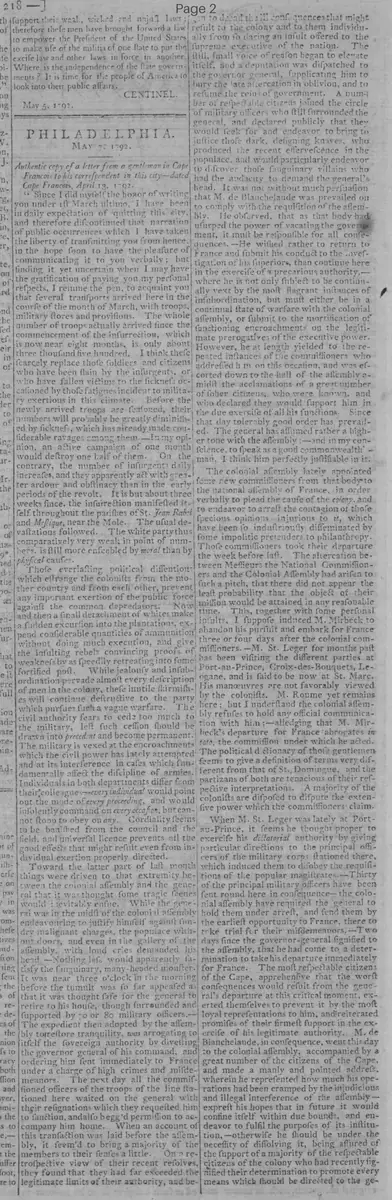
Authentic copy of a letter from a gentleman in Cape Francois to his correspondent in this city—dated Cape Francois, April 13, 1792.
"Since I did myself the honor of writing you under 1st March ultimo, I have been in daily expectation of quitting this city, and therefore discontinued that narration of public occurrences which I have taken the liberty of transmitting you from hence, in the hope soon to have the pleasure of communicating it to you verbally; but finding it yet uncertain when I may have the gratification of paying you my personal respects, I resume the pen, to acquaint you that several transports arrived here in the course of the month of March, with troops, military stores and provisions. The whole number of troops actually arrived since the commencement of the insurrection, which is now near eight months, is only about three thousand five hundred. I think these scarcely replace those soldiers and citizens who have been slain by the insurgents, or who have fallen victims to the sickness occasioned by those fatigues incident to military exertions in this climate. Before the newly arrived troops are seasoned, their numbers will probably be greatly diminished by sickness, which has already made considerable ravages among them.—In my opinion, an active campaign of one month would destroy one half of them. On the contrary, the number of insurgents daily increases, and they apparently act with greater ardour and obstinacy than in the early periods of the revolt. It is but about three weeks since the insurrection manifested itself throughout the parishes of St. Jean Rabel and Meslique, near the Mole. The usual devastations followed. The white party thus comparatively very weak in point of numbers, is still more enfeebled by moral than by physical causes.
Those everlasting political dissensions which estrange the colonists from the mother country and from each other, prevent any important exertion of the public force against the common depredators. Now and then a small detachment of whites make a sudden excursion into the plantation, expend considerable quantities of ammunition without doing much execution, and give the insulting rebels convincing proofs of weakness by as speedily retreating into some fortified post. While jealousy and insubordination pervade almost every description of men in the colony, these inutile skirmishes will continue destructive to the party which pursues such a vague warfare. The civil authority fears to cede too much to the military, lest such cession should be drawn into precedent and become permanent. The military is vexed at the encroachments which the civil power has lately attempted and at its interference in cases which fundamentally affect the discipline of armies. Individuals in both departments differ from their colleagues—every individual would point out the mode of every proceeding, and would insolently command on every occasion, but cannot stoop to obey on any. Cordiality seems to be banished from the council and the field, and universal license prevents all the good effects that might result even from individual exertion properly directed.
Toward the latter part of last month things were driven to that extremity between the colonial assembly and the general that it was thought some tragic scenes would inevitably ensue. While the general was in the midst of the colonial assembly endeavouring to justify himself against sundry malignant charges, the populace without doors, and even in the gallery of the assembly, with loud cries demanded his head.—Nothing less would apparently satisfy the sanguinary, many-headed monster. It was near three o'clock in the morning before the tumult was so far appeased as that it was thought safe for the general to retire to his house, though surrounded and supported by 70 or 80 military officers.—The expedient then adopted by the assembly to restore tranquility, was arrogating to itself the sovereign authority by divesting the governor general of his command, and ordering him sent immediately to France under a charge of high crimes and misdemeanors. The next day all the commissioned officers of the troops of the line stationed here waited on the general with their resignations which they requested him to sanction, and also begg'd permission to accompany him home. When an account of this transaction was laid before the assembly, it seem'd to bring a majority of the members to their senses a little. On a retrospective view of their recent resolves, they found that they had far exceeded the legitimate limits of their authority, and began to dread the consequences that might result to the colony and to them individually from so flagrant an insult offered to the supreme executive of the nation. The still, small voice of reason began to elevate itself, and a deputation was dispatched to the governor general, supplicating him to bury the late altercation in oblivion, and to resume the reins of government. A number of respectable citizens joined the circle of military officers who still surrounded the general, and declared publicly that they would seek for and endeavor to bring to justice those dark, designing knaves, who produced the recent effervescence in the populace, and would particularly endeavor to discover those sanguinary villains who had the audacity to demand the general's head. It was not without much persuasion that M. de Blanchelande was prevailed on to comply with the requisition of the assembly. He observed, that as that body had usurped the power of vacating the government, it must be responsible for all consequences.—He wished rather to return to France and submit his conduct to the investigation of his superiors, than continue here in the exercise of a precarious authority.—where he is not only subject to be continually vext by the most flagrant instances of insubordination, but must either be in a continual state of warfare with the colonial assembly, or submit to the mortification of sanctioning encroachments on the legitimate prerogatives of the executive power. However, he at length yielded to the repeated instances of the commissioners who addressed him on this occasion, and was escorted down to the hall of the assembly amid the acclamations of a great number of sober citizens, who were known, and who declared they would support him in the due exercise of all his functions. Since that day tolerably good order has prevailed. The general has assumed rather a lighter tone with the assembly;—and in my conscience, to speak as a good commonwealth's-man, I think him perfectly justifiable in it. The colonial assembly lately appointed some new commissioners from that body to the national assembly of France, in order verbally to plead the cause of the colony, and to endeavor to arrest the contagion of those specious opinions injurious to it, which have been so industriously disseminated by some impolitic pretenders to philanthropy. Those commissioners took their departure the week before last. The altercation between Messieurs the National Commissioners and the Colonial Assembly had arisen to such a pitch, that there did not appear the least probability that the object of their mission would be attained in any reasonable time. This, together with some personal insults, I suppose induced M. Mirbeck to abandon his pursuit and embark for France three or four days after the colonial commissioners.—M. St. Leger for months past has been visiting the different parties at Port-au-Prince, Croix-des-Bouquets, Leogane, and is said to be now at St. Marc. His manoeuvres are not favorably viewed by the colonists. M. Roume yet remains here: but I understand the colonial assembly refuses to hold any official communication with him;—alleging that M. Mirbeck's departure for France abrogates in toto, the commission under which he acted. The political dictionary of those gentlemen seems to give a definition of terms very different from that of St. Domingue, and the partizans of both are tenacious of their respective interpretations. A majority of the colonists are disposed to dispute the extensive power which the commissioners claim. When M. St. Leger was lately at Port-au-Prince, it seems he thought proper to exercise his dictatorial authority by giving particular directions to the principal officers of the military corps stationed there, which induced them to disobey the requisitions of the popular magistrates.—Thirty of the principal military officers have been sent round here in consequence— the colonial assembly have required the general to hold them under arrest, and send them by the earliest opportunity to France, there to take trial for their misdemeanors.—Two days since the governor-general signified to the assembly, that he had come to a determination to take his departure immediately for France. The most respectable citizens of the Cape, apprehensive that the worst consequences would result from the general's departure at this critical moment, exerted themselves to prevent it by the most loyal representations to him, and reiterated promises of their firmest support in the exercise of his legitimate authority. M. de Blanchelande, in consequence, went this day to the colonial assembly, accompanied by a great number of the citizens of the Cape, and made a manly and pointed address, wherein he represented how much his operations had been cramped by the injudicious and illegal interference of the assembly—expressed his hopes that in future it would confine itself within due bounds, and endeavor to fulfil the purposes of its institution,—otherwise he should be under the necessity of dissolving it, being assured of the support of a majority of the respectable citizens of the colony who had recently signified their determination to promote every means which should be directed to the general good."
For the general good, however it might apparently interfere with their particular interest.—I hope this spirited remonstrance, whereof I can only give you an imperfect sketch at present, will be attended with a good effect.
What sub-type of article is it?
What keywords are associated?
What entities or persons were involved?
Where did it happen?
Foreign News Details
Primary Location
Cape Francois
Event Date
April 13, 1792
Key Persons
Outcome
about 3,500 troops arrived since insurrection began eight months ago, but numbers diminished by sickness and combat; insurgents increasing; temporary political reconciliation between assembly and governor with citizen support.
Event Details
Ongoing slave insurrection in Saint-Domingue with new outbreaks in St. Jean Rabel and Meslique; French reinforcements arrive but suffer from climate-related illnesses; political divisions weaken white forces; colonial assembly attempts to remove Governor Blanchelande amid public unrest, but later apologizes and reinstates him; national commissioners depart amid disputes; military officers arrested for insubordination.