Thank you for visiting SNEWPapers!
Sign up free
Daily National Intelligencer
Washington, District Of Columbia
What is this article about?
British frigate HMS Macedonian captured by US frigate United States under Commodore Decatur on October 25, 1812, at sea in the Atlantic (29°N, 29°30'W). Macedonian suffered heavy damage and 104 casualties; surrendered after two-hour battle against superior American firepower.
Clipping
OCR Quality
Full Text
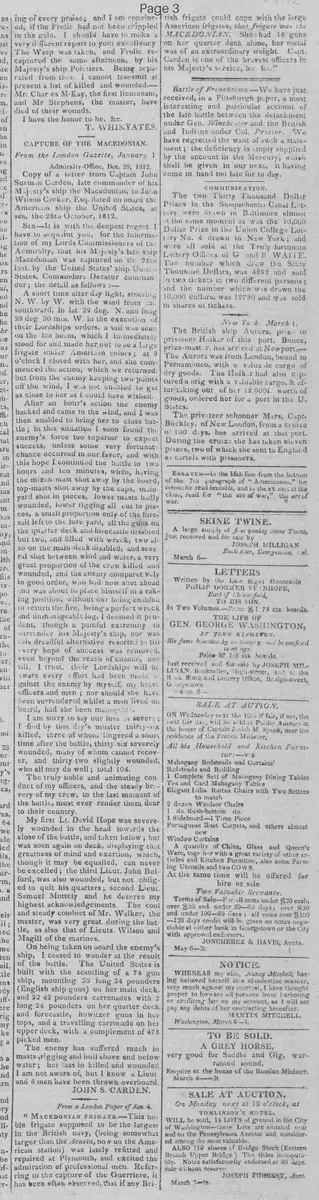
From the London Gazette, January 1
Admiralty-Office, Dec. 29, 1812.
Copy of a letter from Captain John Surman Carden, late commander of his Majesty's ship the Macedonian, to John Wilson Croker, Esq. dated on board the American ship the United States, at sea, the 28th October, 1812.
SIR—It is with the deepest regret I have to acquaint you, for the information of my Lords Commissioners of the Admiralty, that his Majesty's late ship Macedonian was captured on the 25th inst. by the United States' ship United States, Commodore Decatur commander; the detail as follows:—
A short time after day light, steering N. W. by W. with the wind from the southward, in lat. 29 deg. N. and long. 29 deg. 30 min. W. in the execution of their Lordships orders, a sail was seen on the lee beam, which I immediately stood for and made her out to be a large frigate under American colors; at 9 o'clock I closed with her, and she commenced the action, which we returned, but from the enemy keeping two points off the wind, I was not enabled to get as close to her as I could have wished.
After an hour's action the enemy backed and came to the wind, and I was then enabled to bring her to close battle; in this situation I soon found the enemy's force too superior to expect success, unless some very fortunate chance occurred in our favor, and with this hope I continued the battle to two hours and ten minutes, when, having the mizen-mast shot away by the board, top-masts shot away by the caps, main yard shot in pieces, lower masts badly wounded, lower rigging all cut to pieces, a small proportion only of the fore-sail left to the fore yard, all the guns on the quarter deck and forecastle disabled but two, and filled with wreck, two also on the main-deck disabled, and several shot between wind and water, a very great proportion of the crew killed and wounded, and the enemy comparatively in good order, who had now shot ahead and was about to place himself in a raking position, without our being enabled to return the fire, being a perfect wreck and unmanageable log, I deemed it prudent, though a painful extremity to surrender his Majesty's ship, nor was this dreadful alternative resorted to till very hope of success was removed even beyond the reach of chance, nor till, I trust, their Lordships will be aware every effort had been made against the enemy by myself, my brave officers and men; nor should she have been surrendered whilst a man lived on board, had she been manageable.
I am sorry to say our loss is severe; I find by this day's muster thirty-six killed, three of whom lingered a short time after the battle, thirty-six severely wounded, many of whom cannot recover, and thirty-two slightly wounded, who all may do well; total 104.
The truly noble and animating conduct of my officers, and the steady bravery of my crew, to the last moment of the battle, must ever render them dear to their country.
My first Lt. David Hope was severely wounded in the head towards the close of the battle, and taken below; but was soon again on deck, displaying that greatness of mind and exertion, which, though it may be equalled, can never be excelled; the third Lieut. John Bulford, was also wounded, but not obliged to quit his quarters; second Lieut. Samuel Mottely and he deserve my highest acknowledgements. The cool and steady conduct of Mr. Walker, the master, was very great during the battle, as also that of Lieuts. Wilson and Magill of the marines.
On being taken on board the enemy's ship, I ceased to wonder at the result of the battle. The United States is built with the scantling of a 74 gun ship, mounting 30 long 24 pounders (English ship guns) on her main deck, and 22 42 pounders carronades with 2 long 24 pounders on her quarter deck and forecastle, howitzer guns in her tops, and a travelling carronade on her upper deck, with a complement of 478 picked men.
The enemy has suffered much in masts rigging and hull above and below water; her loss in killed and wounded I am not aware of, but I know a Lieut. and 6 men have been thrown overboard
JOHN S. CARDEN.
From a London Paper of Jan. 4.
"MACEDONIAN FRIGATE. This noble frigate supposed to be the largest in the British navy, (being somewhat larger than the Acasta, now on the American station) was lately refitted and repaired at Plymouth, and excited the admiration of professional men. Referring to the capture of the Guerriere, it has been often observed, that if any British frigate could cope with the large American frigates, that frigate was the MACEDONIAN. She had 16 guns on her quarter deck alone, her metal was of an extraordinary weight. Capt. Carden is one of the bravest officers in his Majesty's service, &c. &c."
What sub-type of article is it?
What keywords are associated?
What entities or persons were involved?
Where did it happen?
Foreign News Details
Primary Location
At Sea, Lat. 29 Deg. N. Long. 29 Deg. 30 Min. W.
Event Date
25th October 1812
Key Persons
Outcome
macedonian captured; 36 killed, 36 severely wounded, 32 slightly wounded (total 104); mizen-mast, top-masts, main yard shot away; most guns disabled; enemy suffered damage to masts, rigging, hull; at least 1 lt. and 6 men thrown overboard.
Event Details
HMS Macedonian, under Capt. Carden, engaged US frigate United States (Commodore Decatur) after daylight on October 25, 1812. Action lasted two hours and ten minutes; Macedonian unable to close initially, then fought closely but overwhelmed by superior force (US: 30 long 24-pounders, 22 42-pounder carronades, etc., 478 men). Macedonian became unmanageable wreck and surrendered to avoid raking fire.