Thank you for visiting SNEWPapers!
Sign up free
The New York Journal, And Weekly Register
New York, New York County, New York
What is this article about?
Proceedings of the New York House of Assembly on March 9-10, including passage of bills on absconding debtors, mortgagers, Hendrick Remsen's estate, John Fitch's steamboat monopoly, and a returned divorce bill. Extensive debate on a tax bill proposing levies on houses, mills, carriages, licenses, servants, marriages, and land; motion to strike land/building taxes failed, bill amended and recommitted. Various petitions handled on March 10.
Clipping
OCR Quality
Full Text
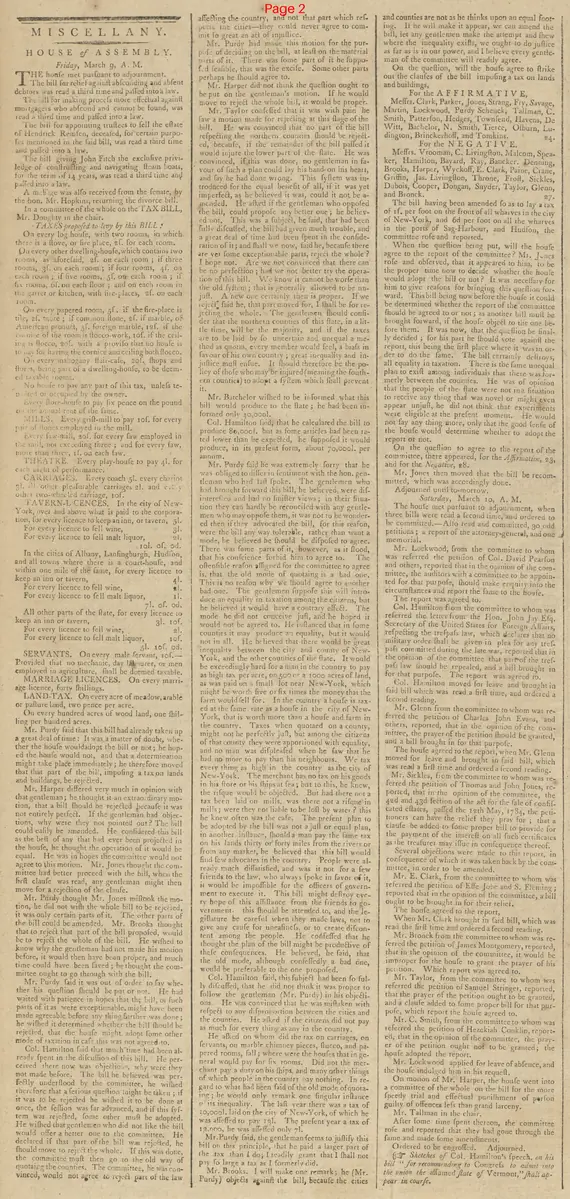
HOUSE of ASSEMBLY
Friday, March 9, A. M.
The house met pursuant to adjournment.
The bill for relief against absconding and absent debtors was read a third time and passed into a law.
The bill for making process more effectual against mortgagers who abscond and cannot be found, was read a third time and passed into a law.
The bill for appointing trustees to sell the estate of Hendrick Remsen, deceased, for certain purposes mentioned in the said bill, was read a third time and passed into a law.
The bill giving John Fitch the exclusive privilege of constructing and navigating steam boats, for the term of 14 years, was read a third time and passed into a law.
A message was also received from the senate, by the hon. Mr. Hopkins, returning the divorce bill.
In a committee of the whole on the TAX BILL.
Mr. Doughty in the chair.
TAXES proposed to levy by this BILL:
On every log house, with two rooms, in which there is a stove, or fire place, 2s. for each room.
On every other dwelling-house, which contains two rooms, as aforesaid, 2s. on each room; if three rooms, 3s. on each room; if four rooms, 4s. on each room; if five rooms, 5s. on each room; if six rooms, 6s. on each floor; and on each room in the garret or kitchen, with fire-places, 2s. on each room.
On every papered room, 5s. if the fire-place is tile, 2s. more; if common stone, 6d. if marble, of American product, 5s. foreign marble, 12s. if the cornice of the room is stucco-work, 10s. if the ceiling is stucco, 20s. with a proviso that no house is to pay for having the cornice and ceiling both stucco.
On every mahogany stair-case, 20s. shops and stores, being part of a dwelling-house, to be deemed taxable rooms.
No house to pay any part of this tax, unless tenanted or occupied by the owner.
Every store-house to pay six pence on the pound on the annual rent of the same.
MILLS. Every grist-mill to pay 10s. for every pair of stones employed in the mill.
Every saw-mill, 20s. for every saw employed in the mill, not exceeding three; and for every saw, more than three, 5s. on each saw.
THEATRE. Every play-house to pay 4l. for each night of performance.
CARRIAGES. Every coach 5l. every chariot 3l. all other pleasurable carriages 6l. and every other two-wheeled carriage, 10s.
TAVERN-LICENCES. In the city of New-York, over and above what is paid to the corporation, for every licence to keep an inn, or tavern, 5l.
For every licence to sell wine, 3l.
For every licence to sell malt liquor, 2l.
10l. 0s. 0d.
In the cities of Albany, Lansingburgh, Hudson, and all towns where there is a court-house, and within one mile of the same, for every licence to keep an inn or tavern, 4l.
For every licence to sell wine, 2l.
For every licence to sell malt liquor, 1l.
7l. 0s. 0d.
All other parts of the state, for every licence to keep an inn or tavern, 3l. 10s.
For every licence to sell wine, 2l.
For every licence to sell malt liquor, 10s.
5l. 10s. 0d.
SERVANTS. On every male servant, 10s.-
Provided that no mechanic, day labourer, or men employed in agriculture, shall be deemed taxable.
MARRIAGE LICENCES. On every marriage licence, forty shillings.
LAND-TAX. On every acre of meadow, arable or pasture land, two pence per acre.
On every hundred acres of wood land, one shilling per hundred acres.
Mr. Purdy said that this bill had already taken up a great deal of time: It was a matter of doubt, whether the house would adopt the bill or not; he hoped the house would not, and that a determination might take place immediately; he therefore moved that that part of the bill, imposing a tax on lands and buildings, be rejected.
Mr. Harper differed very much in opinion with that gentleman; he thought it an extraordinary motion, that a bill should be rejected because it was not entirely perfect. If the gentleman had objections, why were they not pointed out? The bill could easily be amended. He considered this bill as the best of any that had ever been projected in the house, he thought the operation of it would be equal. He was in hopes the committee would not agree to this motion. Mr. Jones thought the committee had better proceed with the bill, when the first clause was read, any gentleman might then move for a rejection of the clause.
Mr. Purdy thought Mr. Jones mistook the motion, he did not wish the whole bill to be rejected, it was only certain parts of it. The other parts of the bill could be amended. Mr. Brooks thought that to reject that part of the bill proposed, would be to reject the whole of the bill. He wished to know why the gentleman had not made his motion before, it would then have been proper, and much time could have been saved; he thought the committee ought to go through with the bill.
Mr. Purdy said it was out of order to say whether his question should be put or not. He had waited with patience in hopes that the bill, or such parts of it as were exceptionable, might have been made agreeable before any thing farther was done; he wished it determined whether the bill should be rejected, that the house might adopt some other mode of taxation in case this was not agreed to.
Col. Hamilton said that much time had been already spent in the discussion of this bill. He perceived there now was objections, why were they not made before. The bill he believed was perfectly understood by the committee, he wished therefore that a serious question might be taken; if it was to be rejected he wished it to be done at once, the session was far advanced, and if this system was rejected, some other must be adopted.
He wished that gentlemen who did not like the bill would offer a better one to the committee. He declared if that part of the bill was rejected, he should move to reject the whole. If this was done, the committee must then go to the old way of quotaing the counties. The committee, he was convinced, would not agree to reject part of the law affecting the country, and not that part which respects the cities—they could never agree to commit so great an act of injustice.
Mr. Purdy had made this motion for the purpose of deciding on the bill, at least on the material parts of it. There was some part of it he supposed feasible, that was the excise. Some other parts perhaps he should agree to.
Mr. Harper did not think the question ought to be put on the gentleman's motion. If he would move to reject the whole bill, it would be proper.
Mr. Taylor confessed that it was with pain he saw a motion made for rejecting at this stage of the bill. He was convinced that no part of the bill respecting the northern counties should be rejected, because, if the remainder of the bill passed it would injure the lower part of the state. He was convinced, if this was done, no gentleman in favour of such a plan could lay his hand on his heart, and say he had done wrong. This system was introduced for the equal benefit of all, if it was yet imperfect, as he believed it was, could it not be amended. He asked if the gentleman who opposed the bill, could propose any better one; he believed not. This was a subject, he said, that had been fully discussed, the bill had given much trouble, and a great deal of time had been spent in the consideration of it; and shall we now, said he, because there are yet some exceptionable parts, reject the whole? I hope not. Are we not convinced that there can be no perfection; had we not better try the operation of this bill. We know it cannot be worse than the old system; that is generally allowed to be unjust. A new one certainly then is proper. If we reject said he, that part moved for, I shall be for rejecting the whole. The gentlemen should consider that the northern counties of this state, in a little time, will be the majority, and if the taxes are to be laid by so uncertain and unequal a method as quotas, every member would feel a bias in favour of his own country; great inequality and injustice must ensue. It should therefore be the policy of those who may be injured (meaning the southern counties) to adopt a system which shall prevent it.
Mr. Batchelor wished to be informed what this bill would produce to the state; he had been informed only 40,000l.
Col. Hamilton said, that he calculated the bill to produce 80,000l. but as some articles had been rated lower than he expected, he supposed it would produce, in its present form, about 70,000l. per annum.
Mr. Purdy said he was extremely sorry that he was obliged to differ in sentiment with the hon. gentleman who had last spoke. The gentlemen who had brought forward this bill, he believed, were disinterested and had no sinister views; in their situation they can hardly be reconciled with any gentlemen who may oppose them, it was not to be wondered then if they advocated the bill, for this reason, were the bill any way tolerable, rather than want a mode, he believed he should be disposed to agree.
There was some parts of it, however, as it stood, that his conscience forbid him to agree to. The ostensible reason assigned for the committee to agree is, that the old mode of quotaing is a bad one. This is no reason why we should agree to another bad one. The gentlemen suppose this will introduce an equality in taxation among the citizens, but he believed it would have a contrary effect. The mode he did not conceive just, and he hoped it would not be agreed to. He instanced that in some counties it may produce an equality, but it would not in all. He believed that there would be great inequality between the city and county of New-York, and the other counties of the state. It would be exceedingly hard for a man in the country to pay as high tax per acre, on 500 or 1000 acres of land, as was paid on a small lot near New-York, which might be worth five or six times the money that the farm would sell for. In the country a house is taxed at the same rate as a house in the city of New-York, that is worth more than a house and farm in the country. Taxes when quotaed on a county, might not be perfectly just, but among the citizens of that county they were apportioned with equality, and no man was displeased when he saw that he had no more to pay than his neighbours. We tax every thing as high in the country as the city of New-York. The merchant has no tax on his goods in his store or his ships at sea; but to this, he knew, the risque would be objected. But had there not a tax been laid on mills, was there not a risque in mills; were they not liable to be lost by water? this he knew often was the case. The present plan to be adopted by the bill was not a just or equal plan, in another instance, should a man pay the same tax on his lands thirty or forty miles from the rivers or from any market, he believed that this bill would find few advocates in the country. People were already much dissatisfied, and was it not for a few friends to the law, who always spoke in favor of it, it would be impossible for the officers of government to execute it. This bill might destroy every hope of this assistance from the friends to government. this should be attended to, and the legislature be careful when they made laws, not to give any cause for uneasiness, or to create discontent among the people. He confessed that he thought the plan of the bill might be productive of these consequences. He believed, he said, that the old mode, although confessedly a bad one, would be preferable to the one proposed.
Col. Hamilton said, this subject had been so fully discussed, that he did not think it was proper to follow the gentleman (Mr. Purdy) in his objections. He was convinced that he was mistaken with respect to any disproportion between the cities and the counties. He asked if the citizens did not pay as much or more on every thing as any in the country.
He asked on whom did the tax on carriages, on servants, on marble chimney pieces, stucco, and papered rooms, fall; where were the houses that in general would pay for six rooms. Did not the merchant pay a duty on his ships, and many other things of which people in the country pay nothing. In regard to what had been said of the old mode of quotaing; he would only remark one singular instance of its inequality. The last year there was a tax of 10,000l. laid on the city of New-York, of which he was assessed to pay 13l. The present year a tax of 13,000l. he was assessed only 7l.
Mr. Purdy said, the gentleman seems to justify this bill on this principle, that he paid a larger part of the tax than I do; I readily grant that I shall not pay so large a tax as I formerly did.
Mr. Brooks. I will make one remark; he (Mr. Purdy) objects against the bill, because the cities and counties are not as he thinks upon an equal footing. If he will make it appear, we can amend the bill, let any gentlemen make the attempt and shew where the inequality exists, we ought to do justice as far as is in our power, and I believe every gentleman of the committee will readily agree.
On the question, will the house agree to strike out the clauses of the bill imposing a tax on lands and buildings,
For the AFFIRMATIVE.
Messrs. Clark, Parker, Jones, Strang, Fry, Savage, Martin, Lockwood, Purdy Schenck, Tallman, C. Smith, Patterson, Hedges, Townsend, Havens, De Witt, Batchelor, N. Smith, Pierce, Osburn, Luddington, Brinckerhoff, and Tompkins. 24.
For the NEGATIVE.
Messrs. Vrooman, C. Livingston, Malcolm, Speaker, Hamilton, Bayard, Ray, Bancker, Denning, Brooks, Harper, Wyckoff, E. Clark, Paine, Crane, Griffin, Jas. Livingston, Thorne, Frost, Sickles, Dubois, Cooper, Dongan, Snyder, Taylor, Glenn, and Bronck. 27.
The bill having been amended so as to lay a tax of 1s. per foot on the front of all wharves in the city of New-York, and 6d per foot on all the wharves in the ports of Sag-Harbour, and Hudson, the committee rose and reported.
When the question being put, will the house agree to the report of the committee? Mr. Jones rose and observed, that it appeared to him, to be the proper time now to decide whether the house would adopt the bill or not? It was necessary for him to give reasons for bringing this question forward. This bill being now before the house it could be determined whether the report of the committee should be agreed to or not; as another bill must be brought forward, if the house object to the one before them. It was now, that the question be finally decided; for his part he should vote against the report, this being the first place where it was in order to do the same. The bill certainly destroys, all equality in taxation. There is the same unequal plan to exist among individuals that there was formerly between the counties. He was of opinion that the people of the state were not in a situation to receive any thing that was novel or might even appear unjust, he did not think that experiments were eligible at the present moment. He would not say any thing more, only that the good sense of the house would determine whether to adopt the report or not.
On the question to agree to the report of the committee, there appeared, for the Affirmative, 23, and for the Negative, 28.
Mr. Jones then moved that the bill be recommitted, which was accordingly done.
Adjourned until to-morrow.
Saturday, March 10, A. M.
The house met pursuant to adjournment, when three bills were read a second time, and ordered to be committed.—Also read and committed, 30 odd petitions; a report of the attorney-general, and one memorial.
Mr. Lockwood, from the committee to whom was referred the petition of Col. David Pearson and others, reported that in the opinion of the committee, the auditors with a committee to be appointed for that purpose, should make enquiry into the circumstances and report the same to the house.
The report was agreed to.
Col. Hamilton from the committee to whom was referred the letter from the Hon. John Jay Esq. Secretary of the United States for Foreign Affairs, respecting the trespass law, which declares that no military order shall be given in plea for any trespass committed during the late war, reported that in the opinion of the committee that part of the trespass law should be repealed, and a bill brought in for that purpose. The report was agreed to.
Col. Hamilton moved for leave and brought in said bill which was read a first time, and ordered a second reading.
Mr. Glenn from the committee to whom was referred the petition of Charles John Evans, and others, reported, that in the opinion of the committee, the prayer of the petition should be granted, and a bill brought in for that purpose.
The house agreed to the report, when Mr. Glenn moved for leave and brought in said bill, which was read a first time and ordered a second reading.
Mr. Sickles, from the committee to whom was referred the petition of Thomas and John Jones, reported, that in the opinion of the committee, the 42d and 43d section of the act for the sale of confiscated estates, passed the 12th May, 1784, the petitioners can have the relief they pray for; that a clause be added to some proper bill to provide for the payment of the interest on all such certificates as the treasurer may issue in consequence thereof.
Several objections were made to this report, in consequence of which it was taken back by the committee, in order to be amended.
Mr. E. Clark, from the committee to whom was referred the petition of Esse Jobes and S. Fleming; reported that in the opinion of the committee, a bill ought to be brought in for their relief.
The house agreed to the report,
When Mr. Clark brought in said bill, which was read the first time and ordered a second reading.
Mr. Bronck from the committee to whom was referred the petition of James Montgomery, reported, that in the opinion of the committee, it would be improper for the house to grant the prayer of his petition. Which report was agreed to.
Mr. Taylor, from the committee to whom was referred the petition of Samuel Stringer, reported, that the prayer of the petition ought to be granted, and a clause added to some proper bill for that purpose, which report the house agreed to.
Mr. C. Smith, from the committee to whom was referred the petition of Hezekiah Conklin, reported, that in the opinion of the committee, the prayer of the petition ought not to be granted; the house adopted the report.
Mr. Lockwood applied for leave of absence, and the house indulged him in his request.
On motion of Mr. Harper, the house went into a committee of the whole on the bill for the more speedy trial and effectual punishment of persons guilty of offences less than grand larceny.
Mr. Tallman in the chair.
After some time spent thereon, the committee rose and reported that they had gone through the same and made some amendments.
Ordered to be engrossed. Adjourned.
Sketches of Col. Hamilton's speech, on his bill "for recommending to Congress to admit into the union the assumed state of Vermont," shall appear in course.
What sub-type of article is it?
What keywords are associated?
What entities or persons were involved?
Where did it happen?
Domestic News Details
Primary Location
New York
Event Date
Friday, March 9, A. M. And Saturday, March 10, A. M.
Key Persons
Outcome
several bills passed into law: relief against absconding debtors, process against absconding mortgagers, sale of hendrick remsen's estate, john fitch's 14-year steamboat monopoly. divorce bill returned from senate. tax bill debated extensively; motion to strike land/building taxes failed (24-27); amended with wharf taxes; report rejected (23-28); recommitted. on march 10, petitions handled: inquiries ordered, bills introduced for repealing trespass law part, granting relief to evans et al. and jobes/fleming, clauses for jones and stringer, denials for montgomery and conklin. leave granted to lockwood. bill on minor offenses amended and ordered engrossed.
Event Details
The House of Assembly met on March 9, passing four bills and receiving a senate message on divorce. In committee on tax bill, detailed levies proposed on houses, rooms, fireplaces, stairs, stores, mills, theaters, carriages, licenses, servants, marriages, and land. Debate ensued with Mr. Purdy moving to reject land/building taxes, opposed by Harper, Jones, Brooks, Hamilton, Taylor; motion failed. Bill amended and reported, but report rejected and recommitted. On March 10, bills read and committed, petitions and reports processed, leading to agreements, introductions, amendments, and denials as noted. House adjourned.