Thank you for visiting SNEWPapers!
Sign up free
Literary
June 28, 1887
Daily Yellowstone Journal
Miles City, Custer County, Montana
What is this article about?
A young narrator falls in love with shy Elfie Reid at a Christmas vicarage party. He pursues her through social visits and a seaside holiday at Toftburn, enduring her prodigy brother and rivals, until he discovers her reciprocated affection when she writes his name in the sand.
Clipping
OCR Quality
95%
Excellent
Full Text
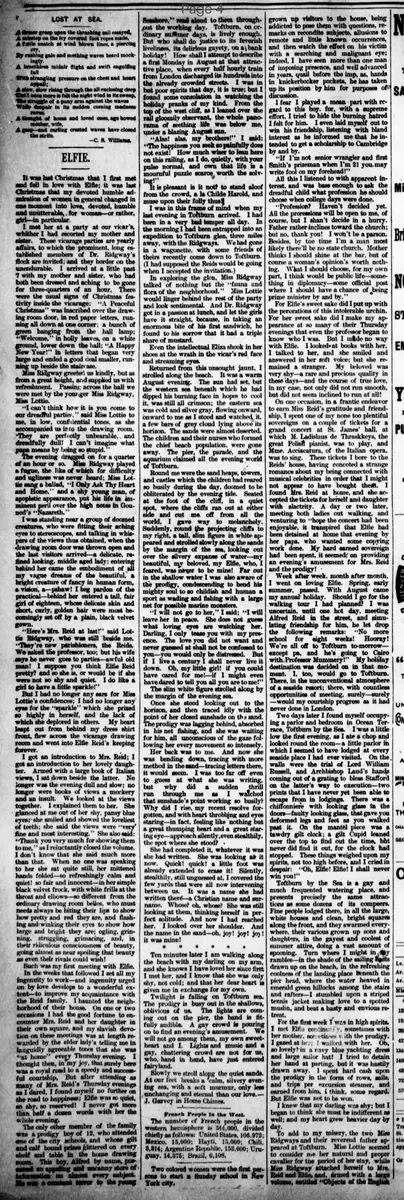
ELFIE.
It was last Christmas that I first met and fell in love with Elfie; it was last Christmas that my devoted humble admiration of women in general changed in one moment into love, devoted, humble and unutterable, for woman-or rather, girl-in particular.
I met her at a party at our vicar's, whither I had escorted my mother and sister. These vicarage parties are yearly affairs, to which the prominent, long established members of Dr. Ridgway's flock are invited; and they border on the unendurable. I arrived at a little past 7 with my mother and sister, who had both been dressed and aching to be gone for three-quarters of an hour. There were the usual signs of Christmas festivity inside the vicarage: "A Peaceful Christmas" was inscribed over the drawing room door, in red paper letters, running all down at one corner; a bunch of green hanging from the hall lamp; "Welcome," in holly leaves, on a white ground, lower down the hall; "A Happy New Year!" in letters that began very large and ended a good deal smaller, running up beside the staircase.
Miss Ridgway greeted us kindly, but as from a great height, and supplied us with refreshment. Passing across the hall we were met by the younger Miss Ridgway, Miss Lottie.
"I can't think how it is you come to our dreadful parties," said Miss Lottie to me, in low, confidential tones, as she accompanied us into the drawing room.
"They are perfectly unbearable, and dreadfully dull! I can't imagine what papa means by being so stupid."
The evening dragged on for a quarter of an hour or so. Miss Ridgway played a fugue, the like of which for difficulty and ugliness was never heard: Miss Lottie sang a ballad, "I Only Ask Thy Heart and Home," and a shy young man, of apoplectic appearance, put his life in imminent peril over the high notes in Gounod's "Nazareth."
I was standing near a group of doomed creatures, who were fitting their aching eyes to stereoscopes, and talking in whispers of the views thus obtained, when the drawing room door was thrown open and the last visitors arrived-a delicate, refined looking, middle aged lady: entering behind her came the embodiment of all my vague dreams of the beautiful, a bright creature of fancy in human form, a vision, pshaw! I beg pardon of the practical-behind her entered a tall, fair girl of eighteen, whose delicate skin and soft, curly, golden hair were most becomingly set off by a plain, black velvet gown.
"Here's Mrs. Reid at last!" said Lottie Ridgway, who was still beside me.
"They're new parishioners, the Reids. We asked the professor, too; but his wife says he never goes to parties-awful old man! I suppose you think Elfie Reid pretty? and so she is, or would be if she were not so shy and quiet. I do like a girl to have a little sparkle!"
But I had no longer any ears for Miss Lottie's confidences; I had no longer any eyes for the "sparkle" which she prized so highly in herself, and the lack of which she deplored in others. My heart leapt out from behind my dress shirt front, flew across the vicarage drawing room and went into Elfie Reid's keeping forever.
I got an introduction to Mrs. Reid: I got an introduction to her lovely daughter. Armed with a large book of Italian views, I sat down beside the latter. No longer was the evening dull and slow; no longer were books of views a mockery and an insult. We looked at the views together. I explained them to her. She glanced at me out of her shy, pansy blue eyes; she smiled and showed the loveliest of teeth; she said the views were "very fine and most interesting." She also said: "Thank you very much for showing them to me," as I reluctantly closed the volume.
I don't know that she said much more than that. When no one was speaking to her she sat quite still, her mittened hands folded-so refreshingly calm and quiet! so fair and innocent-in her simple black velvet frock, with white frills at the throat and elbows--so different from the ordinary drawing room belles, who must needs always be biting their lips to show how pretty and red they are, and flashing and winking their eyes to show how large and bright they are; ogling, grinning, struggling, grimacing, and, in their ridiculous consciousness of beauty, going almost as near spoiling that beauty as even their rivals could wish!
Such was my first meeting with Elfie.
In the weeks that followed I set all my ingenuity to work—and ingenuity urged on by love develops to a wonderful extent—to improve my acquaintance with the Reid family. I haunted the neighborhood of their house. On one or two occasions I had the good fortune to encounter Mrs. Reid and her daughter in their own square, and my slavish devotion on these meetings was at length rewarded by the elder lady's telling me in languidly agreeable tones that she was "at home" every Thursday evening. I thought then, in my joy, that surely here was a royal road to a speedy and successful courtship. But after attending as many of Mrs. Reid's Thursday evenings as I dared, I found myself no further on the road to happiness; Elfie was so quiet, so shy, so reserved! I never got more than half a dozen words with her the whole evening.
The only other member of the family was a prodigy boy of 12, who attended one of the city schools, and whose gilt and calf bound prizes glittered on every shelf and table in the home drawing room. This boy, Alfred by name, possessed an appalling and uncanny store of information on almost every subject. He was a constant terror to the young grown up visitors to the house, being addicted to pose them with questions, remarks on recondite subjects, allusions to remote and little known occurrences, and then watch the effect on his victim with a searching and malignant eye; indeed, I have seen more than one man of imposing presence, and well advanced in years, quail before the imp, as, hands in knickerbocker pockets, he has taken up his position by him for purposes of discussion.
I fear I played a mean part with regard to this boy, for, with a supreme effort, I tried to hide the burning hatred I felt for him. I even laid myself out to win his friendship, listening with bland interest as he informed me that he intended to get a scholarship to Cambridge by and by.
"If I'm not senior wrangler and first Smith's prizeman when I'm 21 you may write fool on my forehead!"
All this I listened to with apparent interest, and was base enough to ask the dreadful child what profession he should choose when college days were done.
"Profession? Haven't decided yet. All the professions will be open to me, of course, but I shan't decide in a hurry. Father rather inclines toward the church; but no, thank you! I won't be a parson. Besides, by the time I'm a man most likely there'll be no state church. Mother thinks I should shine at the bar, but of course a woman's opinion's worth nothing. What I should choose, for my own part, I think would be public life-something in diplomacy-some official post where I should have a chance of being prime minister by and by."
For Elfie's sweet sake did I put up with the perorations of this intolerable urchin. For her sweet sake did I make my appearance at so many of their Thursday evenings that even the professor began to know who I was. But I made no way with Elfie. I looked at books with her. I talked to her, and she smiled and answered in her soft voice; but she remained a stranger. My beloved was very shy-a rare and precious quality in these days-and the course of true love, in my case, not only did not run smooth, but did not seem inclined to run at all!
On one occasion, in a frantic endeavor to earn Miss Reid's gratitude and friendship, I spent one of my none too plentiful sovereigns on a couple of tickets for a grand concert at St. James' hall, at which M. Ladislaus de Thraskkeys, the great Polish pianist, was to play, and Mme. Acciacatura, of the Italian opera, was to sing. These tickets I bore to the Reids' house, having concocted a strange romance about my being connected with musical celebrities in order that I might not appear to have bought them. I found Mrs. Reid at home, and she accepted the tickets for herself and daughter with alacrity. A day or two later, meeting both ladies out walking, and venturing to "hope the concert had been enjoyable," it transpired that Elfie had been detained at home that evening by her papa, who wanted some copying work done. My hard earned sovereign had been spent, it seemed, on providing an evening's amusement for Mrs. Reid and the prodigy!
Week after week, month after month I went on loving Elfie. Spring, early summer, passed. With August came my annual holiday. Should I go for the walking tour I had planned? I was uncertain, until one hot day, meeting Alfred Reid in the street, and simulating friendship for him, he let drop the following remarks: "No more school for eight weeks! Hooray! We're all off to Toftburn to-morrow-except pa, and he's going to Cairo with Professor Mummery!" My holiday destination was decided on in that moment. I, too, would go to Toftburn. There, in the unconventional atmosphere of a seaside resort; there, with countless opportunities of meeting, surely-surely-would my courtship progress as it had never done in London.
Two days later I found myself occupying a parlor and bedroom in Ocean Terrace, Toftburn by the Sea. I was a little low the first evening, as I ate a chop and looked round the room-a little parlor in which I seemed to have lodged at every seaside place I had ever visited. On the walls were the trial of Lord William Russell, and Archbishop Laud's hands coming out of a grating to bless Stafford on the latter's way to execution-two prints that I have never yet been able to escape from in lodgings. There was a chiffonniere with looking glass in the doors-faulty looking glass, that gave you deformed legs and feet as you walked past it. On the mantel piece was a tawdry gilt clock; a gilt Cupid leaned over the top to find out the time, but never did find it out, for the clock had stopped. These things weighed upon my spirits, not too high before, and I cried in despair: "Oh, Elfie! Elfie! I shall never win you!"
Toftburn by the Sea is a gay and much frequented watering place, and presents precisely the same attractions as some dozens of its compeers. Fine people lodged there, in all the large, white houses and clean, bright squares along the front, and they swarmed everywhere, their various grown up sons and daughters, in the gayest and coolest of summer attire, doing a vast amount of spooning. Turn where I might in my rambles—in the shade of the sailing boats drawn up on the beach, in the refreshing coolness of the landing place beneath the pier head, where the water heaved in emerald green hillocks among the stairs and rafters-I stumbled upon a striped tennis jacket making love to a spotted muslin, and beat a hasty and envious retreat.
For the first week I was in high spirits. I met Elfie continually, sometimes with her mother, sometimes with the prodigy. I gazed at her; I walked with her. Oh, so lovely! in a navy blue yachting dress and large sailor hat! I tried to detain her hand at parting, but it was hastily drawn away. I spent hard cash upon the prodigy in the form of rows, sails, and trips per excursion steamer, and earned from him, I think, some regard. But Elfie was not to be won.
I knew that my darling was shy: but I began to think she must be indifferent as well; and my heart grew heavier day by day.
To add to my misery, the two Miss Ridgways and their reverend father appeared at Toftburn. Miss Lottie seemed to consider me her natural and proper cavaliere for the period of her stay, while Miss Ridgway attached herself to Mrs. Reid and Elfie, and, armed with a large volume, entitled "Objects of the English
Seashore," read aloud to them throughout the working day. Toftburn, on ordinary summer days, is lively enough. But who shall do justice to its feverish liveliness, its delirious gayety, on a bank holiday! How shall I attempt to describe a first Monday in August at that attractive place, when every half hourly train from London discharged its hundreds into the already crowded streets. I was in but poor spirits that day, it is true; but I found some consolation in watching the holiday pranks of my kind. From the top of the west cliff, as I leaned over the rail gloomily observant, the whole panorama of seething life was below me, under a blazing August sun.
"Alas! alas, my brothers!" I said:
"The happiness you seek so painfully does not exist! How much wiser to lean here on this railing, as I do, quietly, with your pulse normal, and own that life is a mournful puzzle scarce worth the solving!"
It is pleasant is it not? to stand aloof from the crowd, a la Childe Harold, and muse upon their folly thus!
I was in this frame of mind when my last evening in Toftburn arrived. I had been in a very bad temper all day. In the morning I had been entrapped into an expedition to Toftburn glen, three miles away, with the Ridgways. We had gone in a wagonette, with some friends of theirs recently come down to Toftburn. (I had supposed the Reids would be going when I accepted the invitation.) In exploring the glen, Miss Ridgway talked of nothing but the "fauna and flora of the neighborhood." Miss Lottie would linger behind the rest of the party and look sentimental. And Dr. Ridgway got in a passion at lunch, and let the girls have it straight, because, in taking an enormous bite of his first sandwich, he found to his sorrow that it had a triple share of mustard. Even the intellectual Eliza shook in her shoes at the wrath in the vicar's red face and streaming eyes.
Returned from this unsought jaunt, I strolled along the beach. It was a warm August evening. The sun had set, but the western sea beneath which he had dipped his burning face in hopes to cool it, was still all crimson; the eastern sea was cold and silver gray, flowing onward, onward to me as I stood and watched it, a few bars of gray cloud lying above its horizon. The sands were almost deserted. The children and their nurses who formed the chief beach population, were gone away. The pier, the parade, and the aquarium claimed all the evening world of Toftburn.
Round me were the sand heaps, towers and castles which the children had reared so busily during the day, doomed to be obliterated by the evening tide. Seated at the foot of the cliff, in a quiet spot, where the cliffs ran out at either side and cut me off from all the world, I gave way to melancholy.
Suddenly, round the projecting cliffs to my right, a tall, slim figure in white appeared and strolled slowly along the sands by the margin of the sea, looking out over the silvery expanse of water-my beautiful, my beloved, my Elfie, who, I feared, was never to be mine! Far out in the shallow water I was also aware of the prodigy, condescending to bend his mighty soul to so childish and human a sport as wading and fishing with a large net for possible marine monsters.
"I will not go to her," I said; "I will leave her in peace. She does not guess what loving eyes are watching her. Darling, I only tease you with my presence. The love you did not want and never guessed at shall not be confessed to you-you would only be distressed. But if I live a century I shall never live it down. Oh, my little girl! if you could have cared for me!-if I might even have dared to tell you all you are to me!"
The slim white figure strolled along by the margin of the evening sea. Once she stood looking out to the horizon, and then traced idly with the point of her closed sunshade on the sand. The prodigy was lagging behind, absorbed in his net fishing, and she was waiting for him, all unconscious of the gaze following her every movement so intensely. Her back was to me. And now she was bending down, tracing with more method in the sand-tracing letters there, it would seem. I was too far off even to guess at what she was writing, but why did a sudden thrill run through me as I watched that sunshade's point working so busily! Why did I rise, my recent resolve forgotten, and with heart throbbing and eyes staring-in fact, feeling like nothing but a great thumping heart and a great staring eye-approach silently, even stealthily, the spot where she stood?
She had completed it, whatever it was she had written. She was looking at it now. Quick! quick! a little foot was already extended to erase it! Silently, stealthily, still unguessed at, I covered the few yards that were all now intervening between us. It was a name she had written there-a Christian name and surname. Whose? oh, whose? She was still looking at them, thinking herself in perfect solitude. And now I had reached her. I looked over her shoulder. And the name in the sand-oh, joy! joy! joy! it was mine!
Ten minutes later I am walking along the beach with my darling on my arm, and she knows I have loved her since first I met her, and I know that she was only shy, not cold; and that her dear heart is given me in exchange for my own.
Twilight is falling on Toftburn sea. The prodigy is busy out in the shallows, oblivious of us. The lights are coming out on the pier, the band is fitfully audible. A gay crowd is pouring on to find an evening's amusement. We will not go among them, my own sweet-heart and I. Lights and music and a gay, chattering crowd are not for us, who, hand in hand, have just entered fairyland.
Slowly we stroll along the quiet sands. At our feet breaks a calm, silvery evening sea, with a soft murmur, only less unchanging and eternal than our love.
-J. Garvey in Home Chimes.
It was last Christmas that I first met and fell in love with Elfie; it was last Christmas that my devoted humble admiration of women in general changed in one moment into love, devoted, humble and unutterable, for woman-or rather, girl-in particular.
I met her at a party at our vicar's, whither I had escorted my mother and sister. These vicarage parties are yearly affairs, to which the prominent, long established members of Dr. Ridgway's flock are invited; and they border on the unendurable. I arrived at a little past 7 with my mother and sister, who had both been dressed and aching to be gone for three-quarters of an hour. There were the usual signs of Christmas festivity inside the vicarage: "A Peaceful Christmas" was inscribed over the drawing room door, in red paper letters, running all down at one corner; a bunch of green hanging from the hall lamp; "Welcome," in holly leaves, on a white ground, lower down the hall; "A Happy New Year!" in letters that began very large and ended a good deal smaller, running up beside the staircase.
Miss Ridgway greeted us kindly, but as from a great height, and supplied us with refreshment. Passing across the hall we were met by the younger Miss Ridgway, Miss Lottie.
"I can't think how it is you come to our dreadful parties," said Miss Lottie to me, in low, confidential tones, as she accompanied us into the drawing room.
"They are perfectly unbearable, and dreadfully dull! I can't imagine what papa means by being so stupid."
The evening dragged on for a quarter of an hour or so. Miss Ridgway played a fugue, the like of which for difficulty and ugliness was never heard: Miss Lottie sang a ballad, "I Only Ask Thy Heart and Home," and a shy young man, of apoplectic appearance, put his life in imminent peril over the high notes in Gounod's "Nazareth."
I was standing near a group of doomed creatures, who were fitting their aching eyes to stereoscopes, and talking in whispers of the views thus obtained, when the drawing room door was thrown open and the last visitors arrived-a delicate, refined looking, middle aged lady: entering behind her came the embodiment of all my vague dreams of the beautiful, a bright creature of fancy in human form, a vision, pshaw! I beg pardon of the practical-behind her entered a tall, fair girl of eighteen, whose delicate skin and soft, curly, golden hair were most becomingly set off by a plain, black velvet gown.
"Here's Mrs. Reid at last!" said Lottie Ridgway, who was still beside me.
"They're new parishioners, the Reids. We asked the professor, too; but his wife says he never goes to parties-awful old man! I suppose you think Elfie Reid pretty? and so she is, or would be if she were not so shy and quiet. I do like a girl to have a little sparkle!"
But I had no longer any ears for Miss Lottie's confidences; I had no longer any eyes for the "sparkle" which she prized so highly in herself, and the lack of which she deplored in others. My heart leapt out from behind my dress shirt front, flew across the vicarage drawing room and went into Elfie Reid's keeping forever.
I got an introduction to Mrs. Reid: I got an introduction to her lovely daughter. Armed with a large book of Italian views, I sat down beside the latter. No longer was the evening dull and slow; no longer were books of views a mockery and an insult. We looked at the views together. I explained them to her. She glanced at me out of her shy, pansy blue eyes; she smiled and showed the loveliest of teeth; she said the views were "very fine and most interesting." She also said: "Thank you very much for showing them to me," as I reluctantly closed the volume.
I don't know that she said much more than that. When no one was speaking to her she sat quite still, her mittened hands folded-so refreshingly calm and quiet! so fair and innocent-in her simple black velvet frock, with white frills at the throat and elbows--so different from the ordinary drawing room belles, who must needs always be biting their lips to show how pretty and red they are, and flashing and winking their eyes to show how large and bright they are; ogling, grinning, struggling, grimacing, and, in their ridiculous consciousness of beauty, going almost as near spoiling that beauty as even their rivals could wish!
Such was my first meeting with Elfie.
In the weeks that followed I set all my ingenuity to work—and ingenuity urged on by love develops to a wonderful extent—to improve my acquaintance with the Reid family. I haunted the neighborhood of their house. On one or two occasions I had the good fortune to encounter Mrs. Reid and her daughter in their own square, and my slavish devotion on these meetings was at length rewarded by the elder lady's telling me in languidly agreeable tones that she was "at home" every Thursday evening. I thought then, in my joy, that surely here was a royal road to a speedy and successful courtship. But after attending as many of Mrs. Reid's Thursday evenings as I dared, I found myself no further on the road to happiness; Elfie was so quiet, so shy, so reserved! I never got more than half a dozen words with her the whole evening.
The only other member of the family was a prodigy boy of 12, who attended one of the city schools, and whose gilt and calf bound prizes glittered on every shelf and table in the home drawing room. This boy, Alfred by name, possessed an appalling and uncanny store of information on almost every subject. He was a constant terror to the young grown up visitors to the house, being addicted to pose them with questions, remarks on recondite subjects, allusions to remote and little known occurrences, and then watch the effect on his victim with a searching and malignant eye; indeed, I have seen more than one man of imposing presence, and well advanced in years, quail before the imp, as, hands in knickerbocker pockets, he has taken up his position by him for purposes of discussion.
I fear I played a mean part with regard to this boy, for, with a supreme effort, I tried to hide the burning hatred I felt for him. I even laid myself out to win his friendship, listening with bland interest as he informed me that he intended to get a scholarship to Cambridge by and by.
"If I'm not senior wrangler and first Smith's prizeman when I'm 21 you may write fool on my forehead!"
All this I listened to with apparent interest, and was base enough to ask the dreadful child what profession he should choose when college days were done.
"Profession? Haven't decided yet. All the professions will be open to me, of course, but I shan't decide in a hurry. Father rather inclines toward the church; but no, thank you! I won't be a parson. Besides, by the time I'm a man most likely there'll be no state church. Mother thinks I should shine at the bar, but of course a woman's opinion's worth nothing. What I should choose, for my own part, I think would be public life-something in diplomacy-some official post where I should have a chance of being prime minister by and by."
For Elfie's sweet sake did I put up with the perorations of this intolerable urchin. For her sweet sake did I make my appearance at so many of their Thursday evenings that even the professor began to know who I was. But I made no way with Elfie. I looked at books with her. I talked to her, and she smiled and answered in her soft voice; but she remained a stranger. My beloved was very shy-a rare and precious quality in these days-and the course of true love, in my case, not only did not run smooth, but did not seem inclined to run at all!
On one occasion, in a frantic endeavor to earn Miss Reid's gratitude and friendship, I spent one of my none too plentiful sovereigns on a couple of tickets for a grand concert at St. James' hall, at which M. Ladislaus de Thraskkeys, the great Polish pianist, was to play, and Mme. Acciacatura, of the Italian opera, was to sing. These tickets I bore to the Reids' house, having concocted a strange romance about my being connected with musical celebrities in order that I might not appear to have bought them. I found Mrs. Reid at home, and she accepted the tickets for herself and daughter with alacrity. A day or two later, meeting both ladies out walking, and venturing to "hope the concert had been enjoyable," it transpired that Elfie had been detained at home that evening by her papa, who wanted some copying work done. My hard earned sovereign had been spent, it seemed, on providing an evening's amusement for Mrs. Reid and the prodigy!
Week after week, month after month I went on loving Elfie. Spring, early summer, passed. With August came my annual holiday. Should I go for the walking tour I had planned? I was uncertain, until one hot day, meeting Alfred Reid in the street, and simulating friendship for him, he let drop the following remarks: "No more school for eight weeks! Hooray! We're all off to Toftburn to-morrow-except pa, and he's going to Cairo with Professor Mummery!" My holiday destination was decided on in that moment. I, too, would go to Toftburn. There, in the unconventional atmosphere of a seaside resort; there, with countless opportunities of meeting, surely-surely-would my courtship progress as it had never done in London.
Two days later I found myself occupying a parlor and bedroom in Ocean Terrace, Toftburn by the Sea. I was a little low the first evening, as I ate a chop and looked round the room-a little parlor in which I seemed to have lodged at every seaside place I had ever visited. On the walls were the trial of Lord William Russell, and Archbishop Laud's hands coming out of a grating to bless Stafford on the latter's way to execution-two prints that I have never yet been able to escape from in lodgings. There was a chiffonniere with looking glass in the doors-faulty looking glass, that gave you deformed legs and feet as you walked past it. On the mantel piece was a tawdry gilt clock; a gilt Cupid leaned over the top to find out the time, but never did find it out, for the clock had stopped. These things weighed upon my spirits, not too high before, and I cried in despair: "Oh, Elfie! Elfie! I shall never win you!"
Toftburn by the Sea is a gay and much frequented watering place, and presents precisely the same attractions as some dozens of its compeers. Fine people lodged there, in all the large, white houses and clean, bright squares along the front, and they swarmed everywhere, their various grown up sons and daughters, in the gayest and coolest of summer attire, doing a vast amount of spooning. Turn where I might in my rambles—in the shade of the sailing boats drawn up on the beach, in the refreshing coolness of the landing place beneath the pier head, where the water heaved in emerald green hillocks among the stairs and rafters-I stumbled upon a striped tennis jacket making love to a spotted muslin, and beat a hasty and envious retreat.
For the first week I was in high spirits. I met Elfie continually, sometimes with her mother, sometimes with the prodigy. I gazed at her; I walked with her. Oh, so lovely! in a navy blue yachting dress and large sailor hat! I tried to detain her hand at parting, but it was hastily drawn away. I spent hard cash upon the prodigy in the form of rows, sails, and trips per excursion steamer, and earned from him, I think, some regard. But Elfie was not to be won.
I knew that my darling was shy: but I began to think she must be indifferent as well; and my heart grew heavier day by day.
To add to my misery, the two Miss Ridgways and their reverend father appeared at Toftburn. Miss Lottie seemed to consider me her natural and proper cavaliere for the period of her stay, while Miss Ridgway attached herself to Mrs. Reid and Elfie, and, armed with a large volume, entitled "Objects of the English
Seashore," read aloud to them throughout the working day. Toftburn, on ordinary summer days, is lively enough. But who shall do justice to its feverish liveliness, its delirious gayety, on a bank holiday! How shall I attempt to describe a first Monday in August at that attractive place, when every half hourly train from London discharged its hundreds into the already crowded streets. I was in but poor spirits that day, it is true; but I found some consolation in watching the holiday pranks of my kind. From the top of the west cliff, as I leaned over the rail gloomily observant, the whole panorama of seething life was below me, under a blazing August sun.
"Alas! alas, my brothers!" I said:
"The happiness you seek so painfully does not exist! How much wiser to lean here on this railing, as I do, quietly, with your pulse normal, and own that life is a mournful puzzle scarce worth the solving!"
It is pleasant is it not? to stand aloof from the crowd, a la Childe Harold, and muse upon their folly thus!
I was in this frame of mind when my last evening in Toftburn arrived. I had been in a very bad temper all day. In the morning I had been entrapped into an expedition to Toftburn glen, three miles away, with the Ridgways. We had gone in a wagonette, with some friends of theirs recently come down to Toftburn. (I had supposed the Reids would be going when I accepted the invitation.) In exploring the glen, Miss Ridgway talked of nothing but the "fauna and flora of the neighborhood." Miss Lottie would linger behind the rest of the party and look sentimental. And Dr. Ridgway got in a passion at lunch, and let the girls have it straight, because, in taking an enormous bite of his first sandwich, he found to his sorrow that it had a triple share of mustard. Even the intellectual Eliza shook in her shoes at the wrath in the vicar's red face and streaming eyes.
Returned from this unsought jaunt, I strolled along the beach. It was a warm August evening. The sun had set, but the western sea beneath which he had dipped his burning face in hopes to cool it, was still all crimson; the eastern sea was cold and silver gray, flowing onward, onward to me as I stood and watched it, a few bars of gray cloud lying above its horizon. The sands were almost deserted. The children and their nurses who formed the chief beach population, were gone away. The pier, the parade, and the aquarium claimed all the evening world of Toftburn.
Round me were the sand heaps, towers and castles which the children had reared so busily during the day, doomed to be obliterated by the evening tide. Seated at the foot of the cliff, in a quiet spot, where the cliffs ran out at either side and cut me off from all the world, I gave way to melancholy.
Suddenly, round the projecting cliffs to my right, a tall, slim figure in white appeared and strolled slowly along the sands by the margin of the sea, looking out over the silvery expanse of water-my beautiful, my beloved, my Elfie, who, I feared, was never to be mine! Far out in the shallow water I was also aware of the prodigy, condescending to bend his mighty soul to so childish and human a sport as wading and fishing with a large net for possible marine monsters.
"I will not go to her," I said; "I will leave her in peace. She does not guess what loving eyes are watching her. Darling, I only tease you with my presence. The love you did not want and never guessed at shall not be confessed to you-you would only be distressed. But if I live a century I shall never live it down. Oh, my little girl! if you could have cared for me!-if I might even have dared to tell you all you are to me!"
The slim white figure strolled along by the margin of the evening sea. Once she stood looking out to the horizon, and then traced idly with the point of her closed sunshade on the sand. The prodigy was lagging behind, absorbed in his net fishing, and she was waiting for him, all unconscious of the gaze following her every movement so intensely. Her back was to me. And now she was bending down, tracing with more method in the sand-tracing letters there, it would seem. I was too far off even to guess at what she was writing, but why did a sudden thrill run through me as I watched that sunshade's point working so busily! Why did I rise, my recent resolve forgotten, and with heart throbbing and eyes staring-in fact, feeling like nothing but a great thumping heart and a great staring eye-approach silently, even stealthily, the spot where she stood?
She had completed it, whatever it was she had written. She was looking at it now. Quick! quick! a little foot was already extended to erase it! Silently, stealthily, still unguessed at, I covered the few yards that were all now intervening between us. It was a name she had written there-a Christian name and surname. Whose? oh, whose? She was still looking at them, thinking herself in perfect solitude. And now I had reached her. I looked over her shoulder. And the name in the sand-oh, joy! joy! joy! it was mine!
Ten minutes later I am walking along the beach with my darling on my arm, and she knows I have loved her since first I met her, and I know that she was only shy, not cold; and that her dear heart is given me in exchange for my own.
Twilight is falling on Toftburn sea. The prodigy is busy out in the shallows, oblivious of us. The lights are coming out on the pier, the band is fitfully audible. A gay crowd is pouring on to find an evening's amusement. We will not go among them, my own sweet-heart and I. Lights and music and a gay, chattering crowd are not for us, who, hand in hand, have just entered fairyland.
Slowly we stroll along the quiet sands. At our feet breaks a calm, silvery evening sea, with a soft murmur, only less unchanging and eternal than our love.
-J. Garvey in Home Chimes.
What sub-type of article is it?
Prose Fiction
What themes does it cover?
Love Romance
Social Manners
What keywords are associated?
Romantic Courtship
Shy Heroine
Prodigy Brother
Seaside Holiday
Victorian Romance
Social Parties
What entities or persons were involved?
J. Garvey In Home Chimes.
Literary Details
Title
Elfie.
Author
J. Garvey In Home Chimes.
Key Lines
My Heart Leapt Out From Behind My Dress Shirt Front, Flew Across The Vicarage Drawing Room And Went Into Elfie Reid's Keeping Forever.
Such Was My First Meeting With Elfie.
For Elfie's Sweet Sake Did I Put Up With The Perorations Of This Intolerable Urchin.
And The Name In The Sand Oh, Joy! Joy! Joy! It Was Mine!
At Our Feet Breaks A Calm, Silvery Evening Sea, With A Soft Murmur, Only Less Unchanging And Eternal Than Our Love.