Thank you for visiting SNEWPapers!
Sign up free
Story
May 25, 1898
The Independent
Honolulu, Honolulu County, Hawaii
What is this article about?
An English judge cleverly rules in a usury case against a poor woman by ordering the full amount due to be paid at sixpence a month, delaying the usurer's repayment for 75 years to achieve justice.
Clipping
OCR Quality
98%
Excellent
Full Text
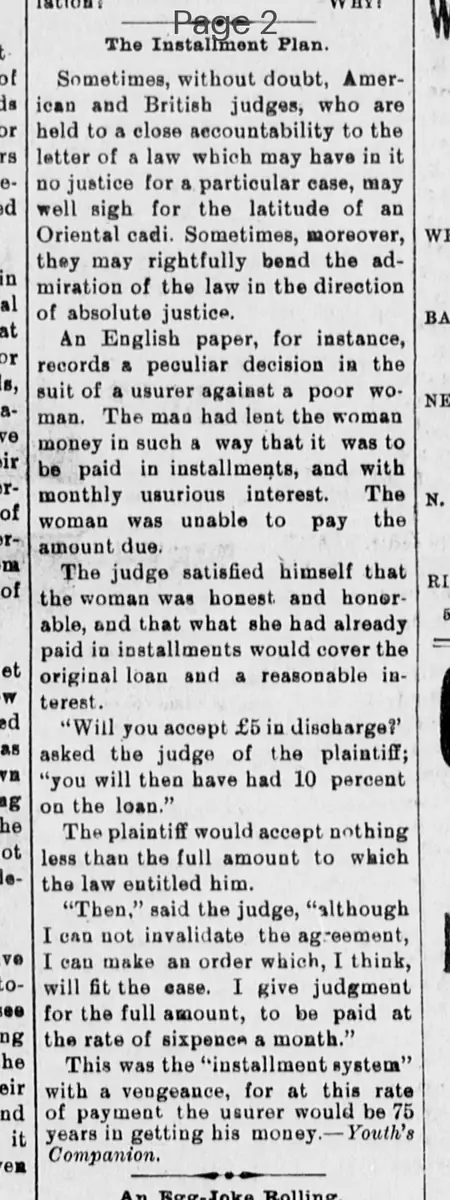
The Installment Plan.
Sometimes, without doubt, American and British judges, who are held to a close accountability to the letter of a law which may have in it no justice for a particular case, may well sigh for the latitude of an Oriental cadi. Sometimes, moreover, they may rightfully bend the administration of the law in the direction of absolute justice.
An English paper, for instance, records a peculiar decision in the suit of a usurer against a poor woman. The man had lent the woman money in such a way that it was to be paid in installments, and with monthly usurious interest. The woman was unable to pay the amount due.
The judge satisfied himself that the woman was honest and honorable, and that what she had already paid in installments would cover the original loan and a reasonable interest.
"Will you accept £5 in discharge?" asked the judge of the plaintiff; "you will then have had 10 percent on the loan."
The plaintiff would accept nothing less than the full amount to which the law entitled him.
"Then," said the judge, "although I can not invalidate the agreement, I can make an order which, I think, will fit the case. I give judgment for the full amount, to be paid at the rate of sixpence a month."
This was the "installment system" with a vengeance, for at this rate of payment the usurer would be 75 years in getting his money.—Youth's Companion.
Sometimes, without doubt, American and British judges, who are held to a close accountability to the letter of a law which may have in it no justice for a particular case, may well sigh for the latitude of an Oriental cadi. Sometimes, moreover, they may rightfully bend the administration of the law in the direction of absolute justice.
An English paper, for instance, records a peculiar decision in the suit of a usurer against a poor woman. The man had lent the woman money in such a way that it was to be paid in installments, and with monthly usurious interest. The woman was unable to pay the amount due.
The judge satisfied himself that the woman was honest and honorable, and that what she had already paid in installments would cover the original loan and a reasonable interest.
"Will you accept £5 in discharge?" asked the judge of the plaintiff; "you will then have had 10 percent on the loan."
The plaintiff would accept nothing less than the full amount to which the law entitled him.
"Then," said the judge, "although I can not invalidate the agreement, I can make an order which, I think, will fit the case. I give judgment for the full amount, to be paid at the rate of sixpence a month."
This was the "installment system" with a vengeance, for at this rate of payment the usurer would be 75 years in getting his money.—Youth's Companion.
What sub-type of article is it?
Curiosity
Deception Fraud
Crime Story
What themes does it cover?
Justice
Deception
Crime Punishment
What keywords are associated?
Installment Plan
Usury
Judge Decision
English Court
Legal Justice
What entities or persons were involved?
Judge
Usurer
Poor Woman
Where did it happen?
England
Story Details
Key Persons
Judge
Usurer
Poor Woman
Location
England
Story Details
In a usury lawsuit, an English judge, finding the poor woman honest and her payments sufficient for reasonable interest, offers the usurer £5 settlement. Upon refusal, the judge orders full judgment payable at sixpence monthly, delaying collection for 75 years.