Thank you for visiting SNEWPapers!
Sign up free
Camden Journal
Camden, Kershaw County, South Carolina
What is this article about?
Analysis of French President Louis-Napoleon's potential to become Emperor, his political stability, popularity-building efforts, and a security deposit system for officials that binds them to the regime, discouraging opposition. Speculates on a nuptial coup d'etat and dynasty longevity.
Clipping
OCR Quality
Full Text
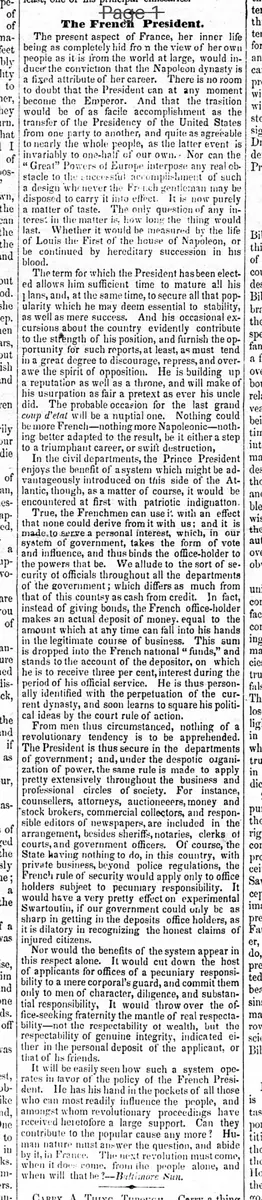
The present aspect of France, her inner life being as completely hid from the view of her own people as it is from the world at large, would induce the conviction that the Napoleon dynasty is a fixed attribute of her career. There is no room to doubt that the President can at any moment become the Emperor. And that the transition would be of as facile accomplishment as the transfer of the Presidency of the United States from one party to another, and quite as agreeable to nearly the whole people, as the latter event is invariably to one-half of our own. Nor can the "Great" Powers of Europe interpose any real obstacle to the successful accomplishment of such a design whenever the French gentleman may be disposed to carry it into effect. "It is now purely a matter of taste. The only question of any interest in the matter is, how long the thing would last. Whether it would be measured by the life of Louis the First of the house of Napoleon, or be continued by hereditary succession in his blood.
The term for which the President has been elected allows him sufficient time to mature all his plans, and, at the same time, to secure all that popularity which he may deem essential to stability, as well as mere success. And his occasional excursions about the country evidently contribute to the strength of his position, and furnish the opportunity for such reports, at least, as must tend in a great degree to discourage, repress, and overawe the spirit of opposition. He is building up a reputation as well as a throne, and will make of his usurpation as fair a pretext as ever his uncle did. The probable occasion for the last grand coup d'etat will be a nuptial one. Nothing could be more French--nothing more Napoleonic--nothing better adapted to the result, be it either a step to a triumphant career, or swift destruction.
In the civil departments, the Prince President enjoys the benefit of a system which might be advantageously introduced on this side of the Atlantic, though, as a matter of course, it would be encountered at first with patriotic indignation. True, the Frenchmen can use it with an effect that none could derive from it with us; and it is made to serve a personal interest, which, in our system of government, takes the form of vote and influence, and thus binds the office-holder to the powers that be. We allude to the sort of security of officials throughout all the departments of the government; which differs as much from that of this country as cash from credit. In fact, instead of giving bonds, the French office-holder makes an actual deposit of money, equal to the amount which at any time can fall into his hands in the legitimate course of business. This sum is dropped into the French national "funds," and stands to the account of the depositor, on which he is to receive three per cent. interest during the period of his official service. He is thus personally identified with the perpetuation of the current dynasty, and soon learns to square his political ideas by the court rule of action.
From men thus circumstanced, nothing of a revolutionary tendency is to be apprehended. The President is thus secure in the departments of government; and, under the despotic organization of power, the same rule is made to apply pretty extensively throughout the business and professional circles of society. For instance, counsellors, attorneys, auctioneers, money and stock brokers, commercial collectors, and responsible editors of newspapers, are included in the arrangement, besides sheriffs, notaries, clerks of courts, and government officers. Of course, the State having nothing to do, in this country, with private business, beyond police regulations, the French rule of security would apply only to office holders subject to pecuniary responsibility. It would have a very pretty effect on experimental Swartoutism, if our government could only be as sharp in getting in the deposits office holders, as it is dilatory in recognizing the honest claims of injured citizens.
Nor would the benefits of the system appear in this respect alone. It would cut down the host of applicants for offices of a pecuniary responsibility to a mere corporal's guard, and commit them only to men of character, diligence, and substantial responsibility. It would throw over the office-seeking fraternity the mantle of real respectability--not the respectability of wealth, but the respectability of genuine integrity, indicated either in the personal deposit of the applicant, or that of his friends.
It will be easily seen how such a system operates in favor of the policy of the French President. He has his hand in the pockets of all those who can most readily influence the people, and amongst whom revolutionary proceedings have received heretofore a large support. Can they contribute to the popular cause any more? Human nature must answer the question, and abide by it, in France. The next revolution must come, when it does come, from the people alone, and when will that be?--Baltimore Sun.
What sub-type of article is it?
What keywords are associated?
What entities or persons were involved?
Where did it happen?
Foreign News Details
Primary Location
France
Key Persons
Outcome
speculative transition to emperor via coup d'etat, potential hereditary dynasty; security system binds officials to regime, discouraging revolution.
Event Details
The article discusses the French President's (Louis-Napoleon) strong position to become Emperor at any time, with public support and no European opposition. His election term allows planning and popularity building through country excursions. A probable nuptial coup d'etat is anticipated. A financial deposit system for officials invests them in the regime's stability, extending to various professions, ensuring loyalty and suppressing opposition. This secures the President against revolution, which would need to come solely from the people.