Thank you for visiting SNEWPapers!
Sign up free
Literary
April 24, 1832
The New Hampshire Gazette
Portsmouth, Rockingham County, New Hampshire
What is this article about?
Continuation of a debate in the New Hampshire Gazette on fuel, defending the use of green wood over dry for better burning, heat, and economy. The anonymous author criticizes the editor's chemical quotations and lack of original insight, advocating careful preparation of green woods like walnut, maple, birch, and oak.
Clipping
OCR Quality
95%
Excellent
Full Text
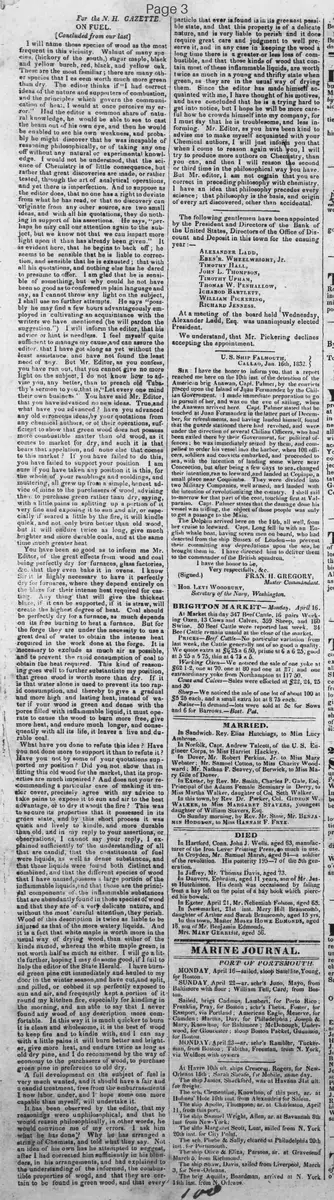
For the N. H. Gazette.
ON FUEL.
[Concluded from our last.]
I will name those species of wood as the most frequent in this vicinity. Walnut of many species, (hickory of the south,) sugar maple, black and yellow birch, red, black, and yellow oak.
These are the most familiar; there are many other species that I esteem worth much more green than dry. The editor thinks if I had correct ideas of the nature and supporters of combustion, and the principles which govern the communication of heat, I would at once perceive my error. Had the editor a common share of natural knowledge, he would be able to see to cast the beam out of his own eye, and then he would be enabled to see his own weakness, and probably he might discover that he was incapable of reasoning philosophically, or of taking any one off without any natural or experimental knowledge. I would not be understood, that the science of Chemistry is of little consequence, but rather that great discoveries are made, or rather tested, through the art of analytical operations, and yet there is imperfection. And to suppose as the editor does, that no one has a right to deviate from what he has read, or that no discovery can originate from any other source, are two small ideas, and with all his quotations, they do nothing in support of his assertions. He says, "perhaps he may call our attention again to the subject, but we know not that we can impart more light upon it than has already been given." It is evident here, that he begins to back off; he seems to be sensible that he is liable to correction, and sensible that he is exhausted; that with all his quotations, and nothing else has he dared to presume to offer. I am glad that he is sensible of something, but why could he not have been so good as to confess in plain language and say, as I cannot throw any light on the subject, I shall use no further attempts. He says "possibly he may find a few hours advantageously employed in cultivating an acquaintance with the writers we have mentioned (he will pardon the suggestion.)" I will inform the editor, that his advice or hint is needless. I feel myself quite sufficient to manage my cause, and can assure the editor, that I have got along as yet without the least assistance, and have not found the least need of any. But Mr. Editor, as you confess, you have run out, that you cannot give no more light on the subject, I do not know how to advise you, any better, than to preach old Tabitha's sermon to you, that is, "Let every one mind their own business." You have said Mr. Editor, that you have advanced no new ideas. True, and what have you advanced? have you advanced any old erroneous ideas, by your quotations from any chemical authors, or of their operations, sufficient to show that green wood does not possess more combustible matter than old wood, as it comes to market for dry, and such it is that bears that appellation, and none else that comes to this market? If you have failed to do this, you have failed to support your position I am sure if you have taken any position it is this, for the whole of your ramblings and scoldings, and muttering, all grew up from a simple, honest advice of mine to the purchasers of wood, advising them to purchase green rather than dry, saying, with a little pains in splitting up a portion of it very fine and exposing it to sun and air, or especially if scorched a little by the fire, it will kindle quick, and not only burn better than old wood, but it will endure twice as long, give much brighter and more durable coals, and at the same time much greater heat.
You have been so good as to inform me Mr. Editor, of the great effects from wood and coal being perfectly dry for furnaces, glass factories, &c. that they even bake it in ovens. I know Sir it is highly necessary to have it perfectly dry for furnaces, where they depend entirely on the blaze for their intense heat required for casting. Any thing that will give the thickest blaze, if it can be supported, if it is straw, will create the highest degree of heat. Coal should be perfectly dry for a furnace, as much depends on its free burning to heat a furnace. But for the forge they are under the necessity to use a great deal of water to obtain the intense heat required in the work done at the forge. It is necessary to exclude as much air as possible, and to prevent the rapid consumption of coal to obtain the heat required. This kind of reasoning goes well to further substantiate my position, that green wood is worth more than dry. If it is that water alone is used to prevent its too rapid consumption, and thereby to give a gradual and more high and lasting heat, instead of water if your wood is green and dense with the pores filled with inflammable liquid, it must operate to cause the wood to burn more free, give more heat, and endure much longer, and consequently with all its life, it leaves a live and durable coal.
What have you done to refute this idea? Have you not done more to support it than to refute it? Have you not by some of your quotations supported my position? Did you not show that in fitting this old wood for the market, that its properties are much impaired? And does not your recommending a particular care of making it under cover, precisely agree with my advice to take pains to expose it to sun and air to the best advantage, or to dry it about the fire? This was to secure its properties that it possessed in its green state, and by this short process it was quick and lively to kindle, and more durable than old, and in my reply to your assertions, or observations, I cannot say your reply, I explained sufficiently to the understanding of all that are candid, that the constituents of fuel were liquids, as well as dense substances, and that those liquids were found both distinct and combined, and that the different species of wood that I have named, possess a large portion of the inflammable liquids, and that those are the principal components of the inflammable substances that are abundantly found in those species of wood and that they are of a very delicate nature, and without the most careful attention, they perish. Wood of this description is twice as liable to be injured as that of the more watery liquids. And it is a fact that white maple is worth more in the usual way of drying wood, than either of the kinds named, whereas the white maple green, is not worth half as much as either. I will go a little further, hoping I may do some good, if I fail to help the editor of the State Herald. I have burned green pine cut immediately and hauled to my door in the winter season, and have cut, and split, and pilled, or cobbed it up perfectly exposed to sun and air, and frequently kept a portion of it round my kitchen fire, especially for kindling in the morning, and am able to say that I never found any wood of any description more comfortable. In this way it is much quicker to burn it is clean and wholesome, it is the best of wood to keep fire and to kindle with, and I can say with a little pains it will burn better and brighter, give more heat, and endure twice as long as old dry pine, and I do recommend by the way of economy to the purchasers of wood, to purchase green pine in preference to old dry.
A full development on the subject of fuel is very much wanted, and it should have a fair and candid treatment, free from the embarrassments I now labor under, and I hope some one more capable than myself, will undertake it.
It has been observed by the editor, that my reasonings were unphilosophical, and that he would reason philosophically, in other words, he would convince me of my errors. I ask him what he has done? Why he has arranged a string of Chemists, and told what they say. Not an idea of his own has he attempted to suggest, after I had corrected him sufficiently in his blunders, in his arrangements, and had explained to the understanding of the informed, the combustible properties of wood, and that they are certain to be found in green wood, and that every particle that ever is found is in its greenest possible state, and that this property is of a delicate nature, and is very liable to perish and it does require great care and judgment to well preserve it, and in any case in keeping the wood a long time there is a greater or less loss of combustible, and that those kinds of wood that contain most of these inflammable liquids, are worth twice as much in a young and thrifty state when green, as they are in the usual way of drying them. Since the editor has made himself acquainted with me, I have thought of his motives, and have concluded that he is trying hard to get into notice, but I hope he will be more careful how he crowds himself into my company, for I must say that he is troublesome, and less informing. Mr. Editor, as you have been kind to advise me to make myself acquainted with your Chemical authors, I will just inform you that when I come to reason again with you, I will try to produce more authors on Chemistry, than you can, and then I will reason the second or third time in the philosophical way you have. But Mr. editor, I am not certain that you are correct in preceding philosophy with chemistry. I have an idea that philosophy precedes every science; that philosophy is the basis, and origin of every art discovered, other than accidental.
ON FUEL.
[Concluded from our last.]
I will name those species of wood as the most frequent in this vicinity. Walnut of many species, (hickory of the south,) sugar maple, black and yellow birch, red, black, and yellow oak.
These are the most familiar; there are many other species that I esteem worth much more green than dry. The editor thinks if I had correct ideas of the nature and supporters of combustion, and the principles which govern the communication of heat, I would at once perceive my error. Had the editor a common share of natural knowledge, he would be able to see to cast the beam out of his own eye, and then he would be enabled to see his own weakness, and probably he might discover that he was incapable of reasoning philosophically, or of taking any one off without any natural or experimental knowledge. I would not be understood, that the science of Chemistry is of little consequence, but rather that great discoveries are made, or rather tested, through the art of analytical operations, and yet there is imperfection. And to suppose as the editor does, that no one has a right to deviate from what he has read, or that no discovery can originate from any other source, are two small ideas, and with all his quotations, they do nothing in support of his assertions. He says, "perhaps he may call our attention again to the subject, but we know not that we can impart more light upon it than has already been given." It is evident here, that he begins to back off; he seems to be sensible that he is liable to correction, and sensible that he is exhausted; that with all his quotations, and nothing else has he dared to presume to offer. I am glad that he is sensible of something, but why could he not have been so good as to confess in plain language and say, as I cannot throw any light on the subject, I shall use no further attempts. He says "possibly he may find a few hours advantageously employed in cultivating an acquaintance with the writers we have mentioned (he will pardon the suggestion.)" I will inform the editor, that his advice or hint is needless. I feel myself quite sufficient to manage my cause, and can assure the editor, that I have got along as yet without the least assistance, and have not found the least need of any. But Mr. Editor, as you confess, you have run out, that you cannot give no more light on the subject, I do not know how to advise you, any better, than to preach old Tabitha's sermon to you, that is, "Let every one mind their own business." You have said Mr. Editor, that you have advanced no new ideas. True, and what have you advanced? have you advanced any old erroneous ideas, by your quotations from any chemical authors, or of their operations, sufficient to show that green wood does not possess more combustible matter than old wood, as it comes to market for dry, and such it is that bears that appellation, and none else that comes to this market? If you have failed to do this, you have failed to support your position I am sure if you have taken any position it is this, for the whole of your ramblings and scoldings, and muttering, all grew up from a simple, honest advice of mine to the purchasers of wood, advising them to purchase green rather than dry, saying, with a little pains in splitting up a portion of it very fine and exposing it to sun and air, or especially if scorched a little by the fire, it will kindle quick, and not only burn better than old wood, but it will endure twice as long, give much brighter and more durable coals, and at the same time much greater heat.
You have been so good as to inform me Mr. Editor, of the great effects from wood and coal being perfectly dry for furnaces, glass factories, &c. that they even bake it in ovens. I know Sir it is highly necessary to have it perfectly dry for furnaces, where they depend entirely on the blaze for their intense heat required for casting. Any thing that will give the thickest blaze, if it can be supported, if it is straw, will create the highest degree of heat. Coal should be perfectly dry for a furnace, as much depends on its free burning to heat a furnace. But for the forge they are under the necessity to use a great deal of water to obtain the intense heat required in the work done at the forge. It is necessary to exclude as much air as possible, and to prevent the rapid consumption of coal to obtain the heat required. This kind of reasoning goes well to further substantiate my position, that green wood is worth more than dry. If it is that water alone is used to prevent its too rapid consumption, and thereby to give a gradual and more high and lasting heat, instead of water if your wood is green and dense with the pores filled with inflammable liquid, it must operate to cause the wood to burn more free, give more heat, and endure much longer, and consequently with all its life, it leaves a live and durable coal.
What have you done to refute this idea? Have you not done more to support it than to refute it? Have you not by some of your quotations supported my position? Did you not show that in fitting this old wood for the market, that its properties are much impaired? And does not your recommending a particular care of making it under cover, precisely agree with my advice to take pains to expose it to sun and air to the best advantage, or to dry it about the fire? This was to secure its properties that it possessed in its green state, and by this short process it was quick and lively to kindle, and more durable than old, and in my reply to your assertions, or observations, I cannot say your reply, I explained sufficiently to the understanding of all that are candid, that the constituents of fuel were liquids, as well as dense substances, and that those liquids were found both distinct and combined, and that the different species of wood that I have named, possess a large portion of the inflammable liquids, and that those are the principal components of the inflammable substances that are abundantly found in those species of wood and that they are of a very delicate nature, and without the most careful attention, they perish. Wood of this description is twice as liable to be injured as that of the more watery liquids. And it is a fact that white maple is worth more in the usual way of drying wood, than either of the kinds named, whereas the white maple green, is not worth half as much as either. I will go a little further, hoping I may do some good, if I fail to help the editor of the State Herald. I have burned green pine cut immediately and hauled to my door in the winter season, and have cut, and split, and pilled, or cobbed it up perfectly exposed to sun and air, and frequently kept a portion of it round my kitchen fire, especially for kindling in the morning, and am able to say that I never found any wood of any description more comfortable. In this way it is much quicker to burn it is clean and wholesome, it is the best of wood to keep fire and to kindle with, and I can say with a little pains it will burn better and brighter, give more heat, and endure twice as long as old dry pine, and I do recommend by the way of economy to the purchasers of wood, to purchase green pine in preference to old dry.
A full development on the subject of fuel is very much wanted, and it should have a fair and candid treatment, free from the embarrassments I now labor under, and I hope some one more capable than myself, will undertake it.
It has been observed by the editor, that my reasonings were unphilosophical, and that he would reason philosophically, in other words, he would convince me of my errors. I ask him what he has done? Why he has arranged a string of Chemists, and told what they say. Not an idea of his own has he attempted to suggest, after I had corrected him sufficiently in his blunders, in his arrangements, and had explained to the understanding of the informed, the combustible properties of wood, and that they are certain to be found in green wood, and that every particle that ever is found is in its greenest possible state, and that this property is of a delicate nature, and is very liable to perish and it does require great care and judgment to well preserve it, and in any case in keeping the wood a long time there is a greater or less loss of combustible, and that those kinds of wood that contain most of these inflammable liquids, are worth twice as much in a young and thrifty state when green, as they are in the usual way of drying them. Since the editor has made himself acquainted with me, I have thought of his motives, and have concluded that he is trying hard to get into notice, but I hope he will be more careful how he crowds himself into my company, for I must say that he is troublesome, and less informing. Mr. Editor, as you have been kind to advise me to make myself acquainted with your Chemical authors, I will just inform you that when I come to reason again with you, I will try to produce more authors on Chemistry, than you can, and then I will reason the second or third time in the philosophical way you have. But Mr. editor, I am not certain that you are correct in preceding philosophy with chemistry. I have an idea that philosophy precedes every science; that philosophy is the basis, and origin of every art discovered, other than accidental.
What sub-type of article is it?
Essay
Satire
What themes does it cover?
Agriculture Rural
What keywords are associated?
Fuel
Wood
Green Wood
Dry Wood
Combustion
Chemistry
Economy
Literary Details
Title
On Fuel.
Subject
Debate On Green Versus Dry Wood For Fuel
Key Lines
Advising Them To Purchase Green Rather Than Dry, Saying, With A Little Pains In Splitting Up A Portion Of It Very Fine And Exposing It To Sun And Air, Or Especially If Scorched A Little By The Fire, It Will Kindle Quick, And Not Only Burn Better Than Old Wood, But It Will Endure Twice As Long, Give Much Brighter And More Durable Coals, And At The Same Time Much Greater Heat.
I Do Recommend By The Way Of Economy To The Purchasers Of Wood, To Purchase Green Pine In Preference To Old Dry.