Thank you for visiting SNEWPapers!
Sign up free
The Rhode Island Republican
Newport, Newport County, Rhode Island
What is this article about?
Crowded Boston meeting at Faneuil Hall supports President Jackson's Proclamation against South Carolina's nullification, passes resolutions upholding Union integrity and Constitution, hopes to avert civil war. (168 characters)
Clipping
OCR Quality
Full Text
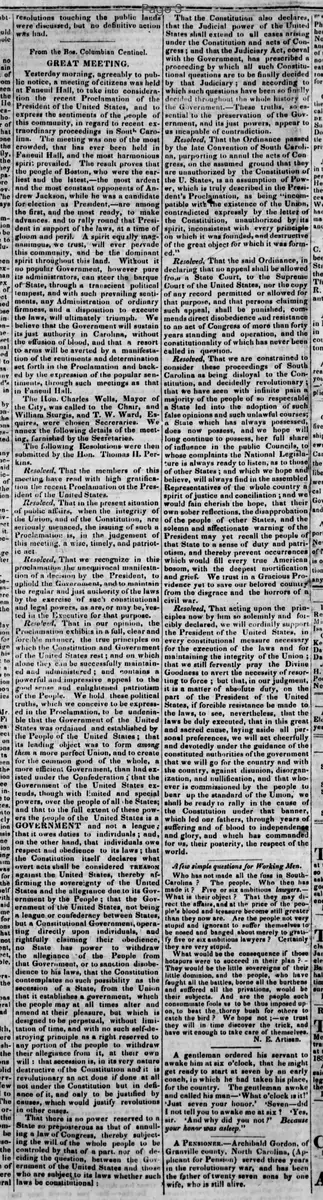
GREAT MEETING.
Yesterday morning, agreeably to public notice, a meeting of citizens was held at Faneuil Hall, to take into consideration the recent Proclamation of the President of the United States, and to express the sentiments of the people of this community, in regard to recent extraordinary proceedings in South Carolina. The meeting was one of the most crowded, that has ever been held in Faneuil Hall, and the most harmonious spirit prevailed. The result proves that the people of Boston, who were the earliest and the latest,—the most ardent and the most constant opponents of Andrew Jackson, while he was a candidate for election as President,—are among the first, and the most ready, to make advances, and to rally round that President in support of the laws, at a time of gloom and peril. A spirit equally magnanimous, we trust, will ever pervade this community, and be the dominant spirit throughout this land. Without it no popular Government, however pure its administrators, can steer the barque of State, through a transient political tempest, and with such prevailing sentiments, any Administration of ordinary firmness, and a disposition to execute the laws, will ultimately triumph. We believe that the Government will sustain its just authority in Carolina, without the effusion of blood, and that a resort to arms will be averted by a manifestation of the sentiments and determination set forth in the Proclamation and backed by the expression of the popular sentiments, through such meetings as that in Faneuil Hall.
The Hon. Charles Wells, Mayor of the City, was called to the Chair, and William Sturgis, and T. W. Ward, Esquires, were chosen Secretaries. We annex the following details of the meeting, furnished by the Secretaries.
The following Resolutions were then submitted by the Hon. Thomas H. Perkins.
Resolved, That the members of this meeting have read with high gratification the recent Proclamation of the President of the United States.
Resolved, That in the present situation of public affairs, when the integrity of the Union, and of the Constitution, are seriously menaced, the issuing of such a Proclamation, is, in the judgement of this meeting, a wise, timely, and patriotic act.
Resolved, That we recognize in this proclamation the unequivocal manifestation of a decision by the President, to uphold the Government, and to maintain the regular and just authority of the laws by the exercise of such constitutional and legal powers, as are, or may be, vested in the Executive for that purpose.
Resolved, That in our opinion, the Proclamation exhibits in a full, clear and forcible manner, the true principles on which the Constitution and Government of the United States rest: and on which alone they can be successfully maintained and administered; and contains a powerful and impressive appeal to the good sense and enlightened patriotism of the People. We hold these political truths, which we conceive to be expressed in the Proclamation, to be undeniable that the Government of the United States was ordained and established by the People of the United States; that its leading object was to form among them a more perfect Union, and to create for the common good of the whole, a more efficient Government, than had existed under the Confederation; that the Government of the United States extends, though with limited and special powers, over the people of all the States; and that to the full extent of these powers the people of the United States is a GOVERNMENT and not a league; that it owes duties to individuals; and, on the other hand, that individuals owe respect and obedience to its laws; that the Constitution itself declares what overt acts shall be considered TREASON against the United States, thereby affirming the sovereignty of the United States and the allegiance due to its Government by the People; that the Government of the United States, not being a league or confederacy between States, but a Constitutional Government, operating directly upon individuals, and rightfully claiming their obedience, no State has power to withdraw the allegiance of the People from that Government, or to sanction disobedience to its laws. That the Constitution contemplates no such possibility as the secession of a State, from the Union that it establishes a government, which the people may at all times alter and amend at their pleasure, but which is designed to be perpetual, without limitation of time, and with no such self-destroying principle as a right reserved to any portion of the people to withdraw their allegiance from it, at their own will : that secession is, in its very nature destructive of the Constitution and it is revolutionary an act done if done at all not under the Constitution but in defiance of it, and only to be justified by causes, which would justify revolutions in other cases.
That there is no power reserved to a State so preposterous as that of annulling a law of Congress, thereby subjecting the will of the whole people to be controlled by that of a part. nor of deciding the question, between the Government of the United States and those who are subject to its laws whether such laws be constitutional :
That the Constitution also declares, that the Judicial power of the United States shall extend to all cases arising under the Constitution and acts of Congress; and that the Judiciary Act, coeval with the Government, has prescribed a proceeding by which all such Constitutional questions are to be finally decided by that Judiciary; and according to which such questions have been so finally decided throughout the whole history of the Government.—These truths, so essential to the preservation of the Government, and its just powers, appear to us incapable of contradiction.
Resolved, That the Ordinance passed by the late Convention of South Carolina, purporting to annul the acts of Congress, on the assumed ground that they are unauthorized by the Constitution of the U. States, is an assumption of Power, which is truly described in the President's Proclamation, as being "incompatible with the existence of the Union, contradicted expressly by the letter of the Constitution, unauthorized by its spirit, inconsistent with every principle on which it was founded, and destructive of the great object for which it was formed."
Resolved, That the said Ordinance, in declaring that no appeal shall be allowed from a State Court, to the Supreme Court of the United States, nor the copy of any record permitted or allowed for that purpose, and that persons claiming such appeal, shall be punished, commands direct disobedience and resistance to an act of Congress of more than forty years standing and operation, and the constitutionality of which has never been called in question.
Resolved, That we are constrained to consider these proceedings of South Carolina as being disloyal to the Constitution, and decidedly revolutionary that we have seen with infinite pain a majority of the people of so respectable a State led into the adoption of such false opinions and such unlawful courses; a State which has always possessed, does now possess, and we hope will long continue to possess, her full share of influence in the public Councils, to whose complaints the National Legislature is always ready to listen, as to those of other States; and which we hope and believe, will always find in the assembled Representatives of the whole country a spirit of justice and conciliation ; and we would fain cherish the hope, that their own sober reflections, the disapprobation of the people of other States, and the solemn and affectionate warning of the President may yet recall the people of that State to a sense of duty and patriotism, and thereby prevent occurrences which would fill every true American bosom, with the deepest mortification and grief. We trust in a Gracious Providence yet to save our beloved country from the disgrace and the horrors of a civil war.
Resolved, That acting upon the principles now by him so solemnly and forcibly declared, we will cordially support the President of the United States, in every constitutional measure necessary for the execution of the laws and for maintaining the integrity of the Union ; that we still fervently pray the Divine Goodness to avert the necessity of resorting to force ; but that, in our judgment, it is a matter of absolute duty, on the part of the President of the United States, if forcible resistance be made to the laws, to see, nevertheless, that the laws be duly executed, that in this great and sacred cause, laying aside all personal preferences, we will act cheerfully and devotedly under the guidance of the constituted authorities of the government that we will go for the country and with the country, against disunion, disorganization, and nullification, and that whoever is commissioned by the people to bear up the standard of the Union, we shall be ready to rally in the cause of the Constitution under that banner, which led our fathers, through years of suffering and of blood to independence and glory, and which has commanded for us, their posterity, the respect of the world.
What sub-type of article is it?
What keywords are associated?
What entities or persons were involved?
Where did it happen?
Domestic News Details
Primary Location
Boston
Event Date
Yesterday Morning
Key Persons
Outcome
the meeting passed resolutions supporting the president's proclamation, upholding the union and constitution, and expressing hope to avert civil war without effusion of blood.
Event Details
A crowded and harmonious meeting of citizens was held at Faneuil Hall to consider the President's Proclamation and express sentiments regarding South Carolina's proceedings. Charles Wells was called to the Chair, William Sturgis and T. W. Ward were chosen Secretaries. Thomas H. Perkins submitted resolutions affirming the Proclamation's wisdom, recognizing the Government's authority, denouncing South Carolina's Ordinance as revolutionary, and pledging support to the President in executing the laws.