Thank you for visiting SNEWPapers!
Sign up free
The National Intelligencer And Washington Advertiser
Washington, District Of Columbia
What is this article about?
Historical article on preserving cider: a 1764 experiment in Suffolk, Mass., kept casks submerged in cold spring water for clarity and quality; another method filters juice through sand in a cask to remove fermenting matter, producing clear, long-lasting cider.
Clipping
OCR Quality
Full Text
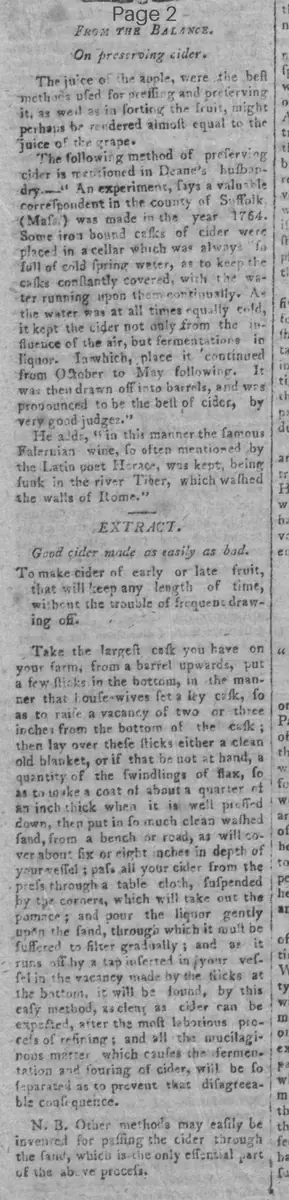
On preserving cider.
The juice of the apple, were the best
methods used for pressing and preserving
it, as well as in sorting the fruit, might
perhaps be rendered almost equal to the
juice of the grape.
The following method of preserving
cider is mentioned in Deane's husbandry.- "An experiment, says a valuable
correspondent in the county of Suffolk
(Mass.) was made in the year 1764.
Some iron bound casks of cider were
placed in a cellar which was always so
full of cold spring water, as to keep the
casks constantly covered, with the water
running upon them continually. As
the water was at all times equally cold,
it kept the cider not only from the influence of the air, but fermentations in
the liquor. In which place it continued
from October to May following. It
was then drawn off into barrels, and was
pronounced to be the best of cider, by
very good judges."
He adds, "in this manner the famous
Falernian wine, so often mentioned by
the Latin poet Horace, was kept, being
sunk in the river Tiber, which washed
the walls of Rome."
EXTRACT.
Good cider made as easily as bad.
To make cider of early or late fruit,
that will keep any length of time,
without the trouble of frequent drawing off.
Take the largest cask you have on
your farm, from a barrel upwards, put
a few sticks in the bottom, in the manner that house-wives set a ley cask, so
as to raise a vacancy of two or three
inches from the bottom of the cask:
then lay over these sticks either a clean
old blanket, or if that be not at hand, a
quantity of the windlings of flax, so
as to make a coat of about a quarter of
an inch thick when it is well pressed
down, then put in so much clean washed
sand, from a beach or road, as will cover about six or eight inches in depth of
your vessel; pass all your cider from the
press through a table cloth, suspended
by the corners, which will take out the
pomace; and pour the liquor gently
upon the sand, through which it must be
filtered gradually; and as it
runs off by a tap inserted in your vessel in the vacancy made by the sticks at
the bottom. it will be found, by this
easy method, as clear as cider can be
expected, after the most laborious process of refining; and all the mucilaginous matter which causes the fermentation and souring of cider, will be so
separated as to prevent that disagreeable consequence.
N. B. Other methods may easily be
invented for passing the cider through
the sand, which is the only essential part
of the above process.
What sub-type of article is it?
What keywords are associated?
Where did it happen?
Story Details
Location
Suffolk County, Mass.
Event Date
1764
Story Details
Experiment in 1764 submerged cider casks in constantly running cold spring water from October to May, preventing fermentation and yielding superior cider; compared to ancient Falernian wine storage in the Tiber River. Additional method filters pressed cider through sand in a cask to remove pomace and mucilaginous matter, producing clear, non-fermenting cider that keeps well.