Thank you for visiting SNEWPapers!
Sign up free
Editorial
March 30, 1943
The Wilmington Morning Star
Wilmington, New Hanover County, North Carolina
What is this article about?
Charles P. Stewart advocates for ongoing exchange of newspapermen between the US and Latin America to foster profitable intercontinental relations, praises Vice President Wallace's tour, and regrets the discontinuation of WWI-era COMPUB propaganda efforts, contrasting it with current OWI challenges.
Clipping
OCR Quality
98%
Excellent
Full Text
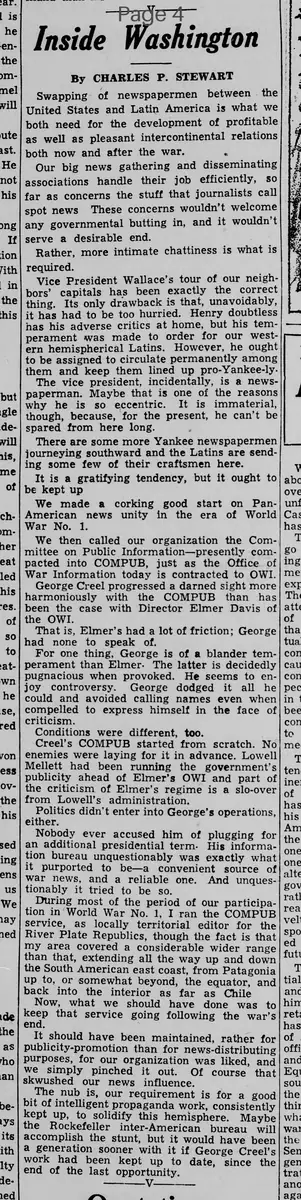
Inside Washington
By CHARLES P. STEWART
Swapping of newspapermen between the United States and Latin America is what we both need for the development of profitable as well as pleasant intercontinental relations both now and after the war.
Our big news gathering and disseminating associations handle their job efficiently, so far as concerns the stuff that journalists call spot news. These concerns wouldn't welcome any governmental butting in, and it wouldn't serve a desirable end.
Rather, more intimate chattiness is what is required.
Vice President Wallace's tour of our neighbors' capitals has been exactly the correct thing. Its only drawback is that, unavoidably, it has had to be too hurried. Henry doubtless has his adverse critics at home, but his temperament was made to order for our western hemispherical Latins. However, he ought to be assigned to circulate permanently among them and keep them lined up pro-Yankee-ly.
The vice president, incidentally, is a newspaperman. Maybe that is one of the reasons why he is so eccentric. It is immaterial, though, because, for the present, he can't be spared from here long.
There are some more Yankee newspapermen journeying southward and the Latins are sending some few of their craftsmen here.
It is a gratifying tendency, but it ought to be kept up.
We made a corking good start on Pan-American news unity in the era of World War No. 1.
We then called our organization the Committee on Public Information-presently compacted into COMPUB, just as the Office of War Information today is contracted to OWI.
George Creel progressed a darned sight more harmoniously with the COMPUB than has been the case with Director Elmer Davis of the OWI.
That is, Elmer's had a lot of friction; George had none to speak of.
For one thing, George is of a blander temperament than Elmer. The latter is decidedly pugnacious when provoked. He seems to enjoy controversy. George dodged it all he could and avoided calling names even when compelled to express himself in the face of criticism.
Conditions were different, too.
Creel's COMPUB started from scratch. No enemies were laying for it in advance. Lowell Mellett had been running the government's publicity ahead of Elmer's OWI and part of the criticism of Elmer's regime is a slo-over from Lowell's administration.
Politics didn't enter into George's operations, either.
Nobody ever accused him of plugging for an additional presidential term. His information bureau unquestionably was exactly what it purported to be-a convenient source of war news, and a reliable one. And unquestionably it tried to be so.
During most of the period of our participation in World War No. 1, I ran the COMPUB service, as locally territorial editor for the River Plate Republics, though the fact is that my area covered a considerable wider range than that, extending all the way up and down the South American east coast, from Patagonia up to, or somewhat beyond, the equator, and back into the interior as far as Chile.
Now, what we should have done was to keep that service going following the war's end.
It should have been maintained, rather for publicity-promotion than for news-distributing purposes, for our organization was liked, and we simply pinched it out. Of course that skwushed our news influence.
The nub is, our requirement is for a good bit of intelligent propaganda work, consistently kept up, to solidify this hemisphere. Maybe the Rockefeller inter-American bureau will accomplish the stunt, but it would have been a generation sooner with it if George Creel's work had been kept up to date, since the end of the last opportunity.
By CHARLES P. STEWART
Swapping of newspapermen between the United States and Latin America is what we both need for the development of profitable as well as pleasant intercontinental relations both now and after the war.
Our big news gathering and disseminating associations handle their job efficiently, so far as concerns the stuff that journalists call spot news. These concerns wouldn't welcome any governmental butting in, and it wouldn't serve a desirable end.
Rather, more intimate chattiness is what is required.
Vice President Wallace's tour of our neighbors' capitals has been exactly the correct thing. Its only drawback is that, unavoidably, it has had to be too hurried. Henry doubtless has his adverse critics at home, but his temperament was made to order for our western hemispherical Latins. However, he ought to be assigned to circulate permanently among them and keep them lined up pro-Yankee-ly.
The vice president, incidentally, is a newspaperman. Maybe that is one of the reasons why he is so eccentric. It is immaterial, though, because, for the present, he can't be spared from here long.
There are some more Yankee newspapermen journeying southward and the Latins are sending some few of their craftsmen here.
It is a gratifying tendency, but it ought to be kept up.
We made a corking good start on Pan-American news unity in the era of World War No. 1.
We then called our organization the Committee on Public Information-presently compacted into COMPUB, just as the Office of War Information today is contracted to OWI.
George Creel progressed a darned sight more harmoniously with the COMPUB than has been the case with Director Elmer Davis of the OWI.
That is, Elmer's had a lot of friction; George had none to speak of.
For one thing, George is of a blander temperament than Elmer. The latter is decidedly pugnacious when provoked. He seems to enjoy controversy. George dodged it all he could and avoided calling names even when compelled to express himself in the face of criticism.
Conditions were different, too.
Creel's COMPUB started from scratch. No enemies were laying for it in advance. Lowell Mellett had been running the government's publicity ahead of Elmer's OWI and part of the criticism of Elmer's regime is a slo-over from Lowell's administration.
Politics didn't enter into George's operations, either.
Nobody ever accused him of plugging for an additional presidential term. His information bureau unquestionably was exactly what it purported to be-a convenient source of war news, and a reliable one. And unquestionably it tried to be so.
During most of the period of our participation in World War No. 1, I ran the COMPUB service, as locally territorial editor for the River Plate Republics, though the fact is that my area covered a considerable wider range than that, extending all the way up and down the South American east coast, from Patagonia up to, or somewhat beyond, the equator, and back into the interior as far as Chile.
Now, what we should have done was to keep that service going following the war's end.
It should have been maintained, rather for publicity-promotion than for news-distributing purposes, for our organization was liked, and we simply pinched it out. Of course that skwushed our news influence.
The nub is, our requirement is for a good bit of intelligent propaganda work, consistently kept up, to solidify this hemisphere. Maybe the Rockefeller inter-American bureau will accomplish the stunt, but it would have been a generation sooner with it if George Creel's work had been kept up to date, since the end of the last opportunity.
What sub-type of article is it?
Foreign Affairs
Trade Or Commerce
What keywords are associated?
News Exchange
Latin America
Pan American Relations
Propaganda
Compub
Owi
Vice President Wallace
George Creel
What entities or persons were involved?
Vice President Wallace
Henry Wallace
George Creel
Elmer Davis
Lowell Mellett
Committee On Public Information
Compub
Office Of War Information
Owi
Rockefeller Inter American Bureau
Editorial Details
Primary Topic
Exchange Of Newspapermen For Us Latin American Relations
Stance / Tone
Supportive Of Inter American News And Propaganda Efforts
Key Figures
Vice President Wallace
Henry Wallace
George Creel
Elmer Davis
Lowell Mellett
Committee On Public Information
Compub
Office Of War Information
Owi
Rockefeller Inter American Bureau
Key Arguments
Swapping Newspapermen Needed For Profitable Intercontinental Relations
Vice President Wallace's Tour Is Correct But Should Be Permanent
Wwi Compub Was Successful And Harmonious Under Creel
Current Owi Under Davis Faces Friction Unlike Compub
Compub Should Have Continued Post Wwi For Propaganda
Intelligent Propaganda Required To Solidify Hemisphere