Thank you for visiting SNEWPapers!
Sign up free
Editorial
June 13, 1913
The Columbia Herald
Columbia, Maury County, Tennessee
What is this article about?
The editorial questions the success of direct government via referendum in Tennessee, citing low voter turnout in Nashville bond elections compared to mayoral races, suggesting people prefer electing officials over direct involvement in administration.
Clipping
OCR Quality
98%
Excellent
Full Text
IS IT A SUCCESS?
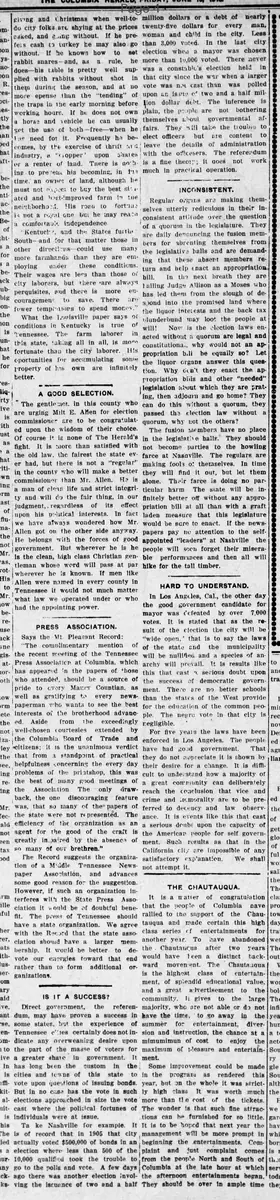
Direct government, the referendum, may have proven a success in some states, but the experience of Tennessee cities certainly does not indicate any overweening desire upon the part of the mass of voters for a greater share in government. It has long been the custom in the cities and towns of this state to vote upon questions of issuing bonds. But in no case has the vote in such elections approached in size the vote cast where the political fortunes of individuals were at issue.
Take Nashville for example. It is of record that in 1905 that city actually voted $500,000 of bonds in an election where less than 500 of the 10,000 qualified took the trouble to go to the polls and vote. A few days ago there was another election involving the issuance of two and a half million dollars or a debt of nearly twenty-five dollars for every man, woman and child in the city. Less than 3,000 voted. In the last city election when a mayor was chosen more than 14,000 voted. There never was a constable's election held in that city since the war when a larger vote was not cast than was polled upon an issue of two and a half million dollar debt. The inference is plain, the people are not bothering themselves about governmental affairs. They will take the trouble to elect officers but are content to leave the details of administration with the officers. The referendum is a fine theory: it does not work much in practical operation.
Direct government, the referendum, may have proven a success in some states, but the experience of Tennessee cities certainly does not indicate any overweening desire upon the part of the mass of voters for a greater share in government. It has long been the custom in the cities and towns of this state to vote upon questions of issuing bonds. But in no case has the vote in such elections approached in size the vote cast where the political fortunes of individuals were at issue.
Take Nashville for example. It is of record that in 1905 that city actually voted $500,000 of bonds in an election where less than 500 of the 10,000 qualified took the trouble to go to the polls and vote. A few days ago there was another election involving the issuance of two and a half million dollars or a debt of nearly twenty-five dollars for every man, woman and child in the city. Less than 3,000 voted. In the last city election when a mayor was chosen more than 14,000 voted. There never was a constable's election held in that city since the war when a larger vote was not cast than was polled upon an issue of two and a half million dollar debt. The inference is plain, the people are not bothering themselves about governmental affairs. They will take the trouble to elect officers but are content to leave the details of administration with the officers. The referendum is a fine theory: it does not work much in practical operation.
What sub-type of article is it?
Constitutional
Suffrage
What keywords are associated?
Referendum
Direct Government
Voter Turnout
Nashville Bonds
Tennessee Elections
What entities or persons were involved?
Tennessee Cities
Nashville
Editorial Details
Primary Topic
Effectiveness Of Referendum In Tennessee
Stance / Tone
Skeptical Of Direct Democracy's Practicality
Key Figures
Tennessee Cities
Nashville
Key Arguments
Voter Turnout In Bond Elections Is Much Lower Than In Elections For Officials.
In 1905, Nashville Approved $500,000 Bonds With Fewer Than 500 Voters Out Of 10,000 Qualified.
Recent $2.5 Million Bond Election Saw Less Than 3,000 Votes, Versus 14,000 In Mayoral Election.
People Prefer Electing Officers And Leaving Administration To Them.
Referendum Is Theoretically Fine But Fails In Practice.