Thank you for visiting SNEWPapers!
Sign up free
Gazette Of The United States
New York, New York County, New York
What is this article about?
Tensions in Paris as the Mayor alerts the military to the King's potential departure, prompting a constitutional dispute. The King questions the Mayor's actions in a letter, while Mayor Petion defends them, asserting the King's limited role in policing and the National Guard.
Clipping
OCR Quality
Full Text
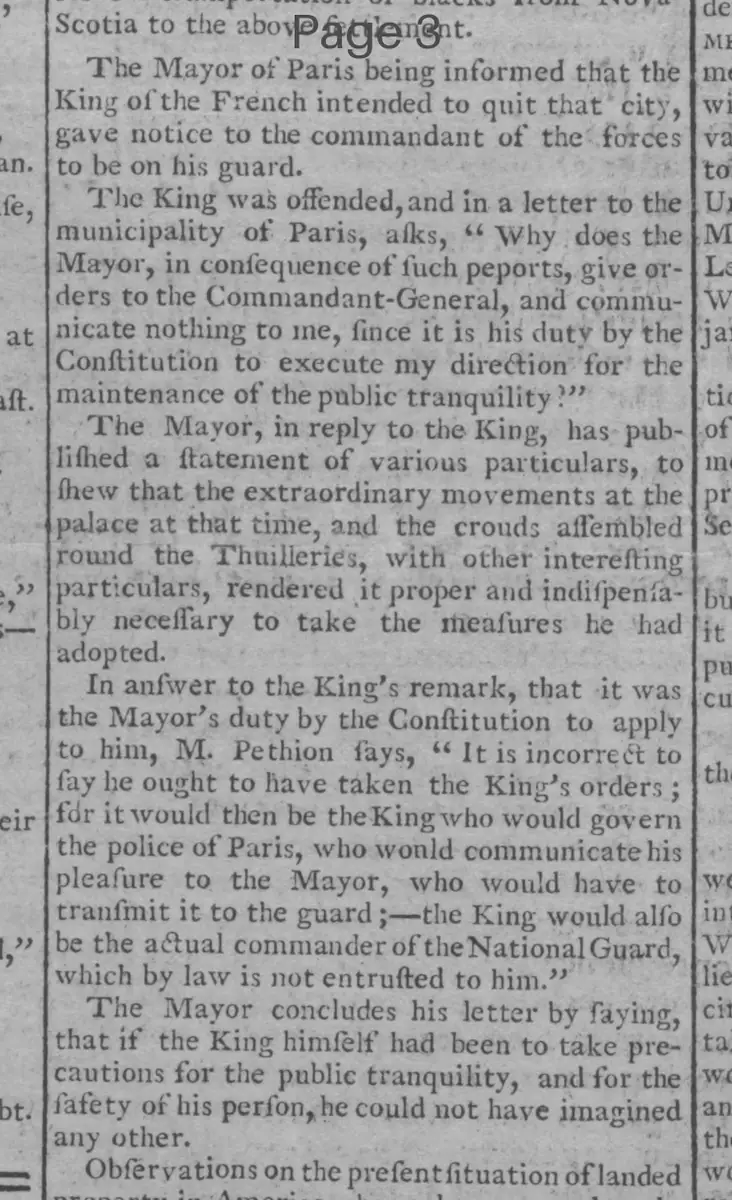
The King was offended, and in a letter to the municipality of Paris, asks, "Why does the Mayor, in consequence of such reports, give orders to the Commandant-General, and communicate nothing to me, since it is his duty by the Constitution to execute my direction for the maintenance of the public tranquility?"
The Mayor, in reply to the King, has published a statement of various particulars, to shew that the extraordinary movements at the palace at that time, and the crowds assembled round the Thuilleries, with other interesting particulars, rendered it proper and indispensably necessary to take the measures he had adopted.
In answer to the King's remark, that it was the Mayor's duty by the Constitution to apply to him, M. Petion says, "It is incorrect to say he ought to have taken the King's orders; for it would then be the King who would govern the police of Paris, who would communicate his pleasure to the Mayor, who would have to transmit it to the guard;—the King would also be the actual commander of the National Guard, which by law is not entrusted to him."
The Mayor concludes his letter by saying, that if the King himself had been to take precautions for the public tranquility, and for the safety of his person, he could not have imagined any other.
What sub-type of article is it?
What keywords are associated?
What entities or persons were involved?
Where did it happen?
Foreign News Details
Primary Location
Paris
Key Persons
Outcome
exchange of letters highlighting constitutional dispute over authority in maintaining public order; mayor justifies independent actions due to crowds and palace movements.
Event Details
The Mayor of Paris, informed of the King's intent to leave the city, alerted the commandant of forces. The King, offended, wrote to the municipality questioning why the Mayor ordered the Commandant-General without consulting him, citing constitutional duty. The Mayor replied publicly, explaining that unusual palace activities and crowds around the Thuilleries necessitated his measures. He refuted the King's claim, stating the King does not govern Paris police or command the National Guard by law, and concluded that even the King would have taken similar precautions for tranquility and personal safety.