Thank you for visiting SNEWPapers!
Sign up free
Virginia Argus
Richmond, Virginia
What is this article about?
Newspaper reports from 1807 detail the Burr conspiracy, defending Gen. Wilkinson against accusations from Burr's associates in New Orleans. Includes a letter praising Wilkinson's actions in thwarting Burr, and Lt. Gaines' account of arresting Burr near Fort Stoddert on Feb. 19, escorting him to Washington amid rescue fears.
Clipping
OCR Quality
Full Text
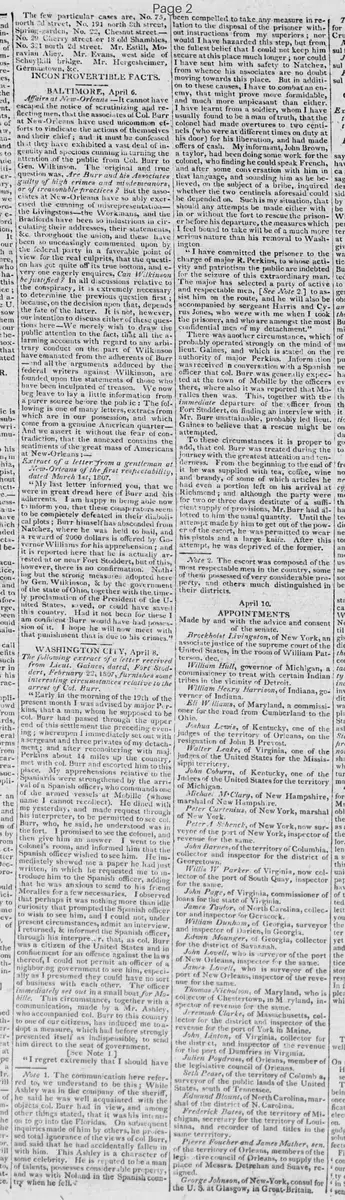
BALTIMORE, April 6.
Affairs at New-Orleans -It cannot have escaped the notice of scrutinizing and reflecting men, that the associates of Col. Burr at New-Orleans have used uncommon efforts to vindicate the actions of themselves and their chief: and it must be confessed that they have exhibited a vast deal of ingenuity and specious cunning in turning the attention of the public from Col. Burr to Gen. Wilkinson. The original and true question was, Are Burr and his Associates guilty of high crimes and misdemeanors, or of treasonable practices? But the associates at New-Orleans have so ably exercised the cunning of misrepresentation—the Livingstons—the Workmans, and the Bradfords have been so industrious in circulating their addresses, their statements, &c. throughout the union, and these have been so unceasingly commented upon by the federal party in a favorable point of view for the real culprits, that the question has got quite off its true bottom, and every one eagerly enquires, Can Wilkinson be justified? In all discussions relative to the conspiracy, it is extremely necessary to determine the previous question first; because, on the decision upon that, depends the fate of the latter. It is not, however, our intention to discuss either of these questions here-We merely wish to draw the public attention to the fact, that all the alarming accounts with regard to any arbitrary conduct on the part of Wilkinson have emanated from the adherents of Burr —and all the arguments adduced by the federal writers against Wilkinson, are founded upon the statements of those who have been inculpated of treason. We now beg leave to lay a little information from a purer source before the public : The following is one of many letters, extracts from which are in our possession, and which come from a genuine American quarter- And we assert it without the fear of contradiction, that the annexed contains the sentiments of the great mass of Americans at New-Orleans:-
Extract of a letter from a gentleman at New-Orleans of the first respectability dated March 1st, 1807.
"My last letter informed you, that we were in great dread here of Burr and his adherents. I am happy in being able now to inform you, that these conspirators seem to be completely defeated in their diabolical plots; Burr himself has absconded from Natchez, where he was held to bail, and a reward of 2000 dollars is offered by Governor Williams for his apprehension; and it is reported here that he is actually arrested at or near Fort Stoddert, but of this, however, there is no confirmation. Nothing but the strong measures adopted here by Gen. Wilkinson, & by the government of the state of Ohio, together with the timely proclamation of the President of the United States, saved, or could have saved this country. Had it not been for these I am confident Burr would have had possession of it. I hope he will now meet with that punishment that is due to his crimes."
WASHINGTON CITY, April 8.
The following extract of a letter received from Lieut. Gaines, dated, Fort Stoddert, February 22, 1807, furnishes some interesting circumstances relative to the arrest of Col. Burr.
" Early in the morning of the 19th of the present month I was advised by major Perkins, that a man, whom he supposed to be col. Burr had passed through the upper end of this settlement the preceding evening; whereupon I immediately set out with a sergeant and three privates of my detachment; and after reconnoitering with maj. Perkins about 14 miles up the country, met with col. Burr and escorted him to this place. My apprehensions relative to the Spaniards were strengthened by the arrival of a Spanish officer, who commands one of the armed vessels at Mobile (whose name I cannot recollect). He dined with me yesterday, and made request through his interpreter, to be permitted to see col. Burr, who, he said, he understood was in the fort. I promised to see the colonel, and then give him an answer I went to the colonel's room, and informed him that the Spanish officer wished to see him. He immediately shewed me a paper he had just written, in which he requested me to introduce him to the Spanish officer, adding that he was anxious to send to his friend Moralles for a few necessaries. I observed that perhaps it was nothing more than idle curiosity that prompted the Spanish officer to wish to see him, and I could not, under present circumstances, admit an interview. I returned, & informed the Spanish officer, through his interpreter, that, as col. Burr was a citizen of the United States and in confinement for an offence against the laws thereof, I could not permit an officer of a neighboring government to see him, especially as I presumed they could have no sort of business with each other. The officer immediately set out in a small boat for Mobile. This circumstance, together with a communication, made by a Mr. Ashley, who accompanied col. Burr to this country to one of our citizens, has induced me to adopt a measure, which had before strongly presented itself as indispensible, to send him direct to the seat of government.
[See Note 1 ]
"I regret extremely that I should have been compelled to take any measure in relation to the disposal of the prisoner without instructions from my superiors; nor would I have hazarded this step, but from the fullest belief that I could not keep him secure at this place much longer ; nor could I have sent him with safety to Natchez, from whence his associates are no doubt moving towards this place. But in addition to these causes, I have to combat an enemy, that might prove more formidable, and much more unpleasant than either. I have learnt from a soldier, whom I have usually found to be a man of truth, that the colonel had made overtures to two centinels (who were at different times on duty at his door) for his liberation, and had made offers of cash. My informant, John Brown, a taylor, had been doing some work for the colonel, who finding he could speak French, and after some conversation with him in that language, and sounding him as he believed, on the subject of a bribe, inquired whether the two centinels aforesaid could be depended on. Such is my situation, that should any attempts be made either within or without the fort to rescue the prisoner before his departure, the measures which I feel bound to take will be of a much more serious nature than his removal to Washington
" I have committed the prisoner to the charge of major R. Perkins, to whose activity and patriotism the public are indebted for the seizure of this extraordinary man. The major has selected a party of active and respectable men, [See Note 2.] to assist him on the route, and he will also be accompanied by sergeant Harris and Cyrus Jones, who were with me when I took the prisoner, and who are amongst the most confidential men of my detachment."
There was another circumstance, which probably operated strongly on the mind of lieut. Gaines, and which is stated on the authority of major Perkins. Information was received in conversation with a Spanish officer that col. Burr was generally expected at the town of Mobile by the officers there, where also it was reported that Morales then was. This, together with the immediate departure of the officer from Fort Stoddert, on finding an interview with Mr. Burr unattainable, probably led lieut. Gaines to believe that a rescue might be attempted.
To these circumstances it is proper to add, that col. Burr was treated during the journey with the greatest attention and tenderness. From the beginning to the end of it he was supplied with tea, coffee, wine and brandy, of some of which articles he had even a portion left on his arrival at Richmond; and although the party were for two or three days destitute of a sufficient supply of provisions, Mr. Burr had allotted to him the usual quantity. Until the attempt made by him to get out of the power of the escort, he was permitted to wear his pistols and a large knife. After this attempt, he was deprived of the former.
Note 2. The escort was composed of the most respectable men in the country, some of them possessed of very considerable property, and others much distinguished in their districts.
Note 1. The communication here referred to, we understand to be this; While Ashley was in the company of the sheriff, he said he was well acquainted with the objects col. Burr had in view, and among other things stated, that it was his intention to go into the Floridas. On subsequent inquiries made of him by others, he professed total ignorance of the views of col Burr, and said that he had accidentally fallen in with him. This Ashley is a character of some celebrity. He is reputed to be a man of talents, possesses considerable property, and was with Noland in the Spanish country when he fell,
What sub-type of article is it?
What themes does it cover?
What keywords are associated?
What entities or persons were involved?
Where did it happen?
Story Details
Key Persons
Location
New Orleans, Fort Stoddert, Natchez, Mobile
Event Date
1807
Story Details
Associates of Col. Burr attempt to shift blame to Gen. Wilkinson amid treason accusations. A letter from New Orleans praises Wilkinson's role in thwarting the plot. Lt. Gaines details Burr's arrest on Feb. 19, 1807, suspicions of Spanish involvement and escape attempts, leading to his escort to Washington.