Thank you for visiting SNEWPapers!
Sign up free
The National Intelligencer And Washington Advertiser
Washington, District Of Columbia
What is this article about?
General Moreau writes to the First Consul from prison, defending his innocence in the conspiracy involving Pichegru and Georges, detailing his past relations and loyalty. He later speaks before the criminal court, recounting his military service and protesting his integrity against the charges.
Clipping
OCR Quality
Full Text
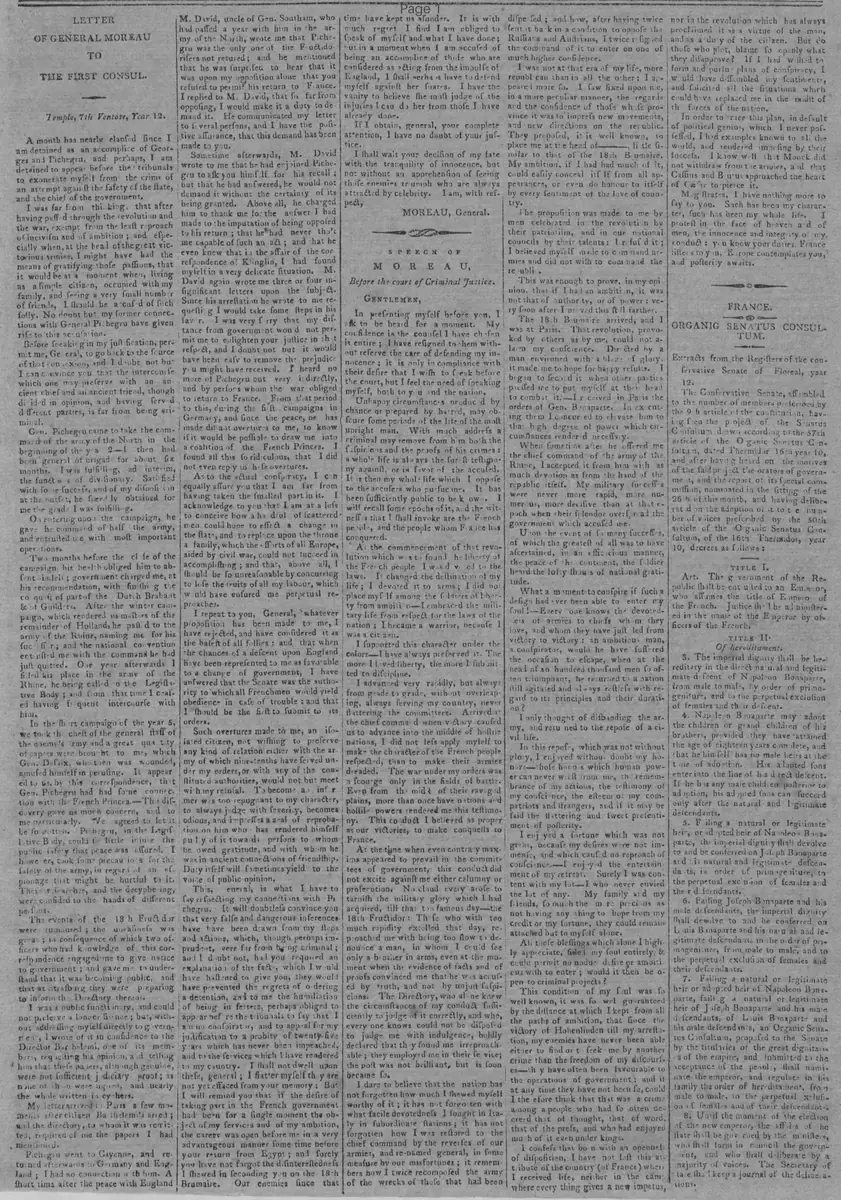
OF GENERAL MOREAU
TO
THE FIRST CONSUL.
Temple, 7th Ventose, Year 12.
A month has nearly elapsed since I am detained as an accomplice of Georges and Pichegru, and perhaps, I am detained to appear before the tribunals to exonerate myself from the crime of an attempt against the safety of the state, and the chief of the government.
I was arrested on this thinking, that after having passed through the revolution and the war, exempt from the least reproach of incivism and of ambition; and especially when, at the head of the great victorious armies, I might have had the means of gratifying those passions, that it would be at a moment when, living as a simple citizen, occupied with my family, and seeing a very small number of friends, I should be accused of such folly. No doubt but my former connections with General Pichegru have given rise to this accusation.
Before speaking in my justification, permit me, General, to go back to the source of that connection, and I doubt not but I can convince you that the intercourse which one may preserve with an ancient chief and an ancient friend, though divided in opinion, and having served different parties, is far from being criminal.
Gen. Pichegru came to take the command of the army of the North in the beginning of the year 2—I then had been general of brigade for about six months. I was fulfilling, ad interim, the functions of divisional. Satisfied with one success, and of my disposition at the outset, he easily obtained for me the grade I was fulfilling.
On entering upon the campaign, he gave his command of half the army, and entrusted me with most important operations.
Two months before the close of the campaign, his health obliged him to absent himself; government charged me, at his recommendation, with finishing the conquest of part of the Dutch Brabant & of Guelderland. After the winter campaign, which rendered us masters of the remainder of Holland, he passed to the army of the Rhine, naming me for his successor; and the national convention entrusted me with the command he had just quitted. One year afterwards I filled his place in the army of the Rhine, he being called to the Legislative Body; and from that time I ceased having frequent intercourse with him.
In the short campaign of the year 5, we took the chest of the general staff of the enemy's army and a great quantity of papers were brought to me, which Gen. Drouet, who then was wounded, amused himself in perusing. It appeared to us, by this correspondence, that Gen. Pichegru had had some connection with the French Princes. This discovery gave us much concern, and to me particularly. We agreed to let it be forgotten. Pichegru, in the Legislative Body, could do little injury to the public liberty, that peace was assured. I however, took some precautions for the safety of the army, in regard of an espionage that might be hurtful to it.
These researches, and the deciphering, were confided to the hands of different persons.
The events of the 18th Fructidor were rumored; the uneasiness was great; in consequence of which two of the officers who had knowledge of this correspondence engaged me to give notice to government; and gave me to understand that it was becoming public, and that at Strasburg they were preparing to inform the Directory thereof.
I was a public functionary, and could not preserve a longer silence; but, without addressing myself directly to government, I wrote of it in confidence to the Director Barthélemi, one of its members, requesting his opinion, and telling him that these papers, although genuine, were not sufficient judiciary proof; as none of them were signed, and nearly the whole written in cyphers.
My letter arrived in Paris a few moments after citizen Barthélemi's arrest; and the directory, to whom it was referred, required of me the papers I had mentioned.
Pichegru went to Cayenne, and returned afterwards to Germany and England; I had no connection with him. A short time after the peace with England, M. David, uncle of Gen. Souham, who had passed a year with him in the army of the North, wrote me that Pichegru was the only one of the Fructidorians not returned: and he mentioned that he was surprised to hear that it was upon my opposition alone that you refused to permit his return to France.
I replied to M. David, that so far from opposing, I would make it a duty to demand it. He communicated my letter to several persons, and I have the positive assurance, that this demand has been made to you.
Sometime afterwards, M. David wrote to me that he had enjoined Pichegru to ask you himself for his recall: but that he had answered, he would not demand it without the certainty of its being granted. Above all, he charged him to thank me for the answer I had made to the imputation of being opposed to his return; that he had never thought me capable of such an act: and that he even knew that in the affair of the correspondence of Klinglin, I had found myself in a very delicate situation. M. David again wrote me three or four insignificant letters upon the subject.
Since his arrestation he wrote to me requesting I would take some steps in his favor. I was very sorry that my distance from government would not permit me to enlighten your justice in that respect, and I doubt not but it would have been easy to remove the prejudices you might have received. I heard no more of Pichegru but very indirectly, and by persons whom the war obliged to return to France. From that period to this, during the last campaigns in Germany, and since the peace, he has made distant overtures to me, to know if it would be possible to draw me into a coalition of the French Princes. I found all this so ridiculous, that I did not even reply to these overtures.
As to the actual conspiracy, I can equally assure you that I am far from having taken the smallest part in it. I acknowledge to you that I am at a loss to conceive how a handful of scattered men could hope to effect a change in the state, and to replace upon the throne a family, which the efforts of all Europe, aided by civil war, could not succeed in accomplishing; and that, above all, I should be so unreasonable as concurring to lose the fruits of all my labor, which would have secured me perpetual reproaches.
I repeat to you, General, whatever proposition has been made to me, I have rejected, and have considered it as the basest of all follies: and that when the chances of a descent upon England have been represented to me as favorable to a change of government, I have answered that the Senate was the authority to which all Frenchmen would yield obedience in case of trouble: and that I should be the first to submit to its orders.
Such overtures made to me, an isolated citizen, not wishing to preserve any kind of relation either with the army of which nine-tenths have served under my orders, or with any of the constituted authorities, would not but meet with my refusal. To become a conspirator was too repugnant to my character, to always judge with severity, becomes odious, and impresses a seal of reprobation on him who has rendered himself guilty of it towards persons to whom he owed gratitude, and with whom he was in ancient connections of friendship.
Duty itself will sometimes yield to the voice of public opinion.
This, General, is what I have to say respecting my connections with Pichegru. It will doubtless convince you that very false and dangerous inferences have been drawn from my steps and actions, which, though perhaps imprudent, were far from being criminal; and I doubt not, had you required an explanation of the fact, which I would have hastened to give you, they would have prevented the regrets of ordering a detention, and to me the humiliation of being in fetters, perhaps obliged to appear before the tribunals to say that I am no conspirator, and to appeal for my justification to a probity of twenty-five years which has never been impeached, and to the services which I have rendered to my Country. I shall not dwell upon these, general; I flatter myself they are not yet effaced from your memory: But I will remind you that if the desire of taking part in the French government had been for a single moment the object of my services and of my ambition, the career was open before me in a very advantageous manner some time before your return from Egypt; and surely you have not forgot the disinterestedness I shewed in seconding you on the 18th Brumaire. Our Enemies since that time have kept us asunder. It is with much regret I find I am obliged to speak of myself and what I have done: but in a moment when I am accused of being an accomplice of those who are considered as acting from the impulse of England. I shall perhaps have to defend myself against her slanders. I have the vanity to believe she must judge of the injuries I can do her from those I have already done.
If I obtain, general, your complete attention, I have no doubt of your justice.
I shall wait your decision of my fate with the tranquility of innocence, but not without an apprehension of seeing those enemies triumph who are always attracted by celebrity. I am, with respect,
MOREAU, General.
SPEECH OF
MOREAU,
Before the court of Criminal Justice.
GENTLEMEN,
In presenting myself before you, I ask to be heard for a moment. My confidence in the counsel I have chosen is entire: I have resigned to them without reserve the care of defending my innocence; it is only in compliance with their desire that I wish to speak before the court, but I feel the need of speaking myself, both to you and the nation.
Unhappy circumstances produced by chance or prepared by hatred, may obscure some periods of the life of the most upright man. With much address a criminal may remove from him both the suspicions and the proofs of his crimes: a whole life is always the surest testimony against, or in favor of the accused.
It is then my whole life which I oppose to the accusers who pursue me. It has been sufficiently public to be known. I will recall some epochs of it, and the witnesses that I shall invoke are the French people, and the people whom France has conquered.
At the commencement of that revolution which was to found the liberty of the French people I was devoted to the laws. I changed the destination of my life; I devoted it to arms; I did not place myself among the soldiers of liberty from ambition—I embraced the military life from respect to the laws of the nation: I became a warrior, because I was a citizen.
I supported this character under the colors—I have always preserved it. The more I loved liberty, the more I submitted to discipline.
I advanced very rapidly, but always from grade to grade, without overleaping, always serving my country, never flattering the committees. Arrived at the chief command when victory caused us to advance into the middle of hostile nations, I did not less apply myself to make the character of the French people respected, than to make their armies dreaded. The war under my orders was a scourge only in the fields of battle. Even from the midst of their ravaged plains, more than once have nations and hostile powers rendered me this testimony. This conduct I believed as proper as our victories, to make conquests to France.
At the time when even contrary maxims appeared to prevail in the committees of government, this conduct did not excite against me either calumny or prosecution. No cloud ever arose to tarnish the military glory which I had acquired, till that too famous day—the 18th Fructidor: They who with too much rapidity extolled that day, reproach me with being too slow to denounce a man, in whom I could see only a brother in arms, even at the moment when the evidence of facts and of proofs convinced me that he was accused by truth, and not by unjust suspicions. The Directory, who alone knew the circumstances of my conduct—consequently to judge of it correctly, and who, every one knows could not be disposed to judge me with indulgence, boldly declared that they found me irreproachable; they employed me in their service; the post was not brilliant, but it soon became so.
I dare to believe that the nation has not forgotten how much I shewed myself worthy of it; it has not forgotten with what facile devotedness I fought in Italy in subordinate stations; it has not forgotten how I was restored to the chief command by the reverses of our armies, and re-named general, in some measure by our misfortunes; it remembers how I twice recomposed the army of the wrecks of those that had been dispersed: and how, after having twice sent it back in a condition to oppose the Russians and Austrians, I twice resigned the command of it to enter on one of much higher confidence.
I was not at that era of my life, more republican than in all the others: I appeared more so. Law fixed upon me, in a more peculiar manner, the regards and the confidence of those whose province it was to impress new movements, and new directions on the republic.
They proposed, it is well known, to place me at the head of---, little similar to that of the 18th Brumaire.
My ambition, if I had had such of it, could easily conceal itself from all appearances, or even do honour to itself by every sentiment of the love of country.
The proposition was made to me by men celebrated in the revolution by their patriotism, and in our national councils by their talents: I refused it: I believed myself made to command armies and did not wish to command the republic.
This was enough to prove, in my opinion, that if I had an ambition, it was not that of authority, or of power: very soon after I served this still farther.
The 18th Brumaire arrived, and I was at Paris. That revolution, provoked by others as by me, could not alarm my conscience. Directed by a man environed with a blaze of glory, it made me to hope for happy results. I begin to second it when other parties picked me to put myself at their head to combat it.—I received in Paris the orders of Gen. Bonaparte. In executing them I concurred to elevate him to that high degree of power which circumstances rendered necessary.
When other armies he offered me the chief command of the army of the Rhine, I accepted it from him with as much devotion as from the hand of the republic itself. My military successes were never more rapid, more numerous, more decisive than at that epoch when their splendor overrode the government which accuses me.
Upon the event of so many successes, of which the greatest of all was to have ascertained, in an efficacious manner, the peace of the Continent, the soldier heard the lofty sounds of national gratitude.
What a moment to conspire if such a design had ever been able to enter my soul! Every one knows the devotedness of armies to chiefs whom they love, and whom they have just led from victory to victory: an ambitious man, a conspirator, would he have suffered the occasion to escape, when at the head of an hundred thousand men often triumphant, he returned to a nation still agitated and always restless with regard to its principles and their duration?
I only thought of disbanding the army, and returned to the repose of a civil life.
In this repose, which was not without glory, I enjoyed without doubt my honors—those honors which human power can never wrest from me, the remembrance of my actions, the testimony of my conscience, the esteem of my compatriots and strangers, and if it may be said the flattering and sweet presentiment of posterity.
I enjoyed a fortune which was not great, because my desires were not immense, and which caused no reproach of conscience.—I enjoyed the entertainment of my retreat. Surely I was content with my lot I who never envied the lot of any. My family and my friends, so much the more precious as not having any thing to hope from my credit or my fortune, they could remain attached but to myself alone.
All these blessings which alone I highly appreciate, filled my soul entirely, & could permit no undue desire or ambition to enter: would it then be open to criminal projects?
This condition of my soul was so well known, it was so well guaranteed by the distance at which I kept from all the paths of ambition, that since the victory of Hohenlinden till my arrestation, my enemies have never been able to find or seek me by another crime than the freedom of my discourse. Yes—they have often been favourable to the operations of government: and it at any time they have not been so, could I therefore think that this was a crime among a people who had so often declared that of thought, that of word, that of the press, and who had enjoyed much of it even under kings.
I confess that born with an openness of disposition, I have not lost this attribute of the country (of France) when I received life, neither in the camp where every thing gives a new impetus, nor in the revolution which has always proclaimed it as a virtue of the man, and as a duty of the citizen. But do those who plot, blame one openly what they disapprove? if I had wished to form and pursue plans of conspiracy, I would have dissembled my sentiments, and solicited all the situations which could have replaced me in the midst of the forces of the nation.
In order to trace this plan, in default of political genius, which I never possessed, I had examples known to all the world, and rendered imposing by their success. I know well that Monk did not withdraw from the armies, and that Caius and Brutus approached the heart of Cæsar to pierce it.
Gentlemen, I have nothing more to say to you. Such has been my character, such has been my whole life. I protest in the face of heaven and of men, the innocence and integrity of my conduct: you know your duties, France listens to you, Europe contemplates you, and posterity awaits.
What sub-type of article is it?
What keywords are associated?
What entities or persons were involved?
Where did it happen?
Foreign News Details
Primary Location
Temple, Paris
Event Date
7th Ventose, Year 12
Key Persons
Outcome
moreau protests his innocence and loyalty, awaiting decision on his fate; no specific outcome reported.
Event Details
General Moreau, detained in the Temple prison, writes a detailed letter to the First Consul defending his past connections with Pichegru and denying involvement in the current conspiracy against the government. He recounts their military history, his handling of incriminating papers, and rejections of overtures. Subsequently, in a speech before the Court of Criminal Justice, Moreau asserts his lifelong devotion to France, military service, and rejection of political ambition, invoking his entire career as proof of innocence.